Arizer XQ2 review: Desktop vaping with hose and balloon
Arizer has been building vaporizers in Ontario, Canada since 2003. The For around 130 euros you can get a device that can handle both tube and balloon mode. Dual-use, as Arizer calls it.
Short version: Convection with ceramic heater, glass cyclone bowl, 50-260°C accurate, remote control, adjustable speed fan, tube and balloon mode. The XQ2 does a lot of things right and costs a fraction of what Storz & Bickel charges for a Volcano.
Current prices and availability: Arizer XQ2 in price comparison
First impression: Inconspicuous, but well thought out
The XQ2 comes in simple packaging. No glossy marketing, no unboxing experience like Apple. Inside is: the device itself (a cylindrical tower, about 20 cm high), the glass Cyclone Bowl, a silicone tube with a mouthpiece, a balloon kit with a valve, sieves, stirring rod, remote control and a power supply. The accessories are extensive – you can get started straight away without having to buy anything else.
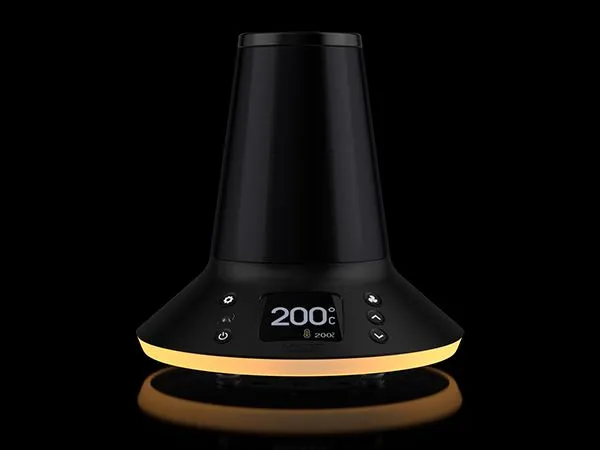
The device is stable on the table. The base has a nice weight and doesn’t tip over when you pull the hose. The display shows temperature and fan speed. It is operated via two buttons on the device or – and this is one of the Plus points – via the remote control.
What is immediately noticeable: The XQ2 looks like a humidifier or a small Bluetooth speaker. If you have it on your desk, you won’t get any questioning looks from visitors. Discreet. Compared to the Volcano, which is immediately recognizable with its distinctive cone, the XQ2 is visually overlooked. For some this is an advantage.
The workmanship is solid, but not premium. Plastic housing, no metal parts on the outside. Feels like a device that’s supposed to do its job without winning any design awards. You can expect that for 130 euros – if you want stainless steel and aluminum, you’ll pay three times as much for the Volcano.
Whip vs. Balloon: Two Modes, Two Experiences
The special thing about the XQ2: You don’t have to decide. Do you want to pull comfortably over the hose? Goes. Do you want to fill a balloon and pass it around on the couch? Works too. Both with the same device, without modification.
The hose mode works simply. Connect the hose to the device, load the bowl with herb and put it on, set the temperature, pull. The heat flows from below through the Cyclone Bowl, which directs the air in a spiral through the material. You pull directly – no fan required, just your own pulling power. This feels meditative. Pull slowly, inhale steam, exhale. Session vaping in its purest form.
The pull resistance in whip mode is low. Significantly more open than with portable devices. You can notice that there is no narrow chamber slowing down the airflow, but rather an open glass body that allows the air to pass through. Anyone coming from a Crafty+ or Pax will be surprised at how effortless pulling is.
The balloon mode is different. The built-in fan takes over here. Load the bowl, put on the balloon with the valve, turn on the fan, wait. The fan pushes hot air through the herb and fills the balloon with steam. Close the valve, remove the balloon, pull on the mouthpiece. Done.
A filled balloon will hold the vapor for about 5 to 8 minutes before it condenses and loses density. So you shouldn’t leave it lying around for half an hour. The principle works well in groups: fill the balloon, pass it on, fill the next balloon. There are two or three balloons per bowl load, depending on the packing density and temperature.
A disadvantage of the balloon mode compared to the Volcano: The valves are designed more simply. With the Volcano Hybrid, the valves close hermetically – no steam escapes. With the XQ2, minimal steam is lost when you remove the balloon. Not a dealbreaker, but noticeable.
My personal workflow: Hose at the desk during the week. Balloon on the couch at the weekend. In the morning, gently pull over the whip at 180 °C. In the evening, turn on the fan and fill a thick balloon at 220 °C. Versatility is the strongest argument for the XQ2.
Steam quality: convection through glass
The XQ2 heats convectively. This means that hot air flows through the material instead of heating it from the outside. A ceramic heater under the Cyclone Bowl generates the heat. The air passes through an all-glass path — Cyclone Bowl, glass adapter, then either hose or balloon.
What does that actually mean? Taste. Pure, clean taste. Arizer vaporizers are known for this, and the XQ2 is no exception. No plastic in the vapor path, no metal — just borosilicate glass and ceramic. The first puffs at 175°C deliver aromatic vapor in which you can taste individual terpenes. Citrus, pine, peppery — depending on the material.
From 195 °C the vapor becomes denser. Here you get what most users call a “good session”: visible vapor, noticeable effect, still decent taste. At 220°C it becomes very dense and bitter. And if you turn it up to 260 °C – the maximum temperature – you really extract everything. However, it no longer tastes particularly pleasant. The last 30 degrees are intended for full extraction rather than enjoyment.
A point that is often overlooked in comparison tests: Desktop vaporizers generally have more power than portable devices. The XQ2 hangs from the socket and does not have to use a battery. The heating system can reheat constantly without the temperature dropping with every pull. With portable devices — even good ones like the Mighty+ — the temperature drops measurably during a long drag. With the XQ2 it remains stable. This is noticeable in the steam consistency. Train for train evenly.
The chamber in the Cyclone Bowl holds about 0.15 to 0.3g, depending on how tightly you pack. When packed loosely there is better airflow and more taste. When tightly packed, there are denser clouds, but the extraction becomes more uneven. The sweet spot is somewhere in the middle – press lightly, but don’t stuff it.
Cyclone Bowl: More than a glass top
The Cyclone Bowl is not just a glass funnel with a sieve. The design forces the air into a spiral motion before flowing through the material. Arizer has adopted this principle from the Extreme Q and refined it in the XQ2.
What’s the point? More even extraction. Instead of the air pushing through the herb via the shortest path (heating the center more than the edge), the vortex distributes the heat across the entire cross section. The ABV then looks uniformly brown – a clear sign that the active ingredients have been evenly dissolved.
The bowl also has a conduction component. The glass itself is heated from below by the ceramic heater and passes this heat on to the material. Not as strong as pure conduction devices, but measurable. Arizer therefore speaks of “convection with conduction assist”. In practice this means: the herb is preheated before you even steep it. Evaporation occurs more quickly than with purely convective systems.
Cleaning the Cyclone Bowl is uncomplicated. Shake out the cabbage, place the bowl in isopropanol, rinse after 30 minutes. Since it is pure borosilicate glass, any residue comes off easily. You should do this every two to three weeks, or weekly if you use it daily. The screens are replaced every few weeks – cost a few cents each.
About the glass handle system of the portable Arizer: The XQ2 uses a different principle. Here the bowl is firmly attached to the device and is loaded from above. No stems that stick out and can break. This is logical for a desktop – the device is on the table anyway. The only risk of breakage is if you remove the bowl to clean it and drop it. Replacement bowls are available for under 20 euros.
The Remote Control: Underrated Feature
Let’s be honest – who wants to get up from the couch to change the temperature? The XQ2’s remote control solves exactly this problem. Temperature up, temperature down, fan on, fan off, set timer. Everything from the sofa.
Sounds like a gimmick. But it’s not.
In everyday life, the remote control changes the way you use the XQ2. You place the device on the coffee table, connect the hose and everything is within reach. Start the temperature at 180 °C, take three puffs, turn it up to 200 °C using the remote control, continue steaming. No getting up, no bending over, no fiddling with the device. That sounds like a small thing, but after a few evenings you won’t want to be without the remote control anymore.
The fan can be regulated in several stages using the remote control. Low level for slow balcony filling with denser steam, high level for quick filling. In whip mode you can also switch on the fan to provide support – then you don’t have to pull so hard. Practical for longer sessions when the jaw muscles get tired. Yes, that happens.
The remote control uses standard batteries (CR2025). They last forever because they only send short signals. In a year of regular use, I have yet to change a battery.
In comparison: The Volcano Hybrid has app control via Bluetooth. Take out your smartphone, open the app, set the temperature. The Arizer remote is faster. Press the button, done. No pairing, no app update, no Bluetooth dropouts. Sometimes the simplest solution is the best.
XQ2 vs. Extreme Q: What has changed?
The Extreme Q was Arizere’s desktop flagship for over a decade. A cult device in vaporizer forums, with a huge fan base. What did Arizer do differently with the XQ2?
| Feature | Arizer XQ2 | Arizer Extreme Q |
|---|---|---|
| Heating principle | Convection (with conduction assist) | Convection |
| Temperature range | 50-260°C (degrees accurate) | 50-260°C (degrees accurate) |
| Heating time | ~90 seconds | ~120 seconds |
| Remote control | Yes (improved) | Yes |
| Cyclone Bowl | New design (optimized airflow) | Older version |
| Fan | Quieter, more steps | Louder, fewer steps |
| Design | Modern, compact tower | Classic tower with wide base |
| Timer | Auto shutoff adjustable | Auto shutoff after 4 hours |
| Price | from ~130 € | ~100 € (remaining stock) |
The improvements are evolutionary, not revolutionary. The Cyclone Bowl has an optimized air duct that better controls turbulence. The fan is quieter – on the Extreme Q the noise was definitely audible at the highest setting. The heating time is around 30 seconds shorter. And the design looks more contemporary.
For Extreme Q owners, the upgrade is only worth it if you really need the quieter fan or the improved bowl. The vapor quality is similar. If you don’t have a desktop yet and are deciding between the two: the XQ2 is the better choice. Quieter, heated up faster, more modern operation. In terms of price, they are close to each other because the Extreme Q is being phased out and is only available as a remaining stock.
An important point for existing customers: Extreme Q accessories are partially compatible with the XQ2. Glass parts, hoses, balloon valves – everything fits. Anyone who has built up a supply of Extreme Q accessories over the years can continue to use some of them. This makes the Switch cheaper.
XQ2 vs Volcano: David vs Goliath
The elephant in the room. Every desktop vaporizer is measured by Volcano. This is unfair but inevitable. So here we go.
| Feature | Arizer XQ2 | Volcano Hybrid |
|---|---|---|
| Price | ab ~130 € | ab ~400 € |
| Whip mode | Yes | Yes (hose adapter) |
| Balloon mode | Yes | Yes (core function) |
| App control | No (remote control) | Yes (Bluetooth + App) |
| Temperature range | 50-260°C | 40-230°C |
| Heating time | ~90 seconds | ~40 seconds |
| Balloon valve | Standard (minimal steam loss) | Patented (tight) |
| Volume | Quiet | Very quiet |
| Vapor density | Good | Very good |
| Warranty | 2 years | 3 years |
The Volcano is better. In almost every way. You have to say it like that. Faster heating time, denser balloons, better valves, more robust workmanship, larger chamber. The Volcano Hybrid has been the reference device for desktop vaping since Storz & Bickel launched the first Volcano Classic in 2000.
But. The Volcano Hybrid costs from 400 euros. That’s three times as much as the XQ2. So the question isn’t whether the Volcano is better — but whether it’s three times as good. And the answer to that is: No.
The XQ2 delivers 80 to 85 percent of the Volcano experience for a third of the price. The vapor quality is close — not identical, but close. The balloons are a little thinner, the valves are not quite as tight, and the workmanship is not at S&B level. But the taste? Almost equal thanks to the glass system. And the XQ2 comes with the hose mode ex works, which you have to buy as an extra for the Volcano.
For whom is the Volcano still worthwhile? For people who use the device daily and intensively, who vape in groups and value maximum balloon density. If you only use a desktop occasionally or want to test whether desktop vaping is for you, the XQ2 is a good choice. You can always upgrade if you realize you want more.
Cleaning: Glass makes it easy
Desktop vaporizers stand on the table and are not carried in your pocket. This means you have fewer excuses to put off cleaning. Cleaning is easy with the XQ2 anyway.
The Cyclone Bowl is the main part that needs to be cleaned regularly. Tap out the ABV after each session. Once a week, soak the bowl in isopropanol (90% or higher), wait 20 to 30 minutes, rinse under warm water. The glass is like new afterwards.
The hose is the most neglected part in desktop vaporizers. Condensate collects on the inner wall, especially at high temperatures. Every two weeks you should flush the hose – run warm water with a little isopropanol through the hose. Or: get a new hose. Silicone hoses cost almost nothing and can be replaced quickly.
Tip from the community: Place the tube in warm milk. The fat in the milk dissolves the resinous residue and you can drink the result afterwards. Sounds crazy, but it’s a classic on desktop forums. Whether you want that is another matter.
The screens in the Cyclone Bowl are changed every few weeks. When pull resistance noticeably increases, it’s time. Strainers cost pennies and are available in packs of 20 to 50. When inserting, make sure that the sieve is flat and free of wrinkles – irregularities will disrupt the Airflow.
The device itself – the housing, the heating unit – hardly needs any care. A damp cloth on the outside, wipe the heating surface with a dry Q-tip every few months. That’s it. Compared to portables with narrow chambers and hidden vapor paths, the XQ2 is a maintenance dream.
One final note: the balloon valves can become sticky over time. Condensate settles in the valve mechanism. A short bath in isopropanol helps. Alternatively: Order new valves. Arizer sells replacement parts directly, and third parties offer compatible kits.
Fan speed and timer
The built-in fan is one of the advantages over pure whip devices. Instead of using your own pulling power to pull the steam through the material, you can let the fan do the work. This is particularly necessary when filling balloons, but is also useful in whip mode.
In whip mode with the fan switched on, the steam becomes denser and more even. You pull gently, the fan pushes, and the result is an effortlessly dense stream of steam. At the lowest setting you hardly notice the fan – neither in the volume nor in the airflow. At the highest setting you can hear a gentle hum and feel the pressure difference. Compared to the old Extreme Q, Arizer has noticeably reduced the volume.
The auto shutoff timer is a safety feature that you learn to appreciate. If you fall asleep on the couch and leave the XQ2 on, you won’t be surprised by a hot device at 3 a.m. The timer switches the device off automatically after an adjustable time. This is particularly relevant for a desktop that is plugged into a socket and could theoretically heat indefinitely.
Temperature tips for everyday life
The temperature range from 50 to 260 °C is huge. In practice, the temperature is between 170 and 230 °C. Here are three settings that have proven themselves:
Pure taste (170–185 °C): Little visible steam, but full aroma. The terpenes evaporate first, and at these temperatures you can taste them most clearly. Ideal for the first hit of a fresh load. Pull slowly in whip mode and let the taste melt on your tongue.
Allround (190–210 °C): The gold zone. Good vapor, decent taste, efficient extraction. This is where you spend 80 percent of your time. A balloon filled at 200°C is dense enough to be visible and still tastes pleasant. In whip mode, this range delivers the most satisfying moves.
Maximum extraction (215-240°C): Dense, harsh vapor. At the end of a session to extract the last remnants. Do not use as a starting setting – the taste is bitter and the material burns at the edge. But after a session at 200 °C, turn it up again to 230 °C? Brings another two to three dense hits from an actually “finished” load.
A workflow that many desktop users swear by: first session at 185 °C via the whip. Then turn up the temperature to 210°C and fill a balloon. Finally 235 °C for the final extraction. Three stages, one charge, maxed out.
Who is the XQ2 made for?
The XQ2 is a home device. Point. It hangs from the socket, stands on the table and is not taken with you. If you’re looking for a portable vaporizer, you’ve come to the wrong place – there’s the Air MAX or Solo 3.
Who benefits the most?
- Price-conscious desktop beginners: You can get a fully-fledged dual-use desktop from 130 euros. Entering the desktop world has never been cheaper.
- Extreme-Q Owner: A logical upgrade with a quieter fan, better bowl and faster heat-up time. Many of the old accessories still fit.
- Tube fans: If you love meditative whip vaping, you will find one of the best tube vaporizers on the market here.
- Occasional group steamer: Fill the balloon, pass it around, fill the next one. This works great for two to three people.
- Remote control lovers: Control everything from the sofa without getting up. Sounds trivial, but it’s worth its weight in gold in everyday life.
If you’re looking for a desktop that only fills balloons and at a reference level – you need a Volcano. If you want extreme vapor density and extraction speed – take a look at the Plenty or a ball vape. The XQ2 is the all-rounder, not the specialist.
Weaknesses in detail
- Balloon valves not hermetic: Minimal steam loss when removed. No drama, but noticeable in direct comparison with the Volcano.
- Plastic housing: Functionally perfect, haptically not premium. Anyone expecting metal and glass will be disappointed.
- Heat-up time 90 seconds: Acceptable for a desktop, but the Volcano Hybrid does it in 40.
- Balloon Density: Good, but not at Volcano level. Anyone who wants thick balloons every day will notice the difference.
- No app control: The remote control is enough for most. But there are no session logs, temperature profiles or firmware updates.
- Silicone hose: No glass mouthpiece on the hose ex works. Can be retrofitted, but costs extra.
Strengths at a glance
- Dual-Use: hose and balloon with one device, no conversion, no extra costs.
- Cyclone Bowl: Spiral airflow for even extraction. Glass = pure taste.
- Remote control: Control temperature and fan from the sofa. No need to get up.
- Price: From 130 euros for a fully equipped dual-use desktop. This is hard to beat.
- Temperature range: 50-260°C accurate. Wider than the Volcano (40-230°C).
- Quiet fan: Noticeably quieter than the Extreme Q. Doesn’t get in the way during a movie night.
- Auto-Shutoff: Sleep protection. Device switches itself off after an adjustable time.
- Arizer Quality: Canadian manufacturing, over 20 years experience, good customer service.
Technical data
| Specification | Arizer XQ2 |
|---|---|
| Manufacturer | Arizer (Canada, since 2003) |
| Type | Desktop vaporizer (dual-use) |
| Heating principle | Convection (with conduction assist via Cyclone Bowl) |
| Temperature range | 50–260 °C (degree accurate, digital) |
| Heating time | ~90 seconds |
| Power source | Power supply (AC/socket) |
| Modi | Whip (tube) + balloon |
| Fan | Yes, multi-stage adjustable |
| Remote control | Yes (temperature, fan, timer) |
| Display | LCD (temperature + fan level) |
| Chamber Size | ~0.15-0.3g (Cyclone Bowl) |
| Heating element | Ceramic |
| Steam path | Borosilicate glass (Cyclone Bowl) |
| Auto Shutoff | Yes (adjustable) |
| Waterpipe | Yes (with WPA adapter) |
| Warranty | 2 years |
| Price |
Conclusion: The best desktop under 200 Euro
The Arizer XQ2 is not a volcano killer. He doesn’t want to be that either. What it offers instead: A full desktop experience with hose and balloon, pure glass vapor path and remote control — for 130 euros. No other desktop in this price range offers this combination.
If you can and want to afford a Volcano, you should do so. Storz & Bickel builds the best balloon device on the market, and the XQ2 doesn’t change that. But if you want to save 270 euros and accept 15 percent less vapor density – the XQ2 is a device that leaves little to be desired in everyday life.
The strength of the XQ2 lies in its versatility. A quick whip at your desk in the morning, balloons on the couch in the evening. Steam alone or as a couple. Low speed at 180°C or full extraction at 240°C. The remote control makes it all convenient without having to get up. And the Cyclone Bowl ensures that the taste is right – session after session.
Arizer has been doing the same thing for over 20 years: solid vaporizers from Canada, with glass in the vapor path and without unnecessary bells and whistles. The XQ2 fits perfectly into this philosophy. No hype, no marketing noise. Simply a device that works.
130 euros for a dual-use desktop with remote control, Cyclone Bowl and a temperature range of up to 260°C. You have to find that first.
→ Arizer XQ2 price comparison: Compare current prices and save
Frequently asked questions about the Arizer XQ2
Can I use the XQ2 with the tube and balloon at the same time?
Not at the same time – you have to switch between the tube and balloon attachment. This takes about ten seconds. In practice, this doesn’t bother you because you rarely change modes in the middle of a session.
How loud is the fan?
Hardly audible at low level. At the highest setting there is a gentle hum, comparable to a quiet table fan. Significantly quieter than its predecessor Extreme Q. It doesn’t bother you when watching a film – you can still hear the dialogue without any problems.
Does Extreme-Q accessories fit the XQ2?
Partial. Glass parts and hoses fit in most cases. The Cyclone Bowl has a slightly different design – it’s worth buying the XQ2 original here. Balloon valves and strainers are compatible. It’s best to ask Arizer first if you’re unsure.
How often do I need to clean the Cyclone Bowl?
If used daily, soak in isopropanol once a week. For occasional use, every two to three weeks. Tap out the ABV after each session — this takes five seconds and keeps the bowl cleaner.
Is the XQ2 suitable for beginners?
Absolutely. The operation is uncomplicated: switch on, select the temperature, load the bowl, steam. The remote control makes it even easier. As a desktop, the XQ2 is also more forgiving than portable devices — you don’t have to worry about battery, packing density or pulling technology. Just get started.
Can I connect the XQ2 to a water pipe?
Yes. There are WPA adapters (Water Pipe Adapter) for 14mm and 19mm joints. The water makes the steam significantly cooler and softer. This makes a noticeable difference in comfort, especially at high temperatures (210+ °C). Third party providers also offer direct adapters that eliminate the need for the hose.
How long does a bowl load last?
In whip mode, about 10 to 15 puffs, depending on temperature and puff length. In balloon mode you get two to three well-filled balloons from one load. The material is then extracted evenly brown. If you vape at a high temperature (220+ °C), you’ll get through it faster – three to four strong puffs and the load is ready.
Does the XQ2 consume a lot of power?
No. The power consumption is in the range of a normal household electrical appliance. During the heating phase it draws the most, after that it just maintains the temperature. The electricity costs per session are in the single-digit cent range – negligible compared to the material consumption.