Water Filtration with Vaporizers: Cooling and Limits of Evidence
Short answer: A water attachment alters the path of the aerosol and can transfer heat as well as retain constituents. The extent to which this occurs depends on the design and operating conditions. In the supplementary device-related selection of twelve primary studies, there is no direct comparison that demonstrates a universal cooling performance, a fixed THC retention rate, or a health benefit of water filtration in dry-herb vaporizers.
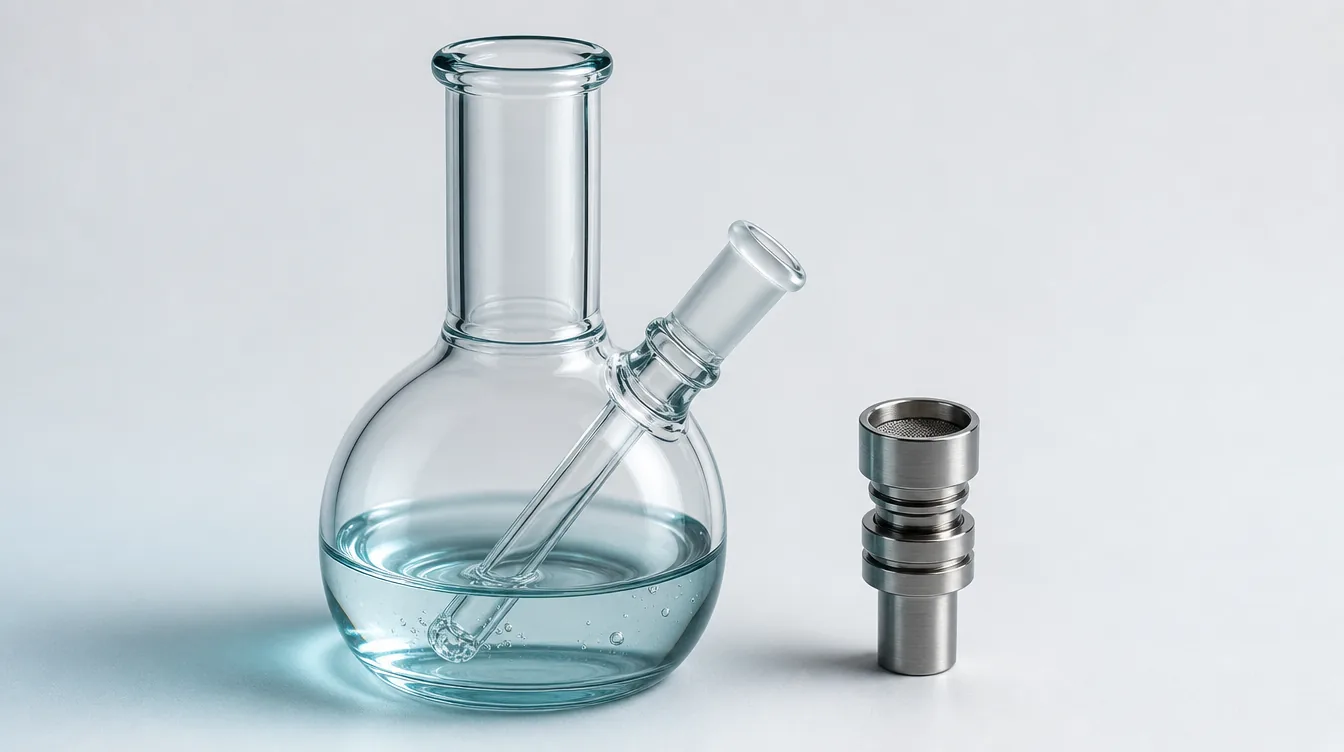
What is meant by water filtration
In a water-cooled setup, the aerosol produced by the vaporizer passes through an adapter into a water-containing vessel. The path may include a downstem, a percolator, a water chamber, and additional dry glass surfaces. Not every part of the path serves the same function.
Heat exchange can take place at water, glass, and air. In addition, substances can deposit on surfaces. The everyday term filtration thus encompasses several processes that would need to be measured separately in scientific terms. A cooler aerosol is not automatically an aerosol with fewer harmful substances.
This article deals with the scientific classification. The supplementary practical article Connecting vaporizers with water filtration explains compatibility, setup, and maintenance. Both pages use the same evidence threshold and have different purposes.
Three questions that must not be conflated
| Question | Appropriate measure | What does not yet follow from this |
|---|---|---|
| Does the outlet become cooler? | Temperature at a defined measurement point over the duration of the draw | Reduced chemical exposure |
| Are substances retained? | Mass balance of individual substances before and after the setup | Selective removal of only unwanted substances |
| Does health improve? | Clinical endpoints in an appropriate comparison | Such a benefit cannot be calculated from cooling alone |
The table describes requirements for evidence. It does not contain results of a water filter experiment that has not yet been conducted.
Why generalised cooling values are not reliable
A temperature difference requires two measurement points and a defined time. “50 degrees cooler” is incomplete without these specifications. Was the measurement taken directly at the heater, before the water, at the mouthpiece, or in an artificial breathing chamber? Was the first draw or a later draw recorded?
The starting temperature of the water, vessel volume, airflow rate, and duration also influence the outcome. Water and glass can warm up during operation. A value from a single brief test cannot therefore simply be presented as a permanent device characteristic.
An appropriate comparison would establish identical initial conditions and use the same measurement chain with and without water. The temperature would need to be recorded throughout the entire draw. It would additionally need to be checked whether the sensor is influenced by condensate or its installation.
This methodological explanation does not substitute for a missing study. It shows what information would be needed before a specific cooling figure on a product page is meaningful.
What can happen to cannabinoids in a water attachment
During aerosol transport, several possible sites of deposition must be distinguished: water, glass, connecting tubing, adapter, and mouthpiece. The question is therefore not only whether a substance is water-soluble. A substance can also remain behind as part of droplets or as condensate on a surface.
Low water solubility does not guarantee complete passage. Conversely, visible residue alone does not prove how large an active-substance loss is. For that, the quantities of substances would need to be determined analytically and related to a defined starting quantity.
The device studies by Lanz and Hazekamp provide background for distinguishing between loading, delivered quantity, and residues. However, they do not examine a direct water filter comparison here. Their figures must therefore not be relabelled as filter retention rates. [Lanz2016] [Hazekamp2006]
The erroneous 95-per-cent attribution
Hazekamp 2006 is occasionally cited as evidence that water filtration retains 95 per cent of active substances. The study validates the THC delivery of a Volcano and varies, amongst other things, temperature, sample type, and balloon volume. It is not evidence of such a water filter retention rate. [Hazekamp2006]
For a reliable percentage value, it would also need to be clear whether “retained” refers to the quantity behind the filter, the quantity in the lungs, or a subjective impression of effect. These quantities are not the same. A citation cannot remedy an incorrect attribution.
The correction does not mean that every water attachment must cause a large loss. It means that the cited numerical value is not substantiated on this basis. For the order of magnitude, an appropriate direct measurement experiment remains necessary.
Why more pleasant does not automatically mean healthier
A subjectively more pleasant draw is a sensory outcome. A person may perceive less heat or a different harshness. This perception is relevant for comfort, but does not measure the complete aerosol composition or a subsequent risk of disease.
Even a demonstrated lower outlet temperature would initially only describe the thermal aspect. Chemical exposure, inhaled quantity, and individual response would remain additional questions. If inhalation behavior changes in response to a more pleasant sensation, exposure may also change; its direction or magnitude is open without investigation.
This article therefore neither formulates a lung protection rate nor the promise of “less irritation” as a general clinical finding. The studies evaluated contain no suitable direct water filtration study addressing these endpoints.
What a reliable water filter experiment would need to contain
A meaningful laboratory comparison begins with the same vaporizer and the same batch of material. Loading, heating setting, and draw profile are defined. The complete path is then examined once with the water setup under investigation and once with a clearly defined reference configuration.
The reference configuration is critical: a long dry glass path and a short water path change several factors simultaneously. To isolate the contribution of the water, the experimental setup must control for these differences or openly treat the comparison as a whole-system comparison.
Not only the aerosol behind the mouthpiece should be collected. Material residues and deposits on the individual components are also relevant. A balance must acknowledge when a proportion cannot be recovered. Missing mass must not automatically be described as destroyed or absorbed by the water.
For the analytical evaluation, recovery experiments, appropriate calibration, and information on detection limits are required. Several independent loadings capture variability better than repeated analysis of the same extract. Temperature and substance measurement complement each other but do not replace one another.
A clinical comparison would be a further stage. It would need to examine actual health endpoints and account for usage behavior and potential confounding factors. A laboratory filter test would be a basis for this, but not yet a conclusion.
What statements about different designs are possible
A bubbler, a large water vessel, and a recycler differ in geometry, volume, and flow path. Technical characteristics can be described from this. A medical ranking does not follow from it.
The number of percolator openings or chambers is also not a standardized quality metric. Additional surfaces can alter heat and mass transfer but may make cleaning more difficult. Practical assessment should therefore take into account draw resistance, stability, and accessibility, without inventing an unmeasured filtration performance.
For specific models, joint dimensions, insertion depth, and permissible orientation belong in the manufacturer’s documentation. Such product data fall outside the scientific study pool and must be checked separately and kept current.
Hygiene and technical matters remain separate topics
Water and visible residues are not a purity test. A transparent vessel facilitates visual inspection but does not reveal the complete chemical or microbiological condition. A chemical purity assessment cannot be inferred from the color of the water.
Of practical relevance are drainable components, reachable inner surfaces, and compatibility with the intended cleaning agents. For handling hot glass, electrical devices, and cleaning chemicals, the instructions of the respective components apply. An unverified home-remedy mixture does not belong in a scientific device comparison.
These notes represent technical diligence, not a clinically tested protective measure. They are intended to prevent an optional attachment from being misunderstood as a medical filtration system.
How the evidence gap is correctly formulated
The statement is: Within the defined pool of twelve primary studies, there is no direct water-filter comparison that supports the universal claims discussed here. It does not state that no such investigation has ever existed anywhere in the world.
The pool was assembled with a specific purpose. It is not a systematic search with complete screening of all databases. A suitable additional primary study would first be required for any new quantitative filter claim, followed by an assessment of its methodology. The mere number of twelve sources does not constitute evidence for a topic that those sources do not directly investigate.
Further source verification
The following sections examine individual statements against primary sources in a targeted manner. This selection is also not a systematic literature review.
Which questions do the evaluated studies not answer?
The table shows the most important outstanding points. It is an overview of the evidential limits present here and not a claim that no research on these topics exists anywhere in the world. Any future direct comparison would need to be appropriate to the respective question.
| Question | Investigation required | What the evaluated studies show |
|---|---|---|
| How much myrcene remains in the water? | Matched samples before and after the same water stage | No suitable direct comparison |
| How much THC reaches the mouthpiece? | Mass balance including deposits and collection | No generalisable water-filter value |
| How much does the temperature drop? | Measurement at defined points under identical airflow | No universal reduction in degrees |
| Are symptoms reduced? | Appropriate human study | No clinical protective effect demonstrated |
| Is a particular configuration superior? | Controlled comparison of specific configurations | No scientific ranking |
These open areas are relevant to purchasing and usage decisions. A percentage figure without an appropriate study should not be replaced by anecdotal reports or data from a different product type.
Why terpene retention cannot be read from the smell
A sensory impression of smell does not depend solely on the total mass of a substance. A weaker scent downstream of an accessory is therefore not a quantitative analysis. Equally, one cannot determine from an aromatically smelling residue the proportion that was originally present in the starting material.
A retention measurement would require the experimental setup to use the same starting sample and a defined procedure. Not only the water but also glass surfaces, connectors, and the transported fraction would need to be captured. Otherwise it remains unclear where any missing proportion has gone.
The sample itself also changes during use. A comparison of “first draws without water, later ones with water” does not reliably isolate the water attachment. The order of draws and the substance already discharged are additional confounding variables.
How to check a WPA for compatibility
A mechanically fitting connection is only the first step. The accessory must be suitable for the specific device and the intended orientation. Weight, leverage, and the load on the mouthpiece or connection must also be taken into account.
Check whether the manufacturer describes use with this accessory. A third-party adapter may enable a mechanical connection without this constituting manufacturer approval or medical validation of the overall system.
Safe storage of hot components and the distance between water and electronics must also be appropriate to the design. The exact steps to follow are set out in the respective manual. The WPA glossary article goes into greater depth on connection terminology.
What the full-text review of Hazekamp clarifies
The near-complete separation of THC at the glass-fiber filter served the purpose of analytical sample collection. The downstream collection vessel contained ethanol, not water. This measurement arrangement is not a test of a water attachment and does not demonstrate a 95 per cent filtration rate. [Hazekamp2006]
Frequently asked questions about water filtration
Does water remove all harmful substances?
No such claim is supported by evidence. A water attachment does not constitute proof of contaminant-free or health-safe inhalation.
Are terpenes lost in the water?
A quantitative statement on a specific setup requires a suitable material balance. The studies evaluated lack a suitable direct comparison for this purpose; no fixed loss rate is stated here.
Is cooler vapor automatically less harmful?
A more comfortable sensation of warmth and a lower health burden are different outcomes. The one does not prove the other.
Does more bubbling mean better filtration?
It describes the visible flow behavior. No known separation rate for any specific substance follows from this.
Can any vaporizer be connected to water accessories?
No. The mechanics, operating orientation, and manufacturer approval must be appropriate to the specific device. An available adapter part alone does not fully answer these questions.
Source status and correction notice
Revised 10 September 2026. The overview documents a source gap; it does not fabricate a scientific basis for water filter percentage values. Device-specific operation depends on the respective manual.
Earlier general claims of protection, retention, and efficacy are replaced by a separate consideration of comfort, measurable quantity, and clinical outcome. The table is an editorial review matrix, not a series of measurements.
Studies, references, and limits of their claims
The study cards describe the respective experimental setup and its limitations.
Lanz2016: In-vitro validation of Volcano Medic, Plenty, Arizer Solo, DaVinci and Vape-or-Smoke with THC- and CBD-containing plant material as well as standards.
Lanz C, Mattsson J, Soydaner U, Brenneisen R. Medicinal Cannabis: In Vitro Validation of Vaporizers for the Smoke-Free Inhalation of Cannabis. PLOS ONE. 2016;11:e0147286.
- Design and material/population
- In-vitro validation of Volcano Medic, Plenty, Arizer Solo, DaVinci and Vape-or-Smoke with THC- and CBD-containing plant material as well as standards.
- Sample units
- Five models, not five clinical groups. The replicates per experimental condition are technical replicates; different sample types and measurement fractions must not be combined into a single total.
- Measurement
- HPLC/GC-MS; investigation of cannabinoid recovery, residues and decarboxylation. Electrical devices were tested under defined temperature conditions.
- Finding
- Cannabinoid recovery differed between the specific devices. Combustion was observed in the gas-powered Vape-or-Smoke that was examined.
- Uncertainty and transferability
- Recovery, decarboxylation and losses at device surfaces are separate measured quantities. No direct measurement of lung deposition, blood levels or long-term disease outcomes.
- Funding and interests/design notes
- No specific funding; the authors declare no competing interests and explain the subsequent employment/involvement of one author at AiFame/AiLab.
- Specific source location
- Materials and Methods: Vaporization, Sample Preparation and Analysis; Results and Discussion: Recovery of Cannabinoids, Decarboxylation; Table 2 and figure legends.
- Review scope
- Relevant full-text passages reviewed on 10.09.2026.
Hazekamp2006: Volcano laboratory validation with pure cannabinoids and plant material; supplementary measurement of exhaled THC.
Hazekamp A, Ruhaak R, Zuurman L, van Gerven J, Verpoorte R. Evaluation of a vaporizing device (Volcano) for the pulmonary administration of tetrahydrocannabinol. Journal of Pharmaceutical Sciences. 2006;95:1308–1317.
- Design and Material/Population
- Volcano laboratory validation with pure cannabinoids and plant material; supplementary measurement of exhaled THC.
- Sample Units
- Four devices; temperature trials conducted in triplicate, final device comparison with 4 mg THC performed five times per device. The brief report does not state an unambiguous total number of clinical participants.
- Measurement
- HPLC and quantitative NMR; predominantly 8-L balloon. Loading 2–8 mg pure THC. Temperature measured centrally in the filling chamber above the liquid pad. Loaded, delivered and exhaled quantities are recorded separately.
- Finding
- In the final device comparison, an average of 53.9 % of the loaded THC passed into the balloon. The trial also investigated condensation at the chamber, valve and balloon. The near-complete deposition on the analytical glass-fiber filter is not a finding relating to a water filter.
- Uncertainty and Transferability
- Recovery is protocol- and substrate-dependent, not a universal bioavailability figure. The supplementary clinical measurement did not include pulmonary function testing. No comparison with and without water filtration was made.
- Funding and Interests / Design Notes
- Devices from Storz & Bickel, plant material from Bedrocan; Farmalyse supported the preparation of clinical cannabinoid standards. No separate comprehensive declaration of interests was found.
- Specific Source Location
- Original pp. 1310–1312: Methods; pp. 1314–1315: delivery/condensation; p. 1316: Acknowledgements. Manufacturer copy with differing pagination additionally cross-checked.
- Review Scope
- Relevant full-text passages, methods and support statements verified on 10.09.2026; previously abstract only.
Verified Source · DOI: 10.1002/jps.20574
Source review: 10 September 2026. Within the targeted pool of twelve primary studies, eleven were reviewed against relevant full-text passages. For Van Dam 2010, original sections accessible in addition to the abstract were checked; a complete PDF and table review remains outstanding. Further literature cited in the article belongs to separate source reviews. No systematic comprehensive search.
Devices with a water-pipe connection in our price comparison
This article does not rate devices. These vaporizers can be connected to glass attachments via an adapter or ground-glass joint. The links lead to the price comparison: Storz & Bickel Venty · Storz & Bickel Mighty+ · Tinymight 2 · Arizer XQ2 · Storz & Bickel Plenty