Vaporization vs. Combustion: Emissions, Acute Effects and Health Boundaries
Short answer: Vaporization heats cannabis without intentional combustion. Studies of certain flower vaporizers show fewer investigated combustion products or a lower carbon monoxide exposure than smoking. This does not imply freedom from risk. THC can still cause acute impairment; at the same nominal dose, several effects were actually stronger after vaporization in one controlled study. [Gieringer2004] [Abrams2007] [Spindle2018]
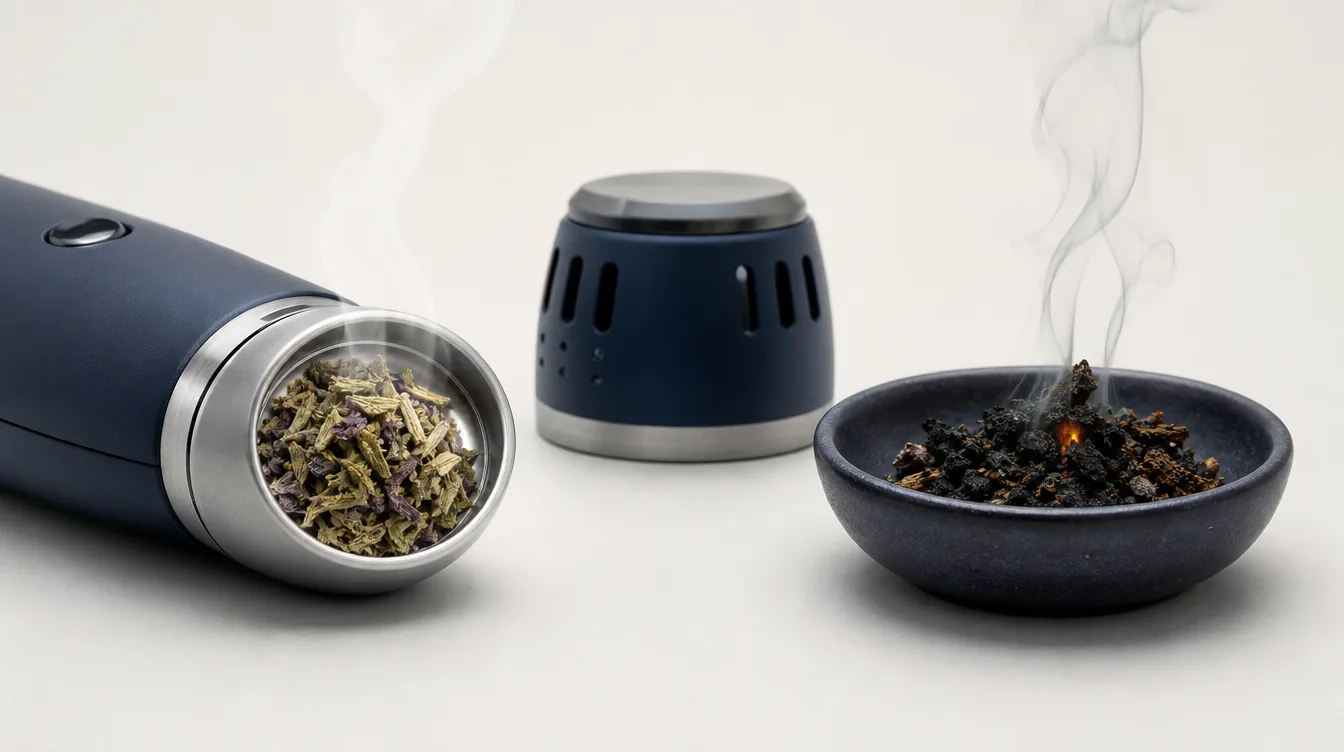
What the comparison covers
This article addresses cannabis flower and the devices examined in the source pool. It does not make blanket assessments of e-cigarette liquids, THC oil cartridges, or dabbing. These applications may involve different starting materials and technical processes. The shared word vaping does not make their findings interchangeable.
The basis is twelve deliberately selected primary works. These include laboratory investigations, acute human trials, and observational data. This is neither twelve clinical trials nor twelve independent confirmations of the same claim. Each work answers a specific question.
The comparison is therefore divided into three levels: What is produced at the device? What enters the body? What health consequences are actually observed? The levels are connected but cannot be converted into one another without additional data.
What happens during combustion and vaporization
During combustion, material reacts with oxygen whilst releasing heat. This produces smoke and further reaction products. In burning plant material, spatially distinct processes also occur: areas are preheated, substances evaporate, and other components are thermally decomposed or oxidized.
A flower vaporizer attempts to release volatile constituents through controlled heating without triggering this combustion process. The resulting mixture is commonly called vapor. At the outlet or upon cooling it may contain gaseous substances and fine droplets or particles. For measurement purposes the term aerosol is therefore often more precise.
Smoke-free describes the process, not the complete absence of all unwanted substances. The starting sample, hot surfaces, and operating conditions are also part of the chemical assessment. A device that appears clean is not in itself a toxicological proof.
No universal safety threshold on the display
A statement such as “safe below 230 °C” conflates a device setting with a health conclusion. The temperature at the sensor, in the air, and within the plant material can differ. Furthermore, thermal decomposition depends not only on a single number but also on time, material, and local conditions.
Even the historical Gieringer study documents different temperature measurement locations in the examined set-up. This shows why even a well-described laboratory value should not be read as a universal display threshold. The specific measurement locations are explained in the temperature article. [Gieringer2004]
The source pool provides no experimentally established threshold value below which all flowers, devices, and patterns of use would be free from health risk. The absence of a visible flame is equally not a complete chemical test. Intended device conditions remain important but do not replace long-term data.
What Gieringer 2004 examined chemically
Gieringer and colleagues compared Volcano vapor with smoke from combusted cannabis samples. Their analytical work distinguished investigated fractions and captured cannabinoids as well as pyrolytic constituents. Under the protocol used, many of the components found in the smoke were not detected in the vapor. [Gieringer2004]
The statement is bound to the device, samples, and analyses used. “Not detected” means that the respective method did not detect the substance above the relevant detection limit under its conditions. It does not mean that all conceivable harmful substances were sought or that every possible exposure was ruled out.
It would be particularly misleading to present a high cannabinoid proportion in an analysed fraction as a measure of the purity of the entire inhaled mixture. Nor does this proportion correspond to the THC yield from the loading. Both percentages can have entirely different denominators.
Four percentage figures that mean different things
| Term | Typical denominator | What it does not measure |
|---|---|---|
| Cannabinoid proportion of a fraction | Mass or signal of the defined analysed fraction | Overall health risk |
| Cannabinoid recovery at the outlet | Starting quantity of the respective cannabinoid | Uptake into the bloodstream |
| Relative change in an emission substance | Measured value of the same substance in the comparison condition | Corresponding change in all diseases |
| Proportion of persons with symptoms | Persons examined in a defined group | Automatically the causal effect of the device |
The table explains measures and contains no new empirical percentage values. It prevents an impressive figure from imperceptibly changing its meaning when cited.
Why lower carbon monoxide is an important but limited finding
Abrams and colleagues compared smoking and Volcano vaporization in a small controlled human study. In addition to THC in plasma, exhaled carbon monoxide and acute effects were among the measures recorded. THC exposure was comparable under the experimental conditions; carbon monoxide exposure was lower after vaporization. [Abrams2007]
This meant that a specific exposure marker was examined directly in humans. That is something different from chemical collection at a smoking machine and usefully complements it. The measurement is not, however, a comprehensive screening of all aerosol constituents.
Above all, a carbon monoxide value is not a direct measure of the later incidence of cancer, chronic bronchitis, or other long-term diseases. Such endpoints require different study designs and longer observation periods. A percentage CO reduction must therefore not be translated as an identical percentage health improvement.
Can vaporized cannabis produce stronger effects than smoked cannabis?
Spindle and colleagues studied 17 healthy adults who had not used cannabis in the preceding month. In a crossover design, various nominal THC doses were smoked or vaporized using a Volcano Medic. Several acute effects were stronger after vaporization at the same nominal dose. [Spindle2018]
This is not a call to enhance effects, but a central interpretive limit for the device comparison: the same quantity of THC in the starting material does not automatically mean the same exposure or the same effect. A change of inhalation route cannot therefore be described by a simple equation of plant quantity.
The study is small and concerns a selected group with low current frequency of use. It does not permit prediction for every individual and does not allow a blanket judgement on all devices. An average stronger effect is also not a statement about what would be safe for any individual person.
The published correction concerns the table title: the table describes peak changes from baseline. It must not be read as a table of absolute measured values. The correction is linked in the references section. [Spindle2018]
Why Abrams and Spindle are not simply contradictory
The two human studies examine different participants, protocols, and endpoints. Abrams is an early pilot comparison in cannabis-experienced individuals. Spindle focuses on adults without use in the preceding month. Different prior experience may be relevant to interpretation without alone explaining all differences.
Cannabis potency, nominal dose, inhalation procedure, and statistical analysis are also not identical. “Comparable THC exposure” in one protocol and “stronger acute effects” in another therefore do not answer exactly the same question. [Abrams2007] [Spindle2018]
A reputable article discloses the differences rather than selecting one study as a definitive winner. A general conclusion would require a systematic review of all relevant evidence. The twelve primary studies evaluated here are only a limited starting point for that purpose.
What Bloor shows about the starting sample
Bloor and colleagues examined heated cannabis plant material with a focus on released ammonia. The abstract reports detection in the material examined. This is a counter-example to the blanket claim that heated cannabis cannot release any undesirable substances without combustion. [Bloor2008]
The finding is specific to the material and experimental conditions. It does not justify asserting a fixed ammonia burden for all today’s controlled flowers or every vaporizer. For any extrapolation, sample origin, processing and measurement conditions would need to be examined.
The verified full-text tables separate the devices and materials examined. The results remain limited to these experimental conditions; they do not provide general everyday concentrations or clinical prognoses.
Respiratory symptoms: what observational data contribute
Earleywine and Smucker Barnwell analysed an internet survey. Among the 6.883 individuals included, 152 were vaporizer users. Vaporizer use was associated with fewer self-reported respiratory complaints, even after statistical adjustment for several confounding variables. [Earleywine2007]
The total of 6.883 must not be presented as the number of vaporizer users studied. The groups were not randomised. People who choose a vaporizer may also differ in other behaviors. Statistical adjustment can only account for factors that have been measured and adequately modeled.
Furthermore, these are self-reports of symptoms and use. That is valuable information, but not an objective diagnosis of all respiratory conditions. The association is compatible with a possible benefit; it does not prove it causally.
An odds ratio from such an analysis is likewise not a direct percentage figure for risk reduction. Particularly for common outcomes, odds and risks can differ considerably. The article therefore refrains from citing a seemingly simple protective proportion.
Before-and-after findings: why the subgroup matters
Van Dam and Earleywine studied 20 frequent consumers with respiratory complaints before and after one month of vaporizer use. The improvements highlighted in the abstract concern twelve individuals who did not develop a respiratory illness during the trial. [VanDam2010]
This selection is central to the interpretation. The result must not be presented without qualification as a finding for all original participants. The small subgroup and the absence of a randomised control group further limit the conclusions that can be drawn.
Before-and-after changes may reflect not only the switch under investigation but also temporal fluctuations, expectations, or other behavioral changes. An improvement after one month is therefore no guarantee of long-term lung health. For quantitative detailed claims, full verification of the original remains outstanding here.
Levels of evidence at a glance
| Study | Type of investigation | Question directly examined | Key limitation |
|---|---|---|---|
| Gieringer 2004 | Emissions analysis | Composition of examined smoke/vapour fractions | No long-term clinical endpoints |
| Abrams 2007 | Controlled human pilot | THC exposure, CO and acute effects | Small sample, specific device |
| Spindle 2018 | Controlled crossover trial | Acute effect at various nominal doses | Selected adults, short observation period |
| Bloor 2008 | Material/emissions analysis | Release of ammonia amongst other substances | No general everyday or disease prognosis |
| Earleywine 2007 | Cross-sectional survey | Association between use and symptoms | Self-selection and self-report |
| Van Dam 2010 | Before-and-after trial | Short-term change in symptoms and spirometry | Small subgroup, no randomised control |
The table is a methodological overview. The complete DOIs, references and verification limits are in the study cards.
What can be said about long-term health
The studies evaluated here provide grounds for distinguishing combustion emissions from vaporization. However, they do not establish a universally valid lifetime risk reduction for modern flower vaporizers. This pool lacks corresponding long-term direct comparisons with adequate control of use and confounding factors.
This means neither that the two inhalation routes are equivalent in every respect, nor that vaporization is risk-free. The correct claim remains tied to the endpoint: fewer specific emission compounds, a different acute exposure, or an observed symptom association.
A personal medical decision therefore cannot be made on the basis of a single percentage figure. This article is a scientific contextualisation, not a therapeutic or dosing guide. In particular, a purportedly clean inhalation is not evidence of the absence of THC-related impairment.
Heating class, price and water filters do not change the rules of evidence
A convection label does not confer a clinical safety rating. A higher price does not provide a toxicological test report. A water attachment does not yield a protective proportion without a direct comparison. These features may have technical relevance, but they do not replace the appropriate investigation.
The heating methods are therefore explained in terms of their heat transfer pathways. Water filtration is broken down into cooling, substance transport and health endpoints. The ball-vape price comparison keeps purchasing and research separate.
Equally, a historical laboratory study should not be relabelled as a recommendation for a current successor model. Changes to the device, material and protocol are possible reasons for different results. The year of publication and the name of the model examined are part of the source reference.
How to evaluate a health claim
Start with the precise claim. Does it concern a substance in the aerosol, a blood value, acute complaints, or a long-term disease risk? Then check whether the cited study actually measured that endpoint.
Next, consider the population or plant material, the device and the comparison condition. A study on a specific system does not answer an arbitrary accessory question. A survey does not permit conclusions about what would have occurred under random allocation.
For figures, the denominator, unit and uncertainty must be visible. A p-value alone says little about the practical magnitude of an effect. A particularly high percentage figure without a defined measurement fraction is a warning sign of imprecise reporting.
Finally, funding, manufacturer connections and verification status matter. A conflict of interest does not automatically invalidate a result; it is part of the assessment. An abstract can identify a study, but for far-reaching health claims it does not substitute for examining methods and results.
What the verified methods additionally show
In Bloor, the devices must be distinguished: the order of magnitude of 200 ppm ammonia belongs to the Blue Meanie. For the Volcano, Table 2 lists a mean of 60 ppm and a range of 50–70 ppm for the seized material. These are concentrations from the respective laboratory samples, not clinical risk ratios. [Bloor2008]
Pomahacova determined the by-product mass by subtracting the measured cannabinoids from the total mass of the condensate. These remaining substances were explicitly neither individually identified nor toxicologically classified. A better cannabinoid mass ratio is therefore not complete evidence of health safety. [Pomahacova2009]
In Van Dam, 22 individuals were enrolled and 20 were followed up. The highlighted findings concern twelve without an intercurrent respiratory illness: symptoms and FVC improved; the FEV1 change was not statistically significant at p = 0.053. These endpoints should not be conflated into a blanket improvement of all lung function values. [VanDam2010]
Does this apply to cartridges and concentrates as well?
This page deals primarily with heated cannabis flower. THC liquids, cartridges, dabbing and nicotine e-cigarettes use different products and heating systems. The review on consumption methods separates these exposures, but describes the route-specific conclusions as preliminary. A Volcano trial therefore does not constitute proof of safety for an arbitrary product labeled “vape”. Muheriwa-Matemba et al. (2024)
What would better evidence look like?
What would be needed are independent comparisons of current devices with full documentation of material, heating profile and draw profile, together with broad emissions analyses and longer-term investigations of clinical endpoints. For observational studies, factors including mixed tobacco use, duration of use and THC exposure must be taken into account. Until these data are available, the statement “lower exposure to several combustion markers” is more robust than a blanket health ranking. Muheriwa-Matemba et al. (2024) Lanz et al. (2016) Ghasemiesfe et al. (2018)
Frequently asked questions
Is vaporizing healthier than smoking?
Certain studies show lower combustion emissions or reduced CO exposure. A universal percentage improvement in long-term health cannot be derived from this pool. [Gieringer2004] [Abrams2007]
Is vapor 95 per cent pure?
A proportion within a specific analysed fraction is not a purity certificate for the entire inhaled mixture. Without a denominator, method and substance selection, the claim is misleading.
Are temperatures below 230 °C safe?
The pool does not validate any such universal display threshold. Sensor location, material and temporal progression must be taken into account; a temperature value is not a health endpoint.
Can the same quantity of cannabis have a stronger effect when vaporized?
In Spindle 2018, several acute effects were more pronounced after vaporization at the same nominal THC dose. The result concerns the small, selected group studied there and is not an individual dose prediction. [Spindle2018]
Do fewer respiratory symptoms prove long-term protection?
No. The observational and before-and-after studies have relevant selection and design limitations. They provide indications, but no general guarantee of lung protection. [Earleywine2007] [VanDam2010]
Can I transfer these findings to THC liquids?
Not without qualification. The article covers the flower and device configurations of the defined source pool. Other starting materials and processes require their own evidence.
Correction to Spindle 2018: Error in Table Title, DOI 10.1001/jamanetworkopen.2018.7241.
Studies, sources and limits of interpretation
The study cards describe the respective study design and its limitations.
Lanz C et al. (2016)
- Study type
- In-vitro device/aerosol validation
- Sample
- No human participants; 5 commercial vaporizers, THC- and CBD-dominant plant material.
- Comparison and measurement
- GC/MS for cannabinoid recovery, HPLC for acidic cannabinoids and decarboxylation; Volcano Medic, Plenty, Arizer Solo, DaVinci and gas-powered device.
- Randomisation and blinding
- Not applicable.
- Outcome
- Electrically temperature-controlled devices decarboxylated THC/CBD very efficiently and delivered cannabinoids reproducibly; combustion was observed with the gas-powered device.
- Strengths
- Validated analytical methods; multiple devices; direct measurement of material transfer.
- Limitations and potential bias
- No human participants, no clinical endpoints, no comprehensive toxicological aerosol analysis; device generations are older.
Lanz C, Mattsson J, Soydaner U, Brenneisen R. 2016. Medicinal Cannabis: In Vitro Validation of Vaporizers for the Smoke-Free Inhalation of Cannabis. PloS one. DOI: 10.1371/journal.pone.0147286 · PMID 26784441 · PMC4718604
Ghasemiesfe M et al. (2018)
- Study type
- Systematic review and meta-analysis
- Sample
- 22 studies (10 prospective cohorts, 12 cross-sectional studies).
- Comparison and measurement
- PubMed, Embase, PsycINFO, MEDLINE, Cochrane 1973–30.04.2018; PROSPERO; 4 reviewers for extraction/ROB, 3 for strength of evidence; pooling only of similar studies with sufficiently low risk of bias.
- Randomisation and blinding
- Predominantly non-randomised observational studies.
- Outcome
- 22 studies in total. Pooled prospective symptom data from two studies: cough RR 2.04 (95% CI 1.02–4.06), sputum RR 3.84 (1.62–9.07). The authors rated the strength of evidence for respiratory symptoms as low; evidence for obstruction and lung function was insufficient.
- Strengths
- Very rigorous methodology; PROSPERO; multiple reviewers; risk-of-bias and evidence assessment; differentiated conclusions.
- Limitations and potential bias
- Primary studies mostly observational data; exposure measurement and tobacco confounding; limited data at very high lifetime exposure.
Ghasemiesfe M, Ravi D, Vali M, Korenstein D, Arjomandi M, Frank J, Austin PC, Keyhani S. 2018. Marijuana Use, Respiratory Symptoms, and Pulmonary Function: A Systematic Review and Meta-analysis. Annals of internal medicine. DOI: 10.7326/M18-0522 · PMID 29971337 · PMC6231497
Muheriwa-Matemba SR et al. (2024)
- Study type
- Systematic review
- Sample
- 42 included publications: 6 case reports, 21 reviews, 15 empirical studies; among the empirical works, including 2 RCTs, 5 retrospective analyses, 3 longitudinal and 3 cross-sectional studies.
- Comparison and measurement
- Web of Science, ProQuest, PsycINFO, Scopus, Embase and Medline; peer-reviewed works 2009–2023; PRISMA; only studies with documented route of administration.
- Randomisation and blinding
- Not at the review level; only a small proportion of the primary studies were randomised.
- Outcome
- Smoking was most consistently associated with respiratory complaints and diseases; edibles showed little direct respiratory effect; tachycardia was reported across several routes of administration.
- Strengths
- Directly tailored to route of administration; broad database search; separates smoking, vaping, oral and dabbing.
- Limitations and potential bias
- Very heterogeneous evidence; includes reviews and case reports alongside primary studies; no meta-analysis; authors themselves describe route-specific conclusions as preliminary.
Muheriwa-Matemba SR, Baral A, Abdshah A, Diggs BA, Gerber Collazos KS, Morris KB, Messiah SE, Vidot DC. 2024. Cardiovascular and Respiratory Effects of Cannabis Use by Route of Administration: A Systematic Review. Substance use & misuse. DOI: 10.1080/10826084.2024.2341317 · PMID 38644600
Gieringer2004: Analytical Volcano laboratory comparison with combusted cannabis samples; investigation of solid and gas phase.
Gieringer D, St. Laurent J, Goodrich S. Cannabis Vaporizer Combines Efficient Delivery of THC with Effective Suppression of Pyrolytic Compounds. Journal of Cannabis Therapeutics. 2004;4(1):7–27.
- Design and material/population
- Analytical Volcano laboratory comparison with combusted cannabis samples; investigation of solid and gas phase.
- Sample units
- In the quantitative experiment, three loadings of 200 mg NIDA cannabis each. Not a human study and not three independently representative device series.
- Measurement
- Chromatographic analysis of collected fractions. Temperature measurement and collection conditions are part of the result.
- Finding
- Under the conditions examined, many pyrolytic constituents of smoke were not detected in the vapor. THC recovery and the proportion of cannabinoids in one analysed fraction have different denominators.
- Uncertainty and transferability
- Not detected means not detected under the conditions of the analysis. It does not mean that every possible harmful substance molecule was excluded.
- Funding and interests/design notes
- Research support and organisational affiliations are disclosed on the first page of the article; involvement of California NORML, MAPS and Chemic Labs should be taken into account.
- Specific source location
- Pp. 7–8: Abstract and funding; Methods and Results, tables on THC recovery and chemical analysis; discussion of temperature measurement.
- Review scope
- Relevant full-text passages reviewed on 10.09.2026; no original figure reproduced.
Abrams2007: Randomised inpatient pilot comparison in 18 healthy cannabis-experienced participants; smoking versus Volcano.
Abrams DI, Vizoso HP, Shade SB, Jay C, Kelly ME, Benowitz NL. Vaporization as a smokeless cannabis delivery system: A pilot study. Clinical Pharmacology & Therapeutics. 2007;82:572–578.
- Design and Material/Population
- Randomised inpatient pilot comparison in 18 healthy cannabis-experienced participants; smoking versus Volcano.
- Sample Units
- 18 participants with repeated measurements; six study days. The various measurement time points do not increase the independent sample size.
- Measurement
- Three cannabis strengths: 1.7, 3.4 and 6.8 % THC. Plasma THC, exhaled carbon monoxide and acute effects; inhalation routes identifiable.
- Finding
- THC exposure was comparable across the conditions studied; carbon monoxide was lower following vaporization than following smoking.
- Uncertainty and Transferability
- Small pilot study. A carbon monoxide finding measures neither all emissions nor the frequency of subsequent pulmonary disease. The sample differs from Spindle2018.
- Funding and Interests / Design Notes
- Funded by the University of California Center for Medicinal Cannabis Research and an NIH grant; no conflicts of interest declared.
- Specific Source Location
- Results: Table 1 and figures for THC/CO; Methods: Subjects and Study design; final article page: funding/Conflict of Interest.
- Review Scope
- Relevant full-text passages verified on 10.09.2026; scope extended from abstract to full-text review compared with the supplied plan.
Spindle2018: Crossover trial with 17 healthy adults who had not used cannabis in the preceding month; smoked or vaporized with the Volcano Medic.
Spindle TR et al. Acute Effects of Smoked and Vaporized Cannabis in Healthy Adults Who Infrequently Use Cannabis: A Crossover Trial. JAMA Network Open. 2018;1:e184841.
- Design and Material/Population
- Crossover trial with 17 healthy adults who had not used cannabis in the preceding month; smoked or vaporized with the Volcano Medic.
- Sample Units
- 17 participants, six conditions per participant; sessions and repeated blood samples do not constitute additional independent participants.
- Measurement
- 0, 10 and 25 mg nominal THC; randomised conditions and blinded dose. The inhalation route was identifiable. Blood THC, subjective and cognitive/psychomotor effects were recorded.
- Finding
- At the same nominal dose, several acute effects were greater following vaporization than following smoking.
- Uncertainty and Transferability
- Small selected sample and acute observation; not transferable to all users, devices or long-term risks. Correction of 21.12.2018 concerns the table heading: peak change from baseline.
- Funding and Interests / Design Notes
- SAMHSA funding; authors report, inter alia, consultancy/honorarium activities outside the study. The funder was involved in several study steps; see Disclosures.
- Specific Source Location
- Methods: Study Design, Participants; Results and corrected table; Article Information. Correction DOI: 10.1001/jamanetworkopen.2018.7241.
- Review Scope
- Relevant full-text passages and publisher correction verified on 10.09.2026.
Bloor2008: SIFT-MS laboratory analysis of heated cannabis leaf material in the Blue Meanie and Volcano, with supplementary smoke measurements.
Bloor RN, Wang TS, Španěl P, Smith D. Ammonia release from heated ‘street’ cannabis leaf and its potential toxic effects on cannabis users. Addiction. 2008;103:1671–1677.
- Design and Material/Population
- SIFT-MS laboratory analysis of heated cannabis leaf material in the Blue Meanie and Volcano, with supplementary smoke measurements.
- Sample Units
- Five seized material samples and five NIDA samples; 200 mg each for the two heating systems. No clinical cohort and no representative market sample.
- Measurement
- Blue Meanie: approximately 250 °C at the heating bowl, direct gas sampling. Volcano: setting 9, sampling from the balloon. The cited temperatures at the heating screen and material surface originate from an earlier publication.
- Finding
- For seized material, Table 1 reports a mean of 205 ppm ammonia for the Blue Meanie; Table 2 reports 60 ppm for the Volcano, range 50–70. The order of magnitude of 200 ppm highlighted in the abstract must not be attributed indiscriminately to the Volcano.
- Uncertainty and Transferability
- Concentrations in different sampling systems are not ingested doses or clinical risk ratios. Material provenance, moisture content, and measurement setup limit transferability.
- Funding and Interests/Design Notes
- Smith and Španěl were directors of Trans Spectra, a SIFT-MS developer. Funded by the North Staffordshire Medical Institute, a regional research and development consortium, and Keele University.
- Specific Source Location
- Pp. 1672–1673: materials and sampling; p. 1674: Tables 1–2; p. 1676: declarations of interest and acknowledgements.
- Review Scope
- Full text, device-specific tables, and declarations of interest reviewed on 10.09.2026.
Earleywine2007: Cross-sectional internet survey; self-reported use of vaporizers and respiratory complaints.
Earleywine M, Smucker Barnwell S. Decreased respiratory symptoms in cannabis users who vaporize. Harm Reduction Journal. 2007;4:11.
- Design and Material/Population
- Cross-sectional internet survey; self-reported use of vaporizers and respiratory complaints.
- Sample Units
- 6.883 persons included, of whom 152 were vaporizer users. The large overall number is not the size of the vaporizer group.
- Measurement
- Logistic regression including, amongst other variables, age, sex, cannabis and cigarette consumption. No randomisation or blinding.
- Finding
- Vaporizer use was associated with fewer reported respiratory complaints.
- Uncertainty and Transferability
- Self-selection, self-report, and residual confounders preclude a causal protection estimate. An odds ratio is not a direct relative risk of disease.
- Funding and Interests/Design Notes
- Recruitment via drug law reform organizations; this recruitment pathway is a relevant design limitation. No independent representative sample.
- Specific Source Location
- Method: Participants; Results: raw numbers and Table 1; Discussion: self-selection and causality.
- Review Scope
- Relevant full-text passages reviewed on 10.09.2026.
VanDam2010: Uncontrolled before-and-after trial with frequent-using adults with respiratory symptoms; switching to a Vaporbrothers vaporizer for one month.
Van Dam NT, Earleywine M. Pulmonary function in cannabis users: Support for a clinical trial of the vaporizer. International Journal of Drug Policy. 2010;21:511–513.
- Design and Material/Population
- Uncontrolled before-and-after trial with frequent-using adults with respiratory symptoms; switching to a Vaporbrothers vaporizer for one month.
- Sample Units
- 22 enrolled, 20 followed up; of whom 12 had no intercurrent respiratory illness and 8 did. Current tobacco use was an exclusion criterion. Four persons reported additional smoking on multiple occasions.
- Measurement
- Nine self-reported respiratory symptoms and spirometry; separate analyses according to intercurrent respiratory illness. FEV1 and FVC from three reproducible attempts.
- Finding
- In the 12 persons without intercurrent illness, symptoms and FVC improved. The FEV1 change did not reach the reported significance level (p = 0.053).
- Uncertainty and Transferability
- No randomised control group; short duration, small selected sample, incomplete switching, and altered consumption quantities. No evidence of long-term safety or guaranteed pulmonary recovery.
- Funding and Interests/Design Notes
- The Marijuana Policy Project funded the work according to the acknowledgements, without influence on design, analysis, or publication. Van Dam declares no conflicts; Earleywine discloses involvement with cannabis law reform groups.
- Specific Source Location
- Publisher’s original sections Participants, Pulmonary function, Statistical analyses, Results and Acknowledgements; additionally a publicly indexed author copy, pp. 511/513.
- Review Scope
- Reviewed on 10.09.2026 beyond the abstract using accessible original text sections. Complete PDF/table review remains outstanding: the author link now leads to a university login page.
Pomahacova2009: Laboratory comparison of Volcano Digital vapor and cannabis cigarette smoke from Bedrocan flower tips; no human study.
Pomahacova B, Van der Kooy F, Verpoorte R. Cannabis smoke condensate III: The cannabinoid content of vaporized Cannabis sativa. Inhalation Toxicology. 2009;21:1108–1112.
- Design and Material/Population
- Laboratory comparison of Volcano Digital vapor and cannabis cigarette smoke from Bedrocan flower tips; no human study.
- Sample Units
- Technical triplicate trials. Initially approximately 500 mg material at 170, 200 and 230 °C; further trials with five temperature settings and 50–1000 mg loading respectively.
- Measurement
- Condensates measured gravimetrically and cannabinoids by HPLC; one approximately 8-L balloon per vaporization sample. Smoking machine: 35-ml puffs over 3 s every 30 s. By-products were calculated as the difference between total mass and measured cannabinoids.
- Finding
- Cannabinoid proportions and absolute yields varied with temperature and loading. A higher cannabinoid proportion and a greater delivered cannabinoid mass are distinct results.
- Uncertainty and Transferability
- By-products were explicitly neither individually identified nor toxicologically classified. The difference mass is therefore not a measured value for overall toxicity. The study does not establish a safe or clinically optimal everyday temperature.
- Funding and Interests / Design Notes
- Authors declare no conflicts of interest. Plant material via the Office of Medicinal Cannabis/Bedrocan, device from Storz & Bickel; no separate funding source cited in the text reviewed.
- Specific Source Location
- Pp. 1109–1110: material, protocols, Figure 2 and Table 1; pp. 1111–1112: interpretation and declaration of interests. Scan with handwritten annotations: these are not statements by the authors.
- Review Scope
- Full text including methods, Table 1, figure legends and declaration of interests verified on 10.09.2026.
Source review: 10 September 2026. Within the targeted pool of twelve primary studies, eleven were verified against relevant full-text passages. For Van Dam 2010, original sections accessible beyond the abstract were checked; a complete PDF and table review remains outstanding. Further literature cited in the article belongs to separate source reviews. No systematic comprehensive search.