Vapor quality in vaporizers: flavor, delivery and evidence
Short answer: Vapor quality is not a single scientific measurement. Taste, visible clouds, draw feel, chemical composition and quantity of cannabinoids delivered are distinct properties. A pleasant draw or a dense cloud proves neither purity nor a high THC dose. The laboratory studies in the source pool investigate specific chemical and technical endpoints. [Fischedick2010] [Lanz2016] [Hazekamp2006]
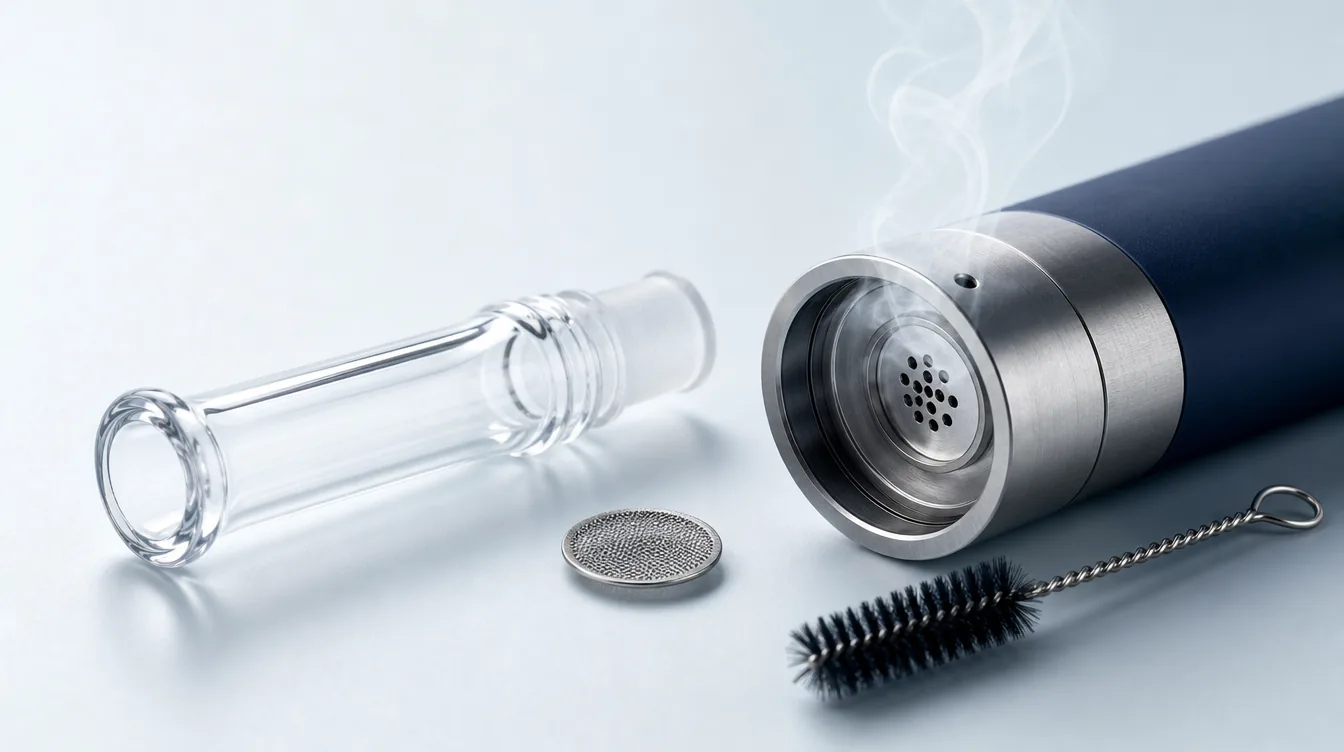
Five dimensions instead of an overall rating
| Dimension | How it is described or measured | What it does not replace |
|---|---|---|
| Taste and aroma | Sensory assessment under documented conditions | Chemical purity testing |
| Draw feel | Subjective perception; supplemented by temperature and airflow resistance | Clinical safety evidence |
| Visible density | Visual impression or appropriate particle measurement | THC mass per draw |
| Chemical composition | Substance-specific analytics with calibration | Automatic inference about individual effect |
| Active substance delivery | Mass of a cannabinoid at a defined measurement point | Systemic uptake or therapeutic effect |
This distinction makes product comparisons more comprehensible. A device may be preferred in a sensory evaluation without having the highest analytical delivery. Conversely, high delivery may coincide with an impression that one person finds less pleasant.
What is referred to as vapor in everyday use
When heated, volatile substances are released and transported along the device pathway. On cooling, fine droplets or particles may form. The mixture exiting at the mouthpiece can therefore be described as an aerosol for many measurement purposes.
The visible cloud is produced by the interaction of light with this mixture. Lighting, background, air dilution and condensation all influence the appearance. A photograph taken under strong backlighting is therefore not a standardized measurement of the quantity of active substance delivered.
A chemical analysis, by contrast, asks about specific compounds and their quantities. It requires a defined collection method. Visibility and chemistry may be associated, but they are not interchangeable scales.
Taste: personal evaluation with a transparent procedure
Taste and aroma can be described meaningfully when conditions and evaluation criteria are clear. These include the material batch, device condition, mouthpiece used and the order of observations. Individual perception and expectation may also influence the assessment.
Terms such as clean, sweet, roasted or sharp are sensory descriptions. They should not be directly translated into “fewer harmful substances” or “more terpenes”. A claim about a specific substance would require a corresponding analysis.
A controlled sensory comparison would use conditions as equal as possible and an appropriate presentation order. With visible devices, full blinding is difficult. This limitation should be stated rather than presenting personal impressions as objective laboratory values.
Why a bowl changes over the course of a session
As use progresses, the thermal state and composition of the remaining material change. A later draw is therefore not simply a repetition of the first. Condensate and heating within the device pathway can also influence the progression.
The perceived flavor progression is not, however, a direct time-curve of individual terpenes. Anyone claiming that a particular substance has completely disappeared after exactly three draws requires time-resolved analytics under precisely that protocol.
The chemical investigation of cannabis vapor shows that various compounds can be analysed. It does not automatically provide a universal sensory sequence applicable to all strains, temperatures and devices. [Fischedick2010]
What Fischedick 2010 actually investigated
Fischedick and colleagues analysed extracts, smoke and Volcano vaporizer output from three medicinal cannabis varieties. Several chromatographic methods and a supplementary CB1 binding assay in vitro were used. The study examines composition and receptor binding, not user evaluation of taste. [Fischedick2010]
The analytics separate and identify compounds under defined conditions. For quantification, reference compounds of a substance class were used in some cases rather than calibrating each individual analyte separately. This methodological limitation is part of the interpretation of the tables. [Fischedick2010]
A chemically detected terpene does not constitute evidence of a clinical entourage effect. Equally, receptor binding in a test tube is not evidence of a specific effect of a flavor profile in humans. Concentration at the target site, uptake and clinical endpoints would be additional questions.
Reading chromatograms correctly
A chromatogram displays the detector signal over a separation time. The position of a peak can contribute to substance identification when an appropriate reference is used. Its area can be used for quantification when appropriate calibration is applied. Without this context, a tall peak does not automatically mean “a large effect”.
Different detectors and substances can produce different signal responses. A peak area must therefore not be read indiscriminately as a mass fraction. Overlapping peaks, detection limits and sample preparation can also influence the evaluation.
In Fischedick 2010, Figure 1 shows representative chromatographic profiles of extract, smoke and vaporizer output. Figure 2 concerns CB1 binding activity. Neither is a universal curve of flavor loss during a session. [Fischedick2010]
The inconsistently labeled images formerly used on this page are not being reused as original data. Instead, the measured quantities are explained here in text and tables. This avoids creating a false impression that an illustrative or differently attributed figure supports a specific claim.
Active substance delivery is more than a percentage figure
Lanz investigated, amongst other things, how much cannabinoid is recovered in various fractions. For any delivery claim, it is essential to specify which fraction is meant and to what the proportion is referred. Material residue and condensate within the device are not the same quantity as the aerosol delivered. [Lanz2016]
Hazekamp’s Volcano validation likewise distinguishes between the quantity loaded and the quantity in the balloon. Such a device-level value is not an individual bioavailability figure. The pathway beyond the device outlet represents a further stage. [Hazekamp2006]
A ranking by price or heating class cannot be derived from these studies without additional data. An older model does not represent all current devices of the same design type. “Desktop better than portable” would be an additional hypothesis, not a direct result of these sources.
Why more clouds do not automatically mean higher quality
A dense visible cloud may be assessed as a desirable impression. Scientifically, however, the optical conditions must be known. Different lighting or air dilution can substantially alter the comparison.
Even if a higher aerosol mass were measured, its composition would remain open. A greater total mass does not necessarily contain proportionally more THC. A substance-specific measurement is required for cannabinoid delivery.
A high cannabinoid quantity is not a universal quality goal either. Reproducibility and delivery appropriate to the particular task are other criteria. A stronger acute effect must not be described as a health benefit. The comparison Vaporization and Combustion discusses the human findings separately.
Cooling, mouthpiece and water
A longer or differently constructed device pathway can alter heat and mass transfer. This may influence the subjective draw feel. Without measurement, however, neither a fixed cooling performance nor a specific substance retention can be quantified.
Water extends the setup with additional contact and flow areas. The source pool contains no direct water filtration comparison from which a general health benefit can be derived. Perceived reduction in warmth is therefore not evidence of selective harmful-substance removal.
For practical selection, compatibility, stability and ease of cleaning are verifiable criteria. The health-related assessment remains separate from these. See Water Filtration: Evidence and Measurement Questions and the Connection Guide.
Material preparation without a universal recipe
The sample influences the result. Grind size, fill mass, packing, and material condition belong in a comparison protocol. This does not mean, however, that the pool establishes a single optimal preparation for all devices.
Very different particle sizes can make the setup less comparable. A blocked airway can alter the draw. Whether and how a fill should be loosened or prepared is, however, device-specific and should be carried out in accordance with the instructions.
A specific relative storage humidity is not a direct measurement of the moisture content of each individual piece of plant material. Equally, the color of the residual material cannot guarantee a remaining THC quantity. Such seemingly precise shortcuts should not be presented as scientific quality assurance.
A scoring sheet for reproducible observations
| Field | Documentation | Classification |
|---|---|---|
| Device | Model, version, mouthpiece, capsule, or adapter | Technical context |
| Sample | Batch, preparation, loading | Starting conditions |
| Procedure | Setting, readiness, pauses, sequence | Reproducibility |
| Flavor | Descriptive terms, time point, evaluating person | Subjective |
| Draw | Perceived resistance and heat | Subjective, unless measured instrumentally |
| Visibility | Identical lighting and background | Visual observation |
| Analytics | Only substances and units actually measured | Objective measurement range with method limits |
This sheet does not turn an observation into a clinical study. It does, however, help to honestly separate personal experience from chemical and health-related claims.
Troubleshooting: keeping observation and cause separate
Little visible aerosol: First check the intended settings, the device condition, and the procedure. Low visibility alone proves neither a defect nor an absence of active substance. A dose cannot be determined from this.
Altered draw resistance: A different setup, soiled designated filter surfaces, or a different fill may be relevant. Specific checking and cleaning are carried out according to the instructions. Do not make several changes simultaneously if the cause is to remain traceable.
Unfamiliar flavor: Change of material, residues, or an altered device pathway are possible associations. A sensory impression does not, however, identify a specific contaminant. Where there are indications of a malfunction, a technical inspection is more appropriate than an invented chemical diagnosis.
Unevenly colored residual material: This may be reason to check the preparation and the intended airway. Color neither quantifies the extraction nor confirms safe continued use.
What a robust quality statement should contain
A sound statement names the dimension, the comparison, and the method. “Preferred in a sensory comparison” is understandable when the persons and conditions are stated. “Higher THC mass at the outlet” is understandable when the analytics, unit, denominator, and variance are visible.
A blanket overall score can conceal such differences. Where several criteria are combined into a single rating, the weighting and data sources should be transparent. Scientific sources must not create the impression that an editorial purchase score is a result of the original study.
The heating methods explain the construction. The temperature page explains measurement locations and substance data. Together, the articles enable more precise questions to be put to a device test, without implying a non-existent universal ranking.
Analytical quality control: what comes before the number
A measured quantity is only as reliable as the sampling and evaluation. First, it must be clear which fraction was collected. A procedure that retains only part of the aerosol cannot be interpreted as a complete output quantity without correction.
A blank value helps to determine whether the device pathway, solvent, or analytical material itself contributes to the signal. A recovery experiment tests how reliably a known quantity of substance is captured by the procedure under investigation. Both answer different questions from an actual vaporizer comparison.
Calibration connects the measurement signal and the substance quantity. It requires a suitable range; very weak or very strong signals outside this range must be treated separately. An identified substance is not automatically quantified with the same degree of certainty.
The limit of detection describes from what point a signal can be distinguished from the background. The limit of quantification concerns a sufficiently reliable quantitative statement. “Not quantifiable” and “not present” are therefore not synonyms.
Finally, the unit must be understandable. A quantity per gram of plant material used, a proportion of total THC, and a concentration per volume of air can describe the same experiment from different perspectives. Without a denominator, the figures cannot be meaningfully compared.
What distinguishes an independent assessment from a product description
A manufacturer’s description can explain the construction and intended functions. A retailer’s listing can state the current scope of delivery. A personal report can describe operation and sensation. None of these source types is automatically an independent chemical investigation.
For an editorial assessment it is therefore necessary to make transparent where each piece of information originates. Was a measured value obtained independently, taken from a test report, or merely a product property described? A single list of sources at the end is insufficient if the attribution within the text remains unclear.
The primary sources of this article underpin the chemical and methodological statements. Practical evaluation frameworks are editorial classification. This distinction allows for informed reading without presenting personal preferences or purchasing decisions as laboratory results.
Further source verification
The following sections examine individual statements against primary sources in a targeted manner. This selection is also not a systematic literature review.
What did Lanz 2016 actually investigate?
Methods: samples, replicates, and endpoints
Two cannabis varieties were investigated per device, each with 50 mg of material in triplicate; additional experiments were conducted with THC/CBD standards. Fractions comprised collected vapor, plant residue, device parts, and connecting tubing. GC/MS detected, amongst other things, THC, CBD, and CBN; HPLC allowed examination of acidic and neutral cannabinoids. The temperature of the butane-powered reference device could not be controlled or monitored. References: Materials and Methods – Vaporization Experiments; Table 1; Table 2. Three technical experimental replicates are not three study participants.
The work is relevant to understanding a mass balance: what disappears from the fill does not necessarily arrive in full at the end of the mouthpiece. Different devices contain different surfaces, connecting pathways, and collection systems. A comparison of such complete systems does not automatically isolate the influence of conduction or convection.
For this reason we refrain from giving general active-substance percentage values for individual heating classes. Such a figure would need to state at minimum the device, material, measured variable, denominator, and protocol. Equally, no ranking of current devices or a clinically effective temperature can be derived from this investigation.
Why does the flavor change during a session?
The starting material and the device change over the course of use. Parts of the fill are heated for longer, volatile constituents may already have been delivered, and deposits in the vapor pathway can contribute to the sensory impression. The first and the last observation of a session therefore do not share the same starting conditions.
The explanation “all terpenes first, all cannabinoids later” is too simplistic. The delivery of different substances can overlap in time. Furthermore, a weaker odor is not evidence of the complete extraction of a substance. The terpene overview separates aroma, measured composition and possible effects in greater detail.
If you wish to compare aroma, clean components and the same starting material are important. Older residue in the mouthpiece can distort a comparison just as much as a different fill. Describe a flavor impression as a personal perception; without measurement, this should not become a statement such as “receives twice as many terpenes”.
How should draw resistance be assessed?
The resistance arises from the entire airflow path, including chamber filling and screens. A change may therefore be caused by the state of maintenance or by packing, without any change to the device’s design. For a fair comparison, these conditions must be documented.
A light draw is a handling characteristic. It does not automatically mean better extraction, and a tight draw is not automatically a defect. What matters is whether the behavior suits the intended design and one’s own needs.
Frequently asked questions about vapor quality
Does dense vapor mean a stronger effect?
Visible density alone is insufficient for this claim. Composition, draw volume, delivered mass and individual absorption are additional variables. Even inconspicuous aerosol is not evidence of negligible exposure.
Does convection inherently deliver better flavor?
No universal sensory outcome follows from the heating principle alone. Device geometry, material, control, loading and cleaning all belong to any comparison. The Lanz device comparison does not isolate the heating principle as the sole variable.
Has research confirmed 170 °C as the terpene maximum?
The Lanz study previously cited for this claim did not investigate it. It is not evidence of a general terpene maximum at 170 °C.
Does brown residual material indicate complete extraction?
No. Color is an observation, not a quantitative residual content analysis. It cannot be used to calculate a reliable remaining or already delivered THC quantity.
Does water make vapor safe for health?
This cannot be inferred from a more pleasant sensation. The studies evaluated lack a suitable direct comparison that would demonstrate such a general protective effect.
Sources and correction notice
The scientific reference is the device experiment by Lanz et al. (2016) described above, in particular the methods and Tables 1 and 2. The practical comparison criteria are editorial assessments and not an independent laboratory validation.
On 10 September 2026, the incorrect 170-degree attribution, blanket rankings for heating classes, unverified active-substance percentage values and unreliably attributed illustrations were removed. Flavor, chemical delivery and human effects are now described separately. The revision does not claim to be a complete systematic evaluation of all vaporizer research.
Studies, sources and limits of claims
The study cards describe the respective experimental design and its limitations.
Fischedick2010: Analytical investigation of extract, Volcano vapor and smoke from Bedrocan, Bedrobinol and Bediol; supplementary CB1 binding assay in vitro.
Fischedick J, Van der Kooy F, Verpoorte R. Cannabinoid Receptor 1 Binding Activity and Quantitative Analysis of Cannabis sativa L. Smoke and Vapor. Chemical and Pharmaceutical Bulletin. 2010;58:201–207.
- Design and Material/Population
- Analytical investigation of extract, Volcano vapor and smoke from Bedrocan, Bedrobinol and Bediol; supplementary CB1 binding assay in vitro.
- Sample Units
- Three plant varieties; tables cite technical replicates with n = 3. These are not patient groups.
- Measurement
- GC-FID, GC-MS and HPLC. Partially normalised quantification using reference compounds of a substance class rather than individual calibration of each analyte.
- Finding
- The work characterizes cannabinoids, terpenoids and investigated pyrolysis products. Figure 1 is a chromatogram; Figure 2 shows CB1 binding activity.
- Uncertainty and Transferability
- Chemical composition and receptor binding establish neither flavor preferences nor a clinical entourage effect. Relative standard deviations must be attributed to the respective table cells.
- Funding and Interests / Design Notes
- STW funded the investigation; Bedrocan BV supplied plant material and PRISNA BV cannabinoid references, according to the Acknowledgements.
- Specific Source Location
- Pp. 202–205: analytics, Tables 2–4, Figures 1–2; p. 206: conclusion and Acknowledgements.
- Review Scope
- Relevant full-text passages and original legends verified on 10.09.2026.
Lanz2016: In-vitro validation of Volcano Medic, Plenty, Arizer Solo, DaVinci and Vape-or-Smoke with THC- and CBD-containing plant material as well as standards.
Lanz C, Mattsson J, Soydaner U, Brenneisen R. Medicinal Cannabis: In Vitro Validation of Vaporizers for the Smoke-Free Inhalation of Cannabis. PLOS ONE. 2016;11:e0147286.
- Design and material/population
- In-vitro validation of Volcano Medic, Plenty, Arizer Solo, DaVinci and Vape-or-Smoke with THC- and CBD-containing plant material as well as standards.
- Sample units
- Five models, not five clinical groups. The replicates per experimental condition are technical replicates; different sample types and measurement fractions must not be combined into a single total.
- Measurement
- HPLC/GC-MS; investigation of cannabinoid recovery, residues and decarboxylation. Electrical devices were tested under defined temperature conditions.
- Finding
- Cannabinoid recovery differed between the specific devices. Combustion was observed in the gas-powered Vape-or-Smoke that was examined.
- Uncertainty and transferability
- Recovery, decarboxylation and losses at device surfaces are separate measured quantities. No direct measurement of lung deposition, blood levels or long-term disease outcomes.
- Funding and interests/design notes
- No specific funding; the authors declare no competing interests and explain the subsequent employment/involvement of one author at AiFame/AiLab.
- Specific source location
- Materials and Methods: Vaporization, Sample Preparation and Analysis; Results and Discussion: Recovery of Cannabinoids, Decarboxylation; Table 2 and figure legends.
- Review scope
- Relevant full-text passages reviewed on 10.09.2026.
Hazekamp2006: Volcano laboratory validation with pure cannabinoids and plant material; supplementary measurement of exhaled THC.
Hazekamp A, Ruhaak R, Zuurman L, van Gerven J, Verpoorte R. Evaluation of a vaporizing device (Volcano) for the pulmonary administration of tetrahydrocannabinol. Journal of Pharmaceutical Sciences. 2006;95:1308–1317.
- Design and Material/Population
- Volcano laboratory validation with pure cannabinoids and plant material; supplementary measurement of exhaled THC.
- Sample Units
- Four devices; temperature trials conducted in triplicate, final device comparison with 4 mg THC performed five times per device. The brief report does not state an unambiguous total number of clinical participants.
- Measurement
- HPLC and quantitative NMR; predominantly 8-L balloon. Loading 2–8 mg pure THC. Temperature measured centrally in the filling chamber above the liquid pad. Loaded, delivered and exhaled quantities are recorded separately.
- Finding
- In the final device comparison, an average of 53.9 % of the loaded THC passed into the balloon. The trial also investigated condensation at the chamber, valve and balloon. The near-complete deposition on the analytical glass-fiber filter is not a finding relating to a water filter.
- Uncertainty and Transferability
- Recovery is protocol- and substrate-dependent, not a universal bioavailability figure. The supplementary clinical measurement did not include pulmonary function testing. No comparison with and without water filtration was made.
- Funding and Interests / Design Notes
- Devices from Storz & Bickel, plant material from Bedrocan; Farmalyse supported the preparation of clinical cannabinoid standards. No separate comprehensive declaration of interests was found.
- Specific Source Location
- Original pp. 1310–1312: Methods; pp. 1314–1315: delivery/condensation; p. 1316: Acknowledgements. Manufacturer copy with differing pagination additionally cross-checked.
- Review Scope
- Relevant full-text passages, methods and support statements verified on 10.09.2026; previously abstract only.
Verified Source · DOI: 10.1002/jps.20574
Source review: 10 September 2026. Within the targeted pool of twelve primary papers, eleven were reviewed against relevant full-text passages. For Van Dam 2010, accessible original sections beyond the abstract were also checked; a complete PDF and table review remains outstanding. Further literature cited in the article belongs to separate source reviews. No systematic comprehensive search.