Arizer Air MAX test: The lightest Arizer in the practical test
102 grams. That’s how little the Air MAX weighs – making it the lightest portable vaporizer Arizer has ever built. The Canadian company has been in this market since 2003 and has made a name for itself with glass stem systems that is celebrated almost like a cult in forums like r/vaporents. But is tradition alone enough?
Short version: Hybrid heater (convection dominant), removable battery (18650), temperature range 50-220 °C, glass handle with insulated air path. Currently from ~€82 in over 110 shops. A solid device that polarizes: the heating time of 80 seconds is annoying, the taste through glass is exciting.
Current prices and availability: Arizer Air MAX in price comparison (110+ shops)
First impression: Simple to spartan
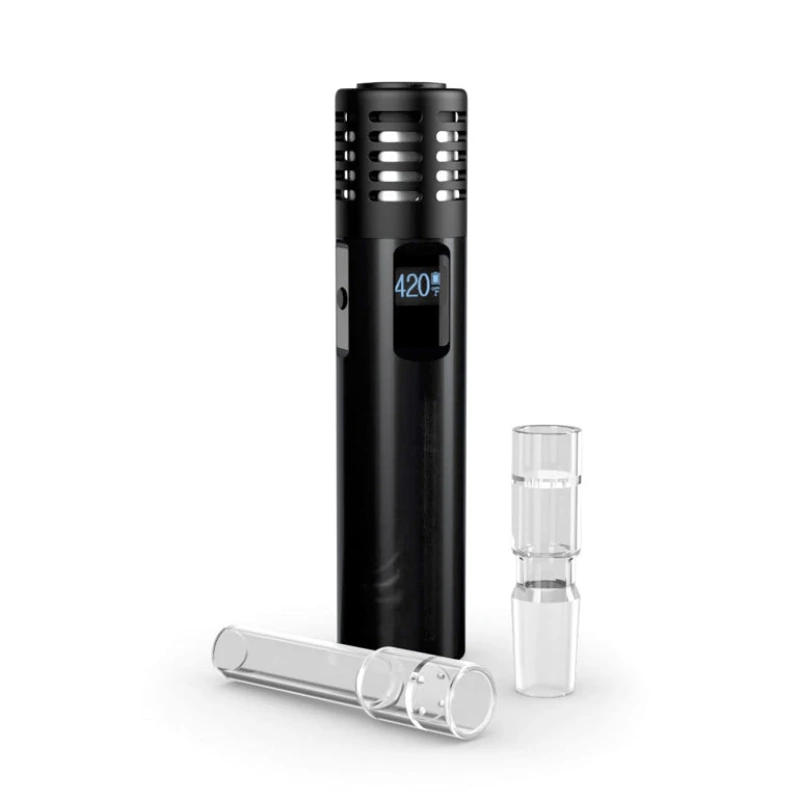
The Air MAX comes in simple packaging. No frills, no marketing insert. Inside is the device itself, two glass handles (short and long), a USB-C cable, a cleaning brush and the instructions. Done.
What is immediately noticeable: the weight. Or rather, the lack of weight. 102 grams — that’s lighter than most smartphones. You quickly forget that you have it in your jacket pocket. The workmanship is unobtrusive and solid. No creaking, no wobbling, but also no premium feeling like a Mighty+ or Venty. The housing is matt plastic, the buttons react directly.
The OLED display shows temperature and battery level. Operation: Click five times to switch on, arrow keys for the temperature, done. No app, no Bluetooth, no firmware updates. Some will see this as a disadvantage. I honestly find it refreshing — a vaporizer doesn’t have to be a smartphone.
The glass stem system: Arizere’s unique selling point
Here you have to briefly explain what Arizer does differently than almost everyone else. With the Air MAX, the herb is not stuffed into a chamber, but rather loaded into the glass stem. The glass stem is then inserted into the device from above. Arizer users have known the principle since the original Solo from 2011 – and that’s exactly why it has such a loyal fan base.
The idea behind it is simple: the vapor path should be as neutral as possible. No stainless steel heat sink, no plastic mouthpiece, no silicone hose. Just borosilicate glass — the same material that makes laboratory equipment and chemical flasks. Heat-resistant, chemically inert, tasteless.
What’s the point?
- Taste: Glass is tasteless. No plastic, no silicone, no metal in the vapor path. The steam tastes like the herb smells. Dot.
- Cleaning: Place the glass stem in isopropanol, done. Cleaner than any other solution.
- Dosage: The glass stem holds approximately 0.1 to 0.15 g. Not much, but enough for one session.
- Precharge: Prepare several glass stems and take them with you. Change session = change style. Takes three seconds.
And what’s annoying?
Glass breaks. It’s that simple. There are hundreds of posts on r/vaporents from people who have dropped their Arizer glass stems. The 11 cm mouthpiece protrudes from the top of the device – with the stem inserted, the Air MAX is not a device for the tight pockets of your pants. Arizer sells replacement stems for a few dollars, and third-party vendors also offer them. You get used to having a supply.
Still: In online communities, the glass stem system is one of the most cited reasons why people stay with Arizer. “Glass is class” is no coincidence as a running gag.
Steam quality: convection dominant and clean
The Air MAX heats hybrid. This means: The chamber is slightly preheated (conduction), but the majority of the heat comes from a controlled airflow (convection). Arizer calls this an “isolated airpath” — the incoming air only touches glass and ceramic before it passes through the herb.
What does that mean in practice?
First puffs at 170-180°C deliver aromatic, thin vapor. Here you can taste terpenes clearly and individually. Production increases significantly from 190°C, and at 200-210°C it becomes dense and filling. At 220 °C – the maximum temperature – you get the last bits out, but the taste becomes bitter and smoky.
In comparison to pure conduction vaporizers (Pax, DaVinci), the vapor is significantly less “roasted”. However, compared to premium convection devices like the Tinymight 2, the explosive on-demand character is missing. The Air MAX is a session vaporizer. You pull 10 to 15 times per glass stem, each pull becomes a little denser, and after 5 to 7 minutes the session is over.
The pull resistance is moderate. Not as open as a DynaVap, not as tight as a Crafty+. Slow, even strokes produce the best results. If you draw quickly, the chamber cools down and you get thin steam.
A detail that Arizer newbies sometimes overlook: the packing density in the glass stem has a huge impact on the airflow. Stuffed too tightly and it’s like pulling through a straw. Too loose and the air flows past the herb instead of through it. The sweet spot is when you press lightly – the herb should sit loosely, but not fall out when you turn the stem over. After three or four sessions you get the hang of it.
One more word about efficiency: 0.1 to 0.15 g per glass stem doesn’t sound like much. It is too. But the convection-dominant heating means the herb is extracted more evenly than in many conduction devices, which burn at the edge and do little in the middle. The ABV (Already Been Vaped) will look uniformly brown after an Air MAX session — a sign that the heat has been well distributed. You need less material per session and still get a full effect.
Akku: The removable battery advantage
This is where the Air MAX stands out from the crowd. Most portable vaporizers in this price range have built-in batteries. The Air MAX uses a standard 18650 battery that can be changed in seconds.
Why is this relevant?
F-installed batteries noticeably lose capacity after 300 to 500 charging cycles. With daily use, this will happen after one to two years. Then you have a device that only lasts half as long – and a battery that you can’t easily replace. The Mighty+ costs 250+ euros and has exactly this problem.
With the Air MAX you buy a new 18650 battery for 8 euros and have full performance again. Additional batteries cost just as little. If you’re on the go a lot, you can plug in two charged batteries and have power for the whole day. This is a real argument in the sustainability debate surrounding electronics.
One point that is important: The Air MAX does not support passthrough charging. So you can’t use it while it’s charging. Plug it in, wait, then steam. With the removable battery this is less of a problem – you simply take the second one.
The charging time via USB-C is around 2.5 hours for a full charge. The running time per battery is sufficient for approximately 60 to 75 minutes of active vaping, depending on the temperature. It lasts longer at low temperatures (170 °C) and shorter at 220 °C. Logical.
If you’re wondering which 18650 you should buy: Samsung 30Q, Sony VTC6 or LG HG2 are the classics. All three have around 3000 mAh and enough power. Stay away from cheap no-name cells from the marketplace – they can be dangerous. There are regular warnings about counterfeits in vaping forums, and you don’t want to take any risks with a device that you hold to your mouth.
An external charger (Nitecore, XTAR or similar) is a sensible investment. This allows you to charge the battery outside of the device while you vape with the second one. Costs around 15 euros and extends the life of the batteries because the charging electronics work more precisely than internal charging via USB-C.
80 second heat-up time: deal-breaker or doesn’t matter?
You have to say this clearly: 80 seconds is long. Really long compared to the competition. An XMAX V4 Pro can do this in 11 seconds. A Venty in 20. A DynaVap with induction heater in 8.
Who is this a problem for?
For anyone who wants to take a quick train. Between meetings, on the balcony in the rain, during a smoke break. 80 seconds then feel like an eternity. This is the Air MAX’s biggest weakness, and Arizer seems to be conscious of it.
Who cares?
For session vapers. If you sit on the couch in the evening, Switch on the Air MAX and then vape in peace for 10 minutes, you will hardly notice the heat-up time. You press the button, get the glass stem ready, and when you’re done, the device beeps. In this scenario it doesn’t matter.
Arizer has obviously decided to sacrifice heat-up time for taste and efficiency. Whether that was the right decision depends on how you vape.
Air MAX vs. Solo 3: Which Arizer is better?
The question keeps coming. Both are from Arizer, both use glass stems, both cost similar. So what makes them different?
| Feature | Air MAX | Solo 3 |
|---|---|---|
| Weight | 102 g | ~160 g |
| Abattery | Replaceable (18650) | Fixed (3500 mAh) |
| Heating time | ~80 seconds | ~25 seconds |
| Max. Temperature | 220 °C | 220 °C |
| Heating principle | Hybrid (convection-dominant) | Hybrid (convection-dominant) |
| Passthrough | No | Yes |
| USB-C | Ja | Ja |
| Price | ab ~82 € | ab ~125 € |
The Solo 3 heats up three times faster. Has passthrough charging. Feels more valuable with its metal housing. And costs around 40 to 50 euros more.
The Air MAX is lighter, cheaper and has a removable battery. The latter is not a small detail. In three years, when the Solo 3 battery dies, the Air MAX user simply plugs in a fresh 18650.
My impression: If you mainly vape at home, you’re better off with the Solo 3 – faster heat-up time and passthrough are worth their weight in gold. If you travel a lot and are concerned about weight, choose the Air MAX. The removable battery gives you flexibility that the Solo 3 cannot offer.
Steam quality? Almost identical. Both use the same glass stem system, both deliver pure, aromatic vapor. If you test blindly, you will hardly taste any difference.
A scenario that clearly prefers the Air MAX: festivals, camping, multi-day trips without a power outlet. Three charged 18650 batteries weigh a total of 135 grams and are enough for 180+ minutes of vaping time. The Solo 3 would be empty after a charge, and without a power outlet it would remain empty. The Air MAX will continue to run as long as you have batteries with you.
The other way around: If you mainly use the vaporizer at your desk or on the couch, you will benefit from the passthrough of the Solo 3. Plug in the cable, vape, and charge the battery at the same time. This is real non-stop couch steaming.
Cleaning and care: Arizere’s strongest argument
Cleaning
vaporizers is usually annoying. Brush out chambers, replace screens, soak mouthpieces. The Air MAX eliminates most of this.
Why? Because the herb sits in the glass stem, not in the device. After the session, you tip out the stem and you’re done. The ABV (Already Been Vaped) falls out, a short blow removes the rest. The chamber in the device itself remains almost completely clean because the herb has no direct contact.
Once a week, place the glass stems in isopropanol (90% or higher). Rinse after 30 minutes and let dry. The stems look like new. The sieve on the glass handle can be cleaned with a needle or the brush provided.
The chamber in the device itself rarely needs attention. A Q-tip with a little isopropanol every few weeks to remove any residue. Not more. Compared to direct chamber loading devices (Crafty+, Pax, DaVinci), the Air MAX is a maintenance dream.
A tip from the community: Store a glass stem with a little condensate as a “honey stem”. The condensate collects over many sessions and can be used later. Some users swear by it.
Another practical tip: The sieves on the glass stem get clogged at some point. You can notice this because the draw resistance increases and the vapor becomes thinner. Inserting a new sieve or soaking the old one in ISO solves this immediately. Arizer screens are standard 10mm — cheap and available everywhere. Some users replace the screens every two weeks, others every two months. Depends on how often you steam and how finely the material is ground.
On the go: Compact, but with limitations
The Air MAX itself is small. 10.5 cm high, 2.5 cm diameter — slightly larger than a thick highlighter. It fits easily in your trouser pocket. But: The glass stem sticks out at the top. With the handle inserted, the device is not suitable for pocketing. You have to transport the handle separately.
Arizer includes a short handle that protrudes less. Some users also buy the “short” stems with a silicone cap that close the glass stem flush. This means the whole thing fits better in your pocket.
What works well in everyday life:
- Take two to three glass stems pre-loaded in a glasses case
- Device in jacket pocket, handles in backpack
- Pack a spare battery (weighs 45g)
- Session, insert the stem, wait 80 seconds, steam
Start
What doesn’t work so well: discretion. The glass stem sticks out, steam is visible, and the device smells of herbs. If you want to vape inconspicuously, you’re better off with a pen-style or a device with a closed chamber.
Compared to a DynaVap (which requires a torch or IH), the Air MAX is still more practical. Press the button, wait, go. No lighter, no clicking, no turning. Simply electronic – with the disadvantages that this brings (battery, heating time).
A realistic scenario for on the go: hike, afternoon break on a bench. Put on your backpack, take out the Air MAX and the glass stem, insert the stem, turn it on, enjoy the view for 80 seconds, vape. No stress with wind and lighters like with the DynaVap. No charging cable necessary because the spare battery is in the side pocket. Then tap out the stem, put the cap on it and put it back in the case. The whole thing takes eight minutes. This is how most Air MAX owners use their device outside.
In cold weather (below 5°C), all lithium-ion batteries lose performance. The removable battery also helps here: keep the battery in your warm trouser pocket and only use it shortly before the session. You don’t have this option with a permanently installed battery.
Who is the Air MAX for?
The Air MAX fills a specific niche. It’s not the best device for on-demand users (it’s too slow). Not the best for intensive vapers (the chamber is too small for that). Not the best for quality fanatics with a big budget (there’s the Tinymight 2 or Venty for that).
But it’s damn good for people who have the following priorities:
- Pure taste — glass stem = most neutral vapor path on the market
- Lurability — removable battery means the device will still work the same in five years
- Easy cleaning — empty the glass stem and soak, that’s it
- Low budget — from €82 for a branded device with proven technology
- Light weight — 102g for a full-fledged session vaporizer
In the r/vaporents community, Arizer is regularly described as “boring but reliable”. This fits the Air MAX perfectly. It doesn’t do anything particularly exciting, but it does everything reliably. Arizer devices are known for lasting for years — the company long had a lifetime warranty, but now it’s two years.
What is also emphasized again and again in forums: Arizer has one of the best customer services in the industry. Even with devices that are out of warranty, users report that Arizer responds accommodatingly. For an 82 euro device, this is a safety net that should not be underestimated. No other manufacturer in this price range has a comparable reputation.
Temperature tips: Three scenarios for everyday life
The temperature range of 50 to 220 °C sounds huge on paper. In practice, the temperature is between 170 and 210 °C. Nevertheless, it is worth knowing three typical settings:
Flavor session (170-185°C): Little visible vapor, but maximum flavor. Terpenes evaporate at low temperatures and deliver the full aroma. Ideal for fresh, high-quality material. Two to three puffs are enough to recognize the flavor notes. Many users start here and work their way up.
All-round session (190-200°C): The gold zone. Good vapor production, decent taste, efficient extraction. This is where you spend most of your time. A glass stem load lasts 10 to 12 hits before the herb is finished.
Maximum extraction (205-220°C): Dense vapor, less flavor, strong effect. Good for the end of a session when you want to get the last active ingredients out of the material. Not ideal as a starting setting – the herb quickly tastes burnt at these temperatures.
An often recommended workflow: First two pulls at 180 °C, then turn up to 195 °C, last three pulls at 210 °C. This way you get the flavor and effect out without needing a new batch. The Air MAX remembers the last temperature – you don’t have to reset it every time.
Weaknesses in detail
No test without honest criticism. Here are the points that bother you:
- 80 seconds heating time: This is no longer up to date in 2026. Other devices in this price range can do this in under 20 seconds.
- No passthrough charging: Device must be off to charge. No vaping at the socket.
- No app: An advantage for some, a disadvantage for tech fans. Session timers, temperature profiles, usage statistics — none of it included.
- Glass Stem Fragility: Glass breaks. Replacement handles cost little, but the breakage is still annoying.
- No Dosing Capsules: No capsule system like Storz & Bickel. The glass stem partially replaces this, but not completely.
- Small chamber: 0.1-0.15g per stem. If you want larger quantities, you have to reload several times.
Strengths at a glance
- Removable battery (18650): Battery empty? Changed in 5 seconds. Declining after years? New battery for 8 euros.
- Glass stem = pure taste: No other material in the vapor path comes close to glass.
- 102 g Weight: Lightest Arizer ever. Lighter than most competitors.
- Insulated air path: Glass and ceramic only — no plastic or silicone notes.
- Low maintenance: Insert the glass stem into the iso, rinse, done.
- Price: From €82 at over 110 shops — very fair for a branded device from Canada.
- 50-220 °C Temperature range: Adjustable to the exact degree. Wide range for different preferences.
Technical data
| Specification | Arizer Air MAX |
|---|---|
| Manufacturer | Arizer (Canada, since 2003) |
| Type | Portable session vaporizer |
| Heating principle | Hybrid (convection dominant) |
| Temperature range | 50-220°C (accurate to the degree) |
| Heating time | ~80 seconds |
| Akku | Replaceable, 18650 Li-Ion |
| Runtime | ~60-75 minutes |
| Charging | USB-C (~2.5 hours) |
| Passthrough | No |
| Weight | 102 g (without glass stem) |
| Dimensions | ~10.5 × 2.5cm |
| Display | OLED |
| Mouthpiece | Glass stem (11 cm aroma tube) |
| Air path | Insulated (glass + ceramic) |
| Dosing Capsules | No |
| App | No |
| Waterpipe | Yes (with WPA adapter) |
| Warranty | 2 years |
| Price | from ~82 € (110+ shops) |
Conclusion: Reliable, puristic, affordable
The Arizer Air MAX isn’t a device that makes headlines at tech events. No fancy app, no record-breaking heat-up time, no eye-catching design. What it offers instead: pure taste through glass, a removable battery that makes the device future-proof, and cleaning that takes under a minute.
If you want fast on-demand hits, buy a DynaVap or Tinymight 2. If you’re looking for a premium session experience and are willing to pay more, check out the Venty or Mighty+. But if you’re looking for a light, uncomplicated everyday device with a replaceable battery and the cleanest vapor path in this price range – the Air MAX is the right choice.
82 euros for a device that will work just as well in five years as it did on day one. Because you can change the battery. Because glass doesn’t age. Because there is simply nothing that can break – except the glass stem. And it costs five euros.
In an industry that releases a new “revolutionary” device every six months, the Air MAX is refreshingly boring. Arizer has been refining, not refining, the glass stem system for over a decade. Anyone who has invested in this system – handles, WPA adapters, replacement screens – can continue to use all of this with the Air MAX. This is sustainability that isn’t on the packaging, but you can feel it.
That’s not an exciting conclusion. But an honest.
→ Arizer Air MAX price comparison: Compare current prices at 110+ shops
Frequently asked questions about the Arizer Air MAX
Which battery does the Arizer Air MAX need?
A standard 18650 battery. They are available in every electronics store or online for 5 to 10 euros. Important: Use high-current cells (at least 10A continuous load). Brands like Samsung, Sony/Murata or LG are recommended. Arizer itself also sells suitable batteries.
Can you use the Air MAX while it is charging?
No. The Air MAX does not support passthrough charging. You have to wait until the battery is charged. Thanks to the removable battery, this is hardly a problem – simply insert a second battery.
How is the Air MAX different from the Air SE?
The Air SE is the entry-level model with a smaller battery and less temperature precision. The Air MAX has a more powerful battery (18650 replaceable), more precise temperature control (accurate to the degree, 50-220 °C) and an OLED display. If you’re serious, take the MAX.
Do solo glass stems fit the Air MAX?
Yes and no. Solo stems have a larger diameter than Air stems. They don’t fit directly into the Air MAX. But: There are universal handles from third-party providers that fit both device lines. Arizer Original stems are specific to Air or Solo.
Is the Air MAX hookah compatible?
Yes. There are WPA (Water Pipe Adapter) adapters for the Air MAX that fit 14mm or 19mm pipes. Some third-party providers also offer glass stems that function directly as corrugators. Using a water pipe makes the steam cooler and softer – a noticeable difference, especially at high temperatures.
How long does a glass stem last?
Theoretically eternal – glass does not age and does not affect the taste. Practical until the first fall on tiles. Replacement stems cost between 5 and 10 euros. If you are careful, a glass stem will last for years. A supply of 3 to 5 stems is still useful, just for convenience.
Is the Arizer Air MAX worth it for beginners?
Absolutely. The price starting at €82 is fair, the operation is uncomplicated (no need for an app, no complicated menu structure), and cleaning is extremely easy. The only point that can irritate beginners: the 80 second heat-up time. Anyone who knows this beforehand and has no problem with it will get a long-lasting entry-level device with pure taste.
How loud is the Air MAX?
Quasi silent. There is no fan and no motor. The only noise comes from the humming of the heating electronics – barely audible and only noticeable in absolute silence. Compared to devices like the Plenty, which have an audible fan, the Air MAX is whisper quiet.