Table of Contents
- How does convection work?
- What does hybrid heating do differently?
- How do conduction, convection and hybrid compare?
- Which heating method suits your needs?
- Should you choose session or on-demand?
- Why is temperature more important than the heating method?
- How do you maintain a conduction vaporizer?
- What typical mistakes do vaporizer users make?
- What should you buy depending on the heating method?
- What are the biggest myths about heating methods?
- Which accessories suit which heating method best?
- Which heating method should you choose?
- Which vaporizers are the best for each heating method?
- Which scientific studies support these findings?
- Frequently asked questions
How does convection work?
With convection, it is not the chamber that gets hot, but the air. When you inhale, hot air flows through your material and carries the active compounds with it. You might know it from a fan oven – same idea.
The good thing: Even heat from all sides. Better flavour, more efficient extraction. The Tinymight 2 or Firefly 2+ deliver really good vapor. For flavour nerds, convection is usually the first choice.
The problem: More expensive, slower to heat up (30–60 seconds), and you need the right draw technique. Drawing too fast? Too little vapor. Too slowly? It overheats. There is a learning curve.
What does hybrid heating do differently?
Hybrid vaporizers combine both methods: the chamber is lightly preheated (conduction) and, when you inhale, hot air also flows through it (convection). Fast heat-up plus good flavour.
Storz & Bickel has been doing this for years: Mighty+, Crafty+, Venty. The Arizer Solo 2 also works with a hybrid system. These devices are often the recommendation for beginners – straightforward and still with good results.
Disadvantage: The complexity costs money. Hybrid vaporizers are rarely cheap. And cleaning can be more annoying because both the chamber and the air path get dirty.
How do conduction, convection and hybrid compare?
| Conduction | Convection | Hybrid | |
|---|---|---|---|
| Heat-up time | 20–30 sec. | 30–60 sec. | 20–40 sec. |
| Flavour | Good | Excellent | Very good |
| Efficiency | 70–85 % | 80–95 % | 85–95 % |
| Price | 50–150 € | 200–400 € | 150–350 € |
| Learning curve | Low | Medium | Low |
| On-demand possible | Rarely | Yes | Partly |
Which heating method suits your needs?
Tight budget, but need something reliable? Conduction. The XMAX V3 Pro for under 100 € is solid. Sure, you have to stir, but in return it is ready quickly and lasts a long time.
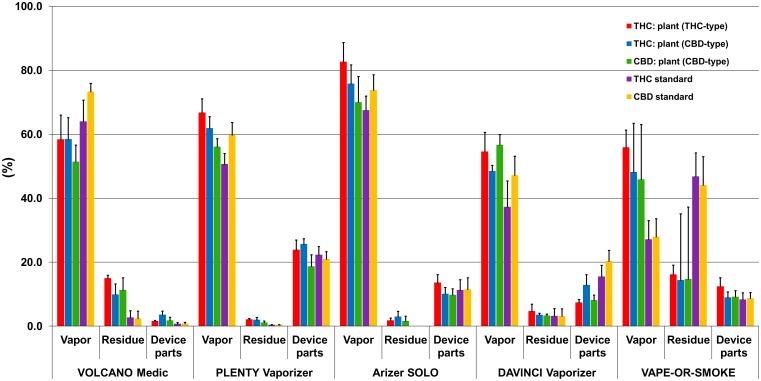
Source: Lanz et al. (2016), PLOS ONE, CC-BY 4.0
Is flavour the most important thing to you? Convection. Tinymight 2, Firefly – here you can taste every terpene. It costs more and needs practice, but the flavour is worth it if that matters to you.
Do you just want something that works? Hybrid. Mighty+ or Crafty+ are popular for a reason. Expensive, yes, but you get good vapor without having to think too much. Switch on, wait, vape.
Should you choose session or on-demand?
Session or on-demand is directly linked to the heating method. Conduction vaporizers are almost always session devices. You switch it on, vape for 5–10 minutes, empty the chamber. Switching it off in between does little – the chamber stays hot and your material keeps vaporising.
Convection can be on-demand: it only heats while you inhale. One draw now, one in an hour, no problem. Often more practical for microdosers and occasional users. Material is not wasted.
Hybrid devices are usually also session-based, but more efficient than pure conduction. The preheated chamber helps at the start, the hot-air flow ensures even extraction.
Why is temperature more important than the heating method?
In the end, temperature control matters more than the heating method alone. Good conduction vaporizers with precise control significantly reduce the main problem (uneven heat).
With convection, the temperature is more stable, but the airspeed affects the result. Fast draw = cooler air reaches the material. Slow draw = more heat.
Hybrids benefit from both effects: the chamber maintains the base temperature, the airflow adds to it. Less dependent on draw technique than pure convection.
Boiling points of important active compounds
| Compound | Boiling point | Effect |
|---|---|---|
| THC | 157 °C | Psychoactive, analgesic |
| CBD | 160–180 °C | Anti-inflammatory, calming |
| CBN | 185 °C | Sedating |
| Myrcene | 167 °C | Relaxing |
| Limonene | 177 °C | Mood-lifting |
| Linalool | 198 °C | Calming |
How do you maintain a conduction vaporizer?
Conduction devices need more frequent cleaning than convection models because direct contact leaves more residue. Brush out the chamber after every session, clean thoroughly with isopropyl alcohol every 5–10 sessions. Check wearing parts such as seals and O-rings regularly – heat makes them brittle over time.
Optimal temperature strategy
| Phase | Temperature | Result |
|---|---|---|
| Start | 175–185 °C | Terpenes, flavour |
| Middle | 185–195 °C | Balanced effects |
| End | 195–210 °C | Complete extraction |
Medium-fine grind – not too fine (clogs), not too coarse (uneven). Draw slowly and evenly, about 10–15 seconds per draw.
What typical mistakes do vaporizer users make?
The most common problems are easy to avoid:
Conduction
| Problem | Cause | Solution |
|---|---|---|
| Burnt flavour | Temperature too high, packed too tightly | Lower temperature, pack more loosely |
| Little vapor | Packed too loosely, temperature too low | Pack more firmly, raise temperature |
| Uneven discolouration | Material not stirred | Stir regularly |
Convection
| Problem | Cause | Solution |
|---|---|---|
| No vapor despite heat | Drawing too fast | Draw more slowly and evenly |
| Vapor too hot | Short vapor path | Water filter or longer mouthpiece |
| Flavour fades | Screens clogged | Clean or replace screens |
What should you buy depending on the heating method?
Recommendations by budget
| Budget | Conduction | Convection | Hybrid |
|---|---|---|---|
| Under 100 € | XMAX V3 Pro | — | — |
| 100–200 € | PAX Mini, DaVinci Miqro | Arizer Solo 2 | POTV Lobo |
| 200–300 € | PAX Plus | Tinymight 2, Firefly 2+ | Crafty+ |
| Over 300 € | — | Volcano Classic | Mighty+, Venty |
Choose conduction if your budget is limited, if you prefer session-based vaping and are looking for compact devices with simple operation.
Choose convection if flavour is the top priority, you want on-demand use and you are willing to learn the draw technique.
Choose hybrid if you want the best of both worlds, have the budget for a premium device and simply want good vapor without stress.
For newcomers, we often recommend a mid-range hybrid vaporizer (e.g. Crafty+ or POTV Lobo). If your budget is limited, the XMAX V3 Pro or PAX Mini offer a solid entry point.
What are the biggest myths about heating methods?
Four misunderstandings persist stubbornly:
Myth 1: “Convection is always better.” Not across the board. High-quality conduction devices such as the PAX Plus or DaVinci IQ2 also deliver good results. The best method depends on your own priorities.
Myth 2: “Hybrid vaporizers are just marketing.” Devices such as the Mighty+ genuinely combine both heating methods – the conduction component ensures fast heat-up, convection ensures even extraction.
Myth 3: “Cheap conduction vaporizers burn the material.” Even inexpensive devices with sensible temperature control vaporise reliably. Proper use is decisive: do not start too hot, do not pack too tightly.
Myth 4: “Convection always takes a long time to heat up.” Modern on-demand devices such as the Tinymight 2 heat up in under 5 seconds.
Which accessories suit which heating method best?
Conduction: Dosing capsules simplify handling and reduce cleaning effort. Replace screens regularly. A cleaning kit with brushes and isopropyl alcohol is basic equipment.
Convection: A water pipe adapter (WPA) cools the vapor. Glass stems in different lengths make it possible to adjust the vapor temperature. Pre-filled dosing tubes are practical for travelling.
Universal: Boveda packs keep material at the optimal 62 % humidity. A storage bag offers protection and discretion.
Which heating method should you choose?
There is no “best” heating method – only the right one for your situation. If you need something cheap and quick while out and about: conduction. If you have time at home and want flavour: convection. If you simply want good vapor without stress and have the budget: hybrid.
In the end, what matters is finding a vaporizer you enjoy using. Try different methods if you can – many people eventually have more than one vaporizer, for different situations.
Which vaporizers are the best for each heating method?
Best conduction vaporizers: PAX Plus, DaVinci IQ2, XMAX V3 Pro, Boundless CFX
Best convection vaporizers: Tinymight 2, Firefly 2+, Elev8R
Best hybrid vaporizers: Mighty+, Crafty+, Venty, Arizer Solo 2
Which scientific studies support these findings?
- Lanz, C. et al. (2016). Medicinal Cannabis: In Vitro Validation of Vaporizers for the Smoke-Free Inhalation of Cannabis. PLoS ONE, 11(1), e0147286. PubMed 26784441
- Hazekamp, A. et al. (2006). Evaluation of a Vaporizing Device (Volcano) for the Pulmonary Administration of Tetrahydrocannabinol. Journal of Pharmaceutical Sciences, 95(6), 1308–1317. PubMed 16637053
- Pomahacova, B. et al. (2009). Cannabis Smoke Condensate III: The Cannabinoid Content of Vaporised Cannabis sativa. Inhalation Toxicology, 21(13), 1108–1112. PubMed 19852551
- Wang, M. et al. (2016). Decarboxylation Study of Acidic Cannabinoids. Cannabis and Cannabinoid Research, 1(1), 262-271. DOI 10.1089/can.2016.0020
Related articles: Best Convection Vaporizers · Best Conduction Vaporizers · Best Hybrid Vaporizers · Best Session Vaporizers
Frequently asked questions
Which is better: conduction or convection?
Convection delivers better flavour and more even extraction. Conduction is cheaper and simpler. Hybrid combines both — the choice depends on budget and priorities.
Which heating method for beginners?
Conduction or hybrid. Conduction vaporizers are straightforward: switch on, wait, vape. Pure convection requires draw technique.
Why are convection vaporizers more expensive?
The technology is more complex. Hot air has to be guided precisely through the material, which requires more complex constructions.