Ball Vape Buying Guide: Which Balloon Vaporizer Fits?
At a glance
Ball vapes are among the hardest-hitting desktop vaporizers you can buy. The concept: small balls made of ruby, stainless steel or glass get heated up and placed onto a bowl. The stored heat vaporizes your herb – often in a single draw. Prices start around 23 euros for basic kits, while complete setups run between 150 and 400 euros. If you want dense convection hits and don’t mind a desktop device, ball vapes are a world of their own.
What is a ball vape?
A ball vape is a convection vaporizer that uses heated balls instead of a traditional heating chamber. Hundreds of small balls get heated up – usually by an induction coil or an industrial heating element. Once hot enough, they sit on top of a bowl filled with herb while you pull through a water piece.
The concept isn’t new. DIY enthusiasts have been building their own ball vape setups for years, often using heat guns and improvised holders. Today there are finished products from over a dozen manufacturers – from simple DIY kits to precision-engineered titanium devices costing 500 euros and up.
Why balls?
The balls provide a huge surface area in a small volume. Hot air flows between them and picks up an enormous amount of heat in the process. The result: air hitting the herb is uniformly hot. No cold spots, no uneven heating. On top of that, the thermal mass means temperature barely drops even during hard draws.
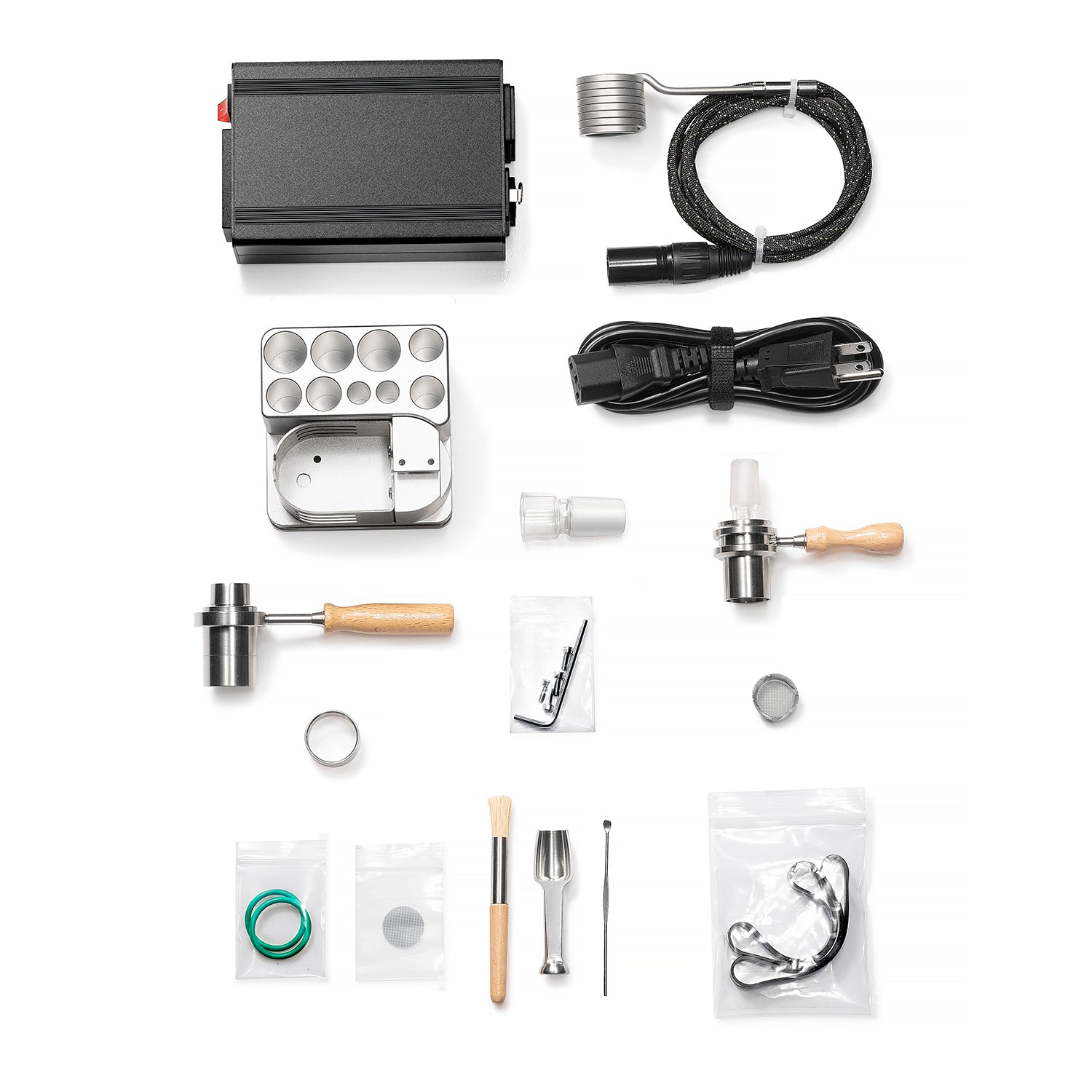
How does a ball vape work?
The process is similar across most ball vapes:
- Heat up: The balls get heated in a coil or heating element. Most devices use a PID controller for automatic temperature regulation.
- Load the bowl: Fill the bowl with herb and place it on a water piece (bong, bubbler).
- Place the balls: The injector head with the hot balls goes on top of the bowl.
- Draw: The suction pulls air through the hot balls, heating it up to vaporize the herb below.
The key difference from conventional vaporizers: heat doesn’t come from a fixed element but is stored in the balls and released on demand. This makes ball vapes extremely efficient – but also different to handle.
Wired vs. wireless
Ball vapes come in two basic variants. The differences are significant, and the choice depends heavily on how you want to vape.
Wired ball vapes
With wired models, the balls sit directly in a heating element that’s permanently connected to power. The advantage: balls are continuously reheated. You can take as many hits as you want without waiting. Models like the Taroma 3.0, the FlowerPot B2 or the Herborizer XL have the heating element sitting right on the bowl – plug in, heat up, start drawing.
This is the more common variant. Most ball vapes on the market are wired, and for the majority of users it’s the better choice. More bowl flexibility, longer sessions, no recharging between hits.
Wireless ball vapes
Wireless models like the WOHW by Crossing Tech work differently: the balls are heated in a separate charging station and then removed. You carry the hot injector head to your bowl, place it on top and draw. Afterwards it goes back to the station for recharging.
Sounds cumbersome, but there’s a clear advantage: no cable. Your water piece can sit anywhere, and you don’t need to be near an outlet. Downside: the stored heat usually lasts for just one hit. Then you wait.
| Feature | Wired | Wireless |
|---|---|---|
| Hits per heat cycle | Unlimited | 1 (then recharge) |
| Sessions | Continuous | Pauses between draws |
| Bowl compatibility | Wide (permanent heat) | Limited (finite heat) |
| Mobility | Tethered to cable | Free around the house |
| Entry price | From ~100 euros | From ~170 euros |
| Typical brands | QaromaShop, Herborizer, Cannabis Hardware | Crossing Tech (WOHW) |
Materials: ruby, stainless steel, glass or titanium?
The balls come in different materials depending on the model. Each has its characteristics.
Ruby balls
Synthetic ruby balls (usually from GemCat or Bodhi) are the standard for most ball vapes. They store heat excellently and release it evenly. Ruby balls are chemically inert – they don’t react with heat or vapor and are taste-neutral. Common sizes: 3 mm to 6 mm diameter. Smaller balls have more relative surface area, larger ones store more heat per ball.
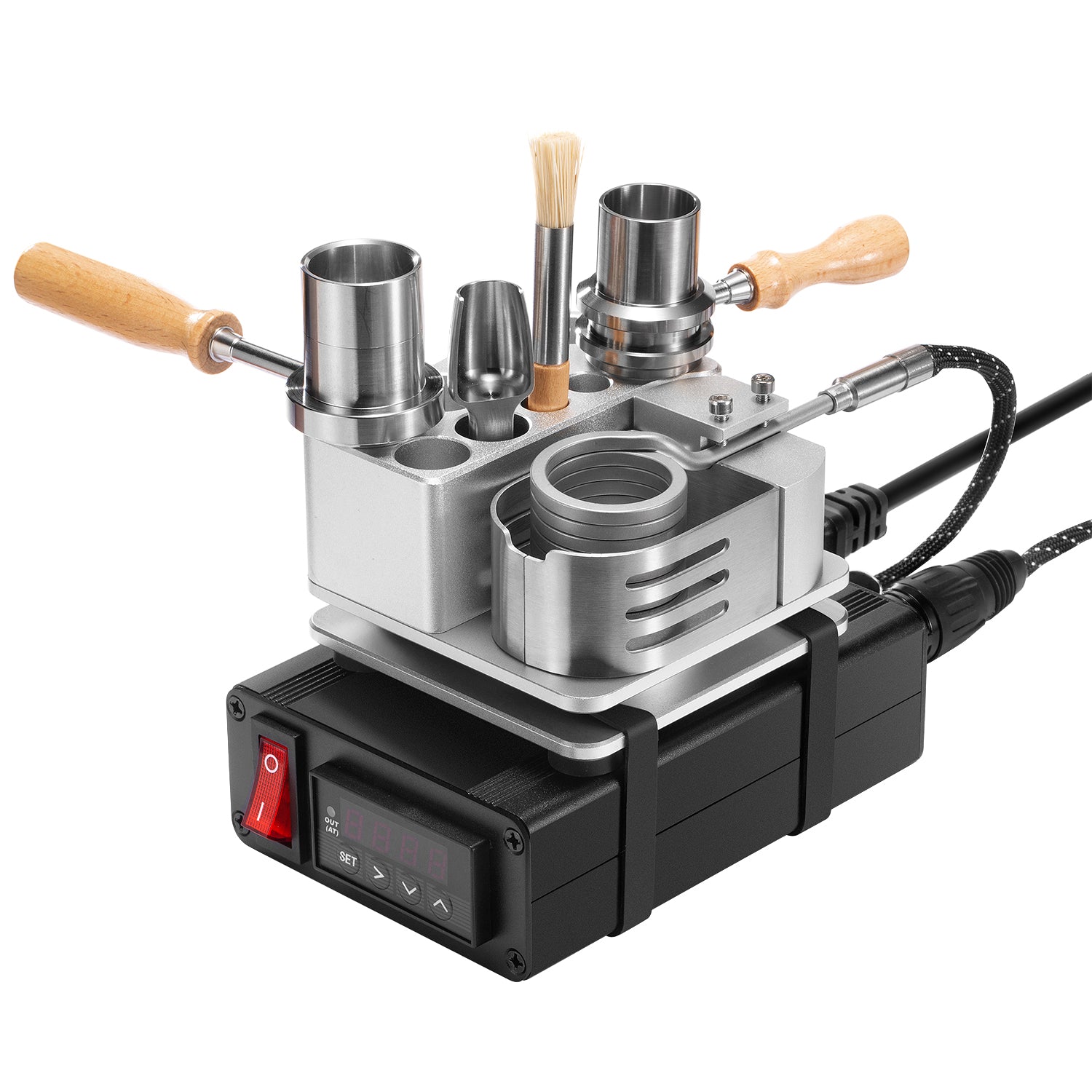
Stainless steel balls
Cheaper than ruby, heavier and with slightly higher thermal mass per ball. Stainless steel (SS316) is often offered with entry-level models or as an alternative. Some users report a minimal metallic taste during the first few uses – it goes away after a few sessions.
Glass balls
Less common, but some manufacturers like 7th Floor offer them. Glass is taste-neutral but stores less heat than ruby. A niche product for most people.
The housing
Beyond the ball material, the housing matters too. Titanium is light and heats up fast. Stainless steel is heavier and stores additional heat – but may impart flavor initially. Glass is taste-neutral but fragile. High-end devices from Herborizer or QaromaShop typically use borosilicate glass or titanium housing.
Injector vs. showerhead: two approaches, one goal
Many ball vapes can operate in two modes – or the manufacturer offers different head variants from the start.
Injector mode: The hot balls sit higher up, airflow is directed downward through an opening. This produces a more concentrated, directed heat stream. Often slightly smoother vapor, easier to dose.
Showerhead mode: The balls sit closer to the herb, heat spreads broadly across the entire bowl surface. More vapor, more even extraction, but also more intense. QaromaShop models (Taroma, Qaroma, Ceroma) use this as their default configuration.
Which mode works better is a matter of preference. Beginners should start with showerhead mode – it’s more forgiving with draw technique.
What do you need to get started?
A ball vape alone isn’t enough. You’ll need a few additional things, which may or may not be included in your kit.
| Component | Function | Included in kit? |
|---|---|---|
| Ball vape head | Holds the balls, gets heated up | Yes (always) |
| Bowl / herb screen | Holds the herb, sits on the water piece | Usually yes |
| Heating coil / PID controller | Heats the balls to the desired temperature | Usually yes (in complete kits) |
| Water piece (bong/bubbler) | Cools and filters the vapor | Almost never |
| Glass adapter (14mm or 18mm) | Connects bowl to water piece | Often yes, sometimes extra |
The water piece is the most important separate purchase. Ball vapes produce hot, dense vapor – without water filtration it can be unpleasant. A simple bubbler for 20-30 euros does the job.
Glass joints are standardized: 14.4 mm and 18.8 mm (often called 14 mm and 18 mm). Most ball vapes come with one or both adapters. Make sure your water piece matches.
Key manufacturers
The ball vape market is smaller than portable vaporizers, but there are now over a dozen manufacturers. Here are the most relevant ones – sorted by entry price.
Crossing Tech (from ~18 euros)
The Chinese manufacturer has by far the broadest lineup. From budget heads like the Core 2.0 (from 67 euros) to the wireless WOHW (from 259 euros), Crossing Tech covers nearly every price segment. The WOHW is the only wireless ball vape with significant market presence. 18 models in the lineup.
QaromaShop (from ~119 euros)
Malaysian manufacturer specializing in high-quality borosilicate glass ball vapes. The Taroma series (Taroma Lite, Taroma 3.0, Taroma 360) is among the most recommended ball vapes in the community. 23 models total – lots of choice, but shipping from Malaysia with only one European retailer.
Herborizer (from ~70 euros)
French manufacturer with a long track record. Herborizer models (XL, Ti, Sphere XL) are beautifully crafted and available from several European shops. Price: 70 to 389 euros. Good availability across Europe.
Cannabis Hardware (from ~27 euros)
American manufacturer of the FlowerPot series. The FlowerPot B2 (from 549 euros) is considered one of the hardest-hitting ball vapes around – massive, heavy, no compromises. For a lower budget: the B0 starts at 375 euros, and the VMAX at 190 euros.
Other manufacturers
- 7th Floor – Known for the Elev8R (from 96 euros), one of the oldest ball vapes on the market
- Ditanium – Hybrid device combining ball vape and e-nail (Ditanium, from 251 euros)
- Camouflet – Portable ball vapes powered by butane (Injector, from 119 euros)
- Vapvana – Premium ball vapes like the Screwball (166 euros) and All-Star Wired (184 euros)
- Jaxels Art – The handcrafted VapBong FlavorMaster (490 euros) – ceramic art piece with cult following
Ball vapes by budget
The price range is enormous. Here’s what to expect at each level.
Under 100 euros: DIY and entry level
At this price you get standalone heads without heating – the PID controller, heating coil and water piece need to be sourced separately. Suited for tinkerers who already own equipment. The Elev8R (96 euros) is a classic entry point with butane heating.
100–250 euros: solid complete kits
This is where complete setups begin. The WOHW (from 259 euros) sits slightly above, but includes everything except the water piece. The Taroma Lite (289 euros) and L Sphere (119 euros) are solid mid-range options.
250–400 euros: premium class
The sweet spot for most users. The Taroma 3.0 (359 euros), the Herborizer XL (239 euros) and the FlowerPot B0 (375 euros) offer premium quality with good European availability.
Over 400 euros: high end
The FlowerPot B2 (549 euros), the VapBong FlavorMaster (490 euros) and the Qaroma XL (533 euros) are for enthusiasts who want the absolute best. Top materials, massive thermal mass, uncompromising vapor quality.
What to look for when buying
Ten points to consider before purchasing:
- Wired or wireless? Wired is the better choice for most people. Go wireless only if you truly need mobility around the house and can LIVE with one hit per charge cycle.
- Complete kit or individual components? Beginners do better with a complete kit. If you already have a PID controller or heating coil, a standalone head saves money.
- Check the glass joint. 14 mm or 18 mm? Must match your water piece. Some kits include both adapters.
- Buy a water piece separately. You’ll almost always need one. A simple bubbler is sufficient.
- Ball material. Ruby is the standard and safest choice. Stainless steel is cheaper, glass is niche.
- European availability. QaromaShop ships from Malaysia (customs + wait time), while Herborizer and many Crossing Tech models are available from European shops with fast shipping.
- PID controller quality. Budget kits often come with basic industrial controllers in Fahrenheit. They work, but settings are fiddly.
- Replacement parts. O-rings, screens, balls – they all wear out eventually. Check availability before buying.
- Bowl size. Standard bowls hold 0.1 to 0.3 grams. Microdosers can find specialized small bowls.
- Space requirements. A ball vape setup needs more room than a portable vaporizer. PID controller, docking station, water piece – it won’t fit on a nightstand.
Frequently asked questions
Do I need a water piece?
Yes, practically speaking. Ball vapes produce very hot, dense vapor. Without water filtration it’s too harsh for most people. A simple bubbler for 20 to 30 euros makes all the difference.
How often do I need to replace the balls?
Essentially never. Ruby balls are extremely durable and don’t change from heat. Stainless steel balls may oxidize minimally after years but are also long-lasting.
Can I use concentrates in a ball vape?
Yes, many ball vapes can handle concentrates directly on the balls or with a concentrate pad. The Ditanium, for example, has an integrated e-nail. Others require a special quartz bowl or dab pad. But ball vapes are primarily designed for dry herbs.
How do I clean a ball vape?
Soak the balls and bowl in isopropyl alcohol, wipe the housing with a damp cloth. The balls themselves barely need cleaning – an occasional soak in isopropanol is enough. The bowl and screen get blown out or soaked as needed. Rinse the water piece after each session.
Is a ball vape loud?
No. The device itself makes almost no noise. The only sound you hear is the bubbling of your water piece while drawing. No fan, no vibration, no beeping.
Ball vape vs. Volcano: which is better?
Ball vapes deliver dense single-draw hits, the Volcano fills bags evenly — choose based on your preferred draw style. The Volcano fills bags with vapor – consistent, controlled, but slow. Ball vapes deliver vapor directly and instantly, with more control over intensity. Want a powerful hit: ball vape. Want to share bags casually: Volcano.
Specific recommendations
Best entry point: WOHW V2 (from 259 euros)
The Wireless One Hit Wonder by Crossing Tech is the easiest entry into ball vapes. Everything included except the water piece, no assembly needed. Wireless, compact, fairly priced. Limitation: one hit per charge cycle. Full WOHW review here.
Best all-rounder: Taroma 3.0 (from 359 euros)
The Taroma 3.0 by QaromaShop is one of the most recommended ball vapes in the community. Borosilicate glass, ruby balls, precise temperature control. Downside: ships from Malaysia, only one European retailer.
Best value: Herborizer XL (from 239 euros)
The Herborizer XL offers French quality at a reasonable price. Available from five European shops with short delivery times. Well-crafted, good support.
For maximalists: FlowerPot B2 (from 549 euros)
The FlowerPot B2 by Cannabis Hardware is for those who want the absolute maximum. Massive stainless steel construction, enormous thermal mass, works with virtually any bowl. Not cheap, but no compromises.
Bottom line: who should get a ball vape?
Ball vapes aren’t for everyone. They need space, a water piece and some interest in the technology. If you just want to switch on a portable on the couch and start vaping, you’re better off with a portable vaporizer.
But if you want hits that no portable device can match – if you’re willing to set up a small station and learn the technique – ball vapes open an entirely new dimension. Vapor quality is in a different league. Material efficiency too. And with prices starting at 100 euros for a usable setup, the barrier to entry is lower than you’d think.
Find all ball vapes with current prices in our price comparison.
Frequently Asked Questions
Do I need a water filter?
Yes, practically speaking. Ball vapes produce very hot, dense vapor. Without a water filter, it’s too harsh for most users. A simple bubbler for 20 to 30 euros makes all the difference.
How long does a ball vape take to heat up?
Wired models need 3 to 5 minutes to fully heat the balls. Wireless models like the WOHW heat the injector head in the charging station in about 60 seconds.
Can I use a ball vape without experience?
Ball vapes are more suited for experienced users. The vapor is very potent, and most models require a PID controller and water pipe setup. If you’re new, start with a portable vaporizer.
Ruby balls or stainless steel — which is better?
Ruby balls store heat better, are chemically inert, and completely flavor-neutral. Stainless steel is cheaper and heavier but may have a slight metallic taste initially. Ruby is the standard.
Which ball vape offers the best value?
The Crossing Tech Core 2.0 starting at 67 euros is the most affordable complete set. For a premium experience, the QaromaShop Taroma Lite at 119 euros is hard to beat.
Are ball vapes safe?
Yes, when used correctly. The balls are made of inert materials (synthetic ruby or food-grade stainless steel). Use a PID controller for precise temperature control and always use a water filter to cool the vapor.