Vaporizer vs Joints: The Scientific Comparison
Vaporizer vs Joints: The Scientific Comparison
In brief: Vaporizers and joints use the same plant – but the delivery method differs fundamentally. A joint burns cannabis at 600–900 °C, producing over 100 harmful compounds. A vaporizer heats to 160–230 °C, delivering up to 95% pure cannabinoids without tar or carbon monoxide. This article compares both methods based on current research, examines Europe’s widespread tobacco-mixing habit, and offers practical tips for switching.
Fundamental Difference: Combustion vs. Vaporization
What Happens with a Joint?
When cannabis burns in a joint, temperatures reach 600-900°C, releasing not just the desired cannabinoids but also numerous combustion byproducts. These include tar and particles similar to those found in tobacco smoke. Carbon monoxide is produced during incomplete combustion, and polycyclic aromatic hydrocarbons – substances considered potentially carcinogenic – are released as well.
What Happens with a Vaporizer?
Vaporizers heat cannabis to 160-230°C, well below the combustion point. Because there is no combustion, neither tar nor carbon monoxide is generated. The targeted extraction process releases only the desired compounds, while precise temperature control allows users to manage exactly which substances are activated at what point.
The Tobacco Question: Europe’s Joint Culture
Across Europe, 77–91% of all joints contain tobacco – a factor many discussions overlook. In Germany, France, or the Netherlands, rolling a joint almost always means mixing in tobacco. The consequences extend well beyond cannabis itself.
Double Dependency
Research shows that regularly mixing cannabis with tobacco increases the risk of nicotine dependence beyond that of tobacco-only smokers (Hindocha et al., 2017). The joint can serve as a gateway to nicotine addiction – especially for young users who never smoked cigarettes before. A vaporizer removes tobacco from the equation entirely.
Tobacco-Specific Toxins
On top of cannabis combustion byproducts, tobacco joints introduce tobacco-specific nitrosamines (TSNA) – classified carcinogens. Then there is nicotine, which raises heart rate and constricts blood vessels. A vaporizer uses cannabis only – no tobacco, no nicotine, none of these additional risks.
Health Aspects
| Aspect | Joint | Vaporizer |
|---|---|---|
| Tar | High | Minimal to none |
| Carbon monoxide | Significant | Undetectable |
| Airway irritation | Severe | Mild |
| Coughing | Frequent | Rare |
What the Studies Show
These table values reflect what multiple studies have confirmed. Hazekamp et al. (2006) analyzed Volcano vapor and found it consists of 95% cannabinoids – the remainder mostly terpenoids. Cannabis smoke, by contrast, contains over 100 different compounds including PAHs and benzene.
Earleywine and Barnwell (2007) surveyed over 6,000 cannabis users: vaporizer users reported 40% fewer respiratory symptoms such as coughing, shortness of breath, or phlegm. Loflin and Earleywine (2015) replicated these findings in a follow-up study.
Efficiency and Compound Yield
| Method | THC Bioavailability | Material Use |
|---|---|---|
| Joint | 20-30% | High |
| Vaporizer | 50-80% | Low |
Bioavailability in Detail
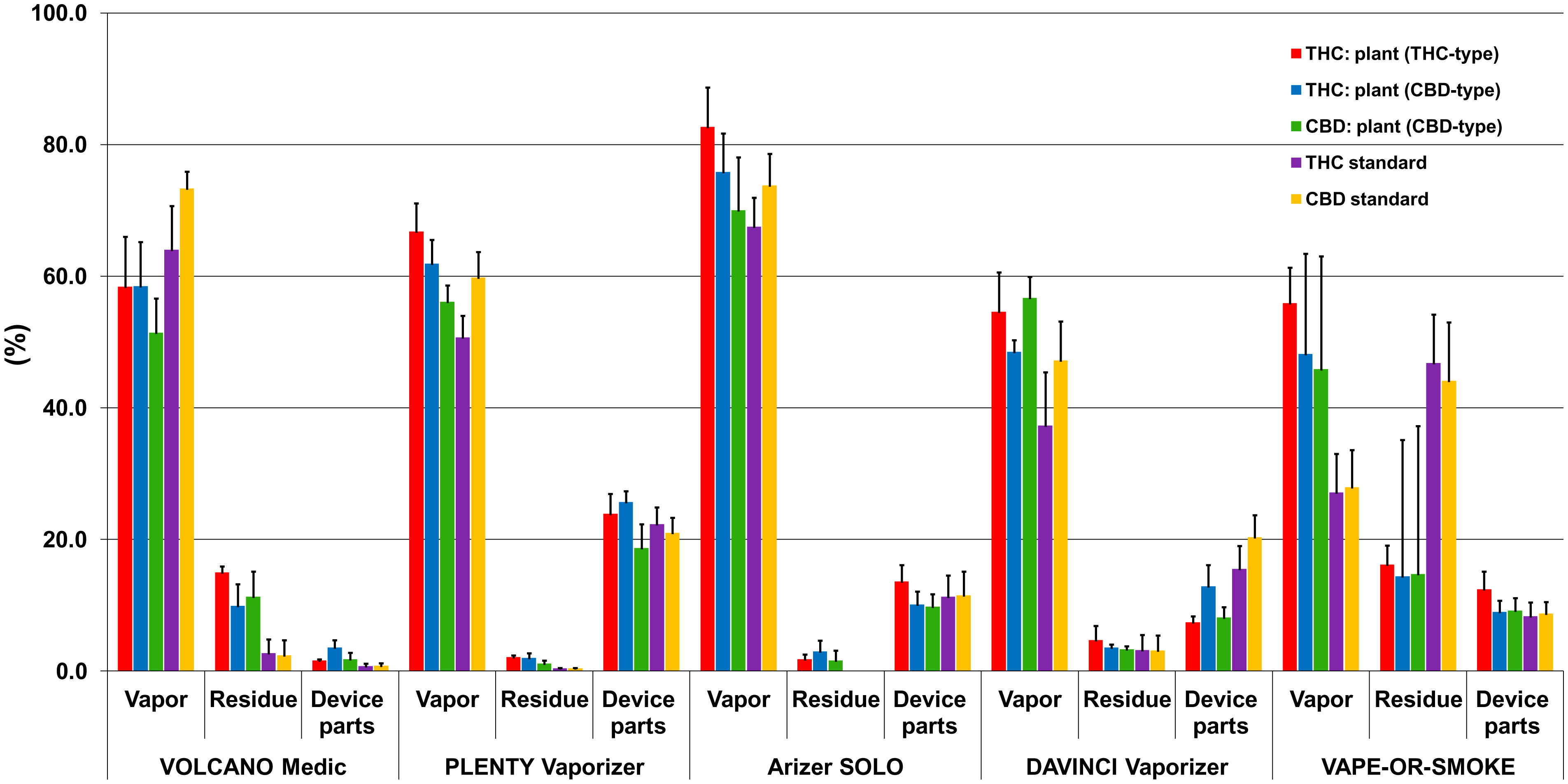
The 50–80% bioavailability range for vaporizers depends heavily on the device. Pomahacova et al. (2009) demonstrated that 230°C delivers the optimal THC yield. In a validation study (Hazekamp et al., 2016), the Arizer Solo achieved 83% THC recovery, while the Volcano Medic reached 58%.
In practice, this means a vaporizer user needs roughly half the material of a joint smoker for the same effect. With regular use, the savings add up quickly – one key reason why the higher upfront cost pays for itself.
Flavor and Terpenes
| Aspect | Joint | Vaporizer |
|---|---|---|
| Terpene preservation | Low | High |
| Flavor profile | Smoky, burnt | Clean, strain-specific |
| Odor intensity | Strong, lingering | Subtle |
The flavor difference is obvious from the first draw: instead of burnt, smoky taste, the herb tastes fruity, floral, or earthy – depending on the strain. At low temperatures (170–185°C), lighter terpenes like myrcene and limonene dominate. Raising the temperature releases heavier terpenes – the flavor profile shifts with each step. In a joint, all terpenes are destroyed simultaneously at 600+°C.
Onset and Dosability
With a joint, the full effect hits within 1–3 minutes because all material combusts at once. Dosing is hard to control: once lit, the joint keeps burning – material is lost as sidestream smoke between draws.
A vaporizer allows a different approach: you control temperature, draw length, and pacing. Starting at 170°C and working up in 5°C increments lets you build effects gradually – known as temperature stepping. On-demand vaporizers take this further: they heat only during the draw, enabling true microdosing with 0.05–0.1 g per bowl.
AVB: The Second Use
An often overlooked advantage: what remains after vaporizing is not waste. Already Vaped Bud (AVB) still contains residual cannabinoids – already decarboxylated and ready to use. AVB can be stirred into butter, packed into capsules, or blended into smoothies. Joint ash, by contrast, is actual waste: combustion destroys all usable compounds completely.
Odor and Discretion
Cannabis smoke clings to clothing, hair, and furniture – often for hours. The smell is intense and noticeable from a distance. Vaporizer vapor, by contrast, dissipates within minutes. It is milder, less pungent, and far more discreet. This makes vaporizers more practical for everyday use – though to be clear: vaporizing is not completely odor-free either.
Cost
| Factor | Joint | Vaporizer |
|---|---|---|
| Initial cost | ~2€ | 50-400€ |
| Material per session | 0.3-0.5g | 0.1-0.2g |
| Long-term cost | Higher | Lower after break-even |
What That Means in Euros
Example calculation at €10/g: A joint uses 0.3–0.5 g per session – that is €3–5 per use. A vaporizer needs 0.1–0.2 g – so €1–2 per session. Daily users save roughly €60–90 per month with a vaporizer. A solid portable vaporizer at €150 pays for itself within 2–3 months.
Environmental Impact
Each joint requires: rolling papers, filter tips, tobacco packaging, a lighter, and produces ash. A daily joint smoker generates kilograms of waste per year. A vaporizer is a one-time purchase that lasts years with proper care. The only regular consumables are the occasional screen or dosing capsule – minimal compared to the daily disposable joint.
Practical Tips for Switching
The switch from joints to a vaporizer feels unfamiliar at first. Key tips:
- Start low: Begin at 170–180°C and increase in 5°C steps. This lets you explore the flavor differences.
- Grind properly: A consistent medium grind significantly improves extraction.
- Adjust expectations: Vapor feels “lighter” than smoke. That is not weaker effects – it is less irritation.
- Give it two weeks: Many former joint smokers report the difference becomes noticeable after 1–2 weeks as airways recover.
- Try on-demand: On-demand vaporizers best replicate the joint experience: short draws, immediate effects, no waiting.
When a Joint Has Its Place
Despite all the advantages, there are situations where a joint is more practical: passing around a group is easier. On the go, you need no charged device. And for someone who consumes rarely, the investment may not be worth it. That said: anyone who uses cannabis regularly – and that describes most people reading this comparison – is better off with a vaporizer in every respect.
Conclusion
The scientific comparison is clear: vaporizers drastically reduce harmful compounds (95% pure cannabinoids in vapor vs. 100+ compounds in smoke), double the compound yield, eliminate the tobacco problem, and save money long-term. Add better flavor, more discreet use, and the option to reuse AVB. For regular cannabis users, switching from joints to a vaporizer is one of the most effective harm reduction measures – confirmed consistently by 20 years of research.
Scientific Sources
- Abrams, D. I. et al. (2007). Vaporization as a Smokeless Cannabis Delivery System. Clinical Pharmacology & Therapeutics. PubMed
- Earleywine, M. & Barnwell, S. S. (2007). Decreased respiratory symptoms in cannabis users who vaporize. Harm Reduction Journal. PubMed
- Hazekamp, A. et al. (2006). Evaluation of a vaporizing device (Volcano) for the pulmonary administration of tetrahydrocannabinol. Journal of Pharmaceutical Sciences. PubMed
- Pomahacova, B. et al. (2009). Cannabis smoke condensate III: The cannabinoid content of vaporised Cannabis sativa. Inhalation Toxicology. PubMed
- Loflin, M. & Earleywine, M. (2015). No smoke, no fire: What the initial literature suggests regarding vapourized cannabis and respiratory risk. Canadian Journal of Respiratory Therapy. PubMed
- Hazekamp, A. et al. (2016). Medicinal Cannabis: In Vitro Validation of Vaporizers. PLoS ONE. PubMed
- Hindocha, C. et al. (2017). Associations between cigarette smoking and cannabis dependence. Addictive Behaviors. PubMed
- Spindle, T. R. et al. (2018). Acute Effects of Smoked and Vaporized Cannabis. JAMA Network Open. PubMed
Related Articles
- Vaporization vs. Combustion: The Toxicological Comparison
- Terpenes & the Entourage Effect
- Vaporizer Temperature Settings
- AVB/ABV: Reusing Already Vaped Bud
- Microdosing with Vaporizers
- Session vs. On-Demand Vaporizers
Related Articles: Vaporization vs. Combustion · Boiling Points · Terpenes · Best Beginner Vaporizers
Frequently Asked Questions
Is a vaporizer healthier than a joint?
Studies show vaporizers produce up to 95% fewer harmful substances than joints. Without combustion, neither tar nor carbon monoxide is produced. Respiratory issues are significantly reduced.
Does a vaporizer save material compared to joints?
Yes. Vaporizers extract cannabinoids more efficiently: one chamber load (0.1–0.3 g) equals roughly one joint (0.3–0.5 g). Long-term, a vaporizer saves 30–50% material.
Does a vaporizer taste different from a joint?
Yes. Without combustion, terpenes are preserved, resulting in a purer and more nuanced flavor. Joints mask terpenes with smoke and combustion byproducts.
{“@context”:”https://schema.org”,”@type”:”FAQPage”,”mainEntity”:[{“@type”:”Question”,”name”:”Is a vaporizer healthier than a joint?”,”acceptedAnswer”:{“@type”:”Answer”,”text”:”Studies show vaporizers produce up to 95% fewer harmful substances than joints. Without combustion, neither tar nor carbon monoxide is produced. Respiratory issues are significantly reduced.”}},{“@type”:”Question”,”name”:”Does a vaporizer save material compared to joints?”,”acceptedAnswer”:{“@type”:”Answer”,”text”:”Yes. Vaporizers extract cannabinoids more efficiently: one chamber load (0.1–0.3 g) equals roughly one joint (0.3–0.5 g). Long-term, a vaporizer saves 30–50% material.”}},{“@type”:”Question”,”name”:”Does a vaporizer taste different from a joint?”,”acceptedAnswer”:{“@type”:”Answer”,”text”:”Yes. Without combustion, terpenes are preserved, resulting in a purer and more nuanced flavor. Joints mask terpenes with smoke and combustion byproducts.”}}]}