Cannabinoid Boiling Points: The Science of Optimal Temperature Selection
- THC: 157°C – primary psychoactive effect
- CBD: 160-180°C – medicinal, non-intoxicating
- CBN: 185°C – sedating, useful for sleep issues
- Terpenes: 150-180°C – flavor and entourage effect
- Recommendation: Start at 170°C, gradually increase to 200°C
Introduction to Cannabinoid Boiling Points
Anyone who uses a vaporizer is controlling which active compounds get released simply by adjusting the temperature. Every cannabinoid and every terpene has its own boiling point – the temperature at which a substance transitions from its solid or liquid state into vapor. In physics, this is the point where a compound’s vapor pressure equals atmospheric pressure. For cannabinoids, which sit in solid or semi-solid form inside the plant, it means the temperature at which they become inhalable vapor.
What does this mean in practice? Set your vaporizer to 170°C and you get a different compound profile than at 200°C. Lower temperatures bring out terpenes and lighter cannabinoids – the effect stays clear and heady. Higher temperatures also release heavier compounds like CBN, producing more physical, sedating effects. This knowledge turns vaporizing from simple heating into targeted extraction, where you actively shape the outcome.
Several factors influence how effectively a compound vaporizes. The purity of the substance plays a role, as does air pressure at your location – in the mountains, the boiling point drops by roughly 3°C per 1,000 meters of elevation. The plant matrix itself changes the behavior: isolated cannabinoids vaporize differently from compounds embedded in plant material. Even the heating method of the device – whether convection or conduction – affects the effective vaporization temperature, since heat transfer to the material differs in fundamental ways.
Major Cannabinoids and Their Boiling Points
THC (Delta-9-Tetrahydrocannabinol)
| Property | Value |
|---|---|
| Boiling Point | 157°C (315°F) |
| Optimal Range | 170-190°C |
| Effects | Psychoactive, euphoric, pain-relieving |
THC is the primary psychoactive cannabinoid and starts vaporizing at about 157°C. For the best extraction, aim for 170-190°C – this range releases most of the THC while less desirable compounds still largely remain in the plant. At 160-170°C, you get a light, clear effect with a lucid head. Between 170 and 185°C, the experience becomes more balanced and the psychoactive component noticeably stronger. Above 185°C, sedation increases because additional CBN and heavy terpenes are released.
THC is also analgesic, appetite-stimulating, and antiemetic – properties that are especially valued in medical use for chemotherapy patients and people with chronic pain. Most users don’t need temperatures above 200°C to extract the majority of available THC.
CBD (Cannabidiol)
| Property | Value |
|---|---|
| Boiling Point | 160-180°C (320-356°F) |
| Optimal Range | 175-195°C |
| Effects | Anxiolytic, anti-inflammatory, non-psychoactive |
CBD has a broader boiling range than THC and is best extracted at slightly higher temperatures. It produces no intoxication but instead delivers anti-inflammatory, anxiety-reducing, and anticonvulsant properties. What makes CBD particularly interesting is its ability to modulate the THC effect – it can soften side effects like anxiety or paranoia. This modulating action is one reason why strains with a balanced THC:CBD ratio are often perceived as more pleasant than pure THC strains. Neuroprotective properties have also been demonstrated, which makes CBD relevant for research into neurodegenerative conditions.
In medical applications, CBD is used for epilepsy, chronic inflammation, anxiety disorders, and neuropathic pain. For maximum CBD extraction, choose at least 175°C and increase the temperature over the course of your session to 195°C, pulling the last CBD molecules from the material.
CBN (Cannabinol)
| Property | Value |
|---|---|
| Boiling Point | 185°C (365°F) |
| Optimal Range | 185-200°C |
| Effects | Sedating, mildly psychoactive, antibacterial |
CBN forms through the oxidation of THC and is the strongest sedating cannabinoid found in the cannabis plant. It vaporizes at higher temperatures than THC, which is why lower settings automatically produce less sedation. Older or improperly stored cannabis naturally contains more CBN, since THC breaks down over time. That is also why aged cannabis tends to make people sleepier than fresh material.
If you struggle with sleep, temperatures from 190°C upward will help, as CBN is released alongside sedating terpenes like myrcene and linalool. CBN and CBD work synergistically together: the combination of both cannabinoids is more effective for sleep than either compound on its own for many users. Antibacterial properties have also been documented for CBN in published studies.
Other Cannabinoids: CBC, THCV, CBG and More
| Cannabinoid | Boiling Point | Effects | Notes |
|---|---|---|---|
| CBC (Cannabichromene) | 220°C | Anti-inflammatory, antidepressant | Supports the endocannabinoid system |
| THCV (Tetrahydrocannabivarin) | 220°C | Energizing, appetite-suppressing | Shorter-acting than THC, common in African strains |
| CBG (Cannabigerol) | 52°C (theoretical) | Antibacterial, neuroprotective | “Stem cell” of cannabinoids; in practice: 170-190°C |
| Delta-8-THC | ~175°C | Mildly psychoactive, anxiolytic | Less intense than Delta-9-THC, more stable structure |
| THCP | Not yet fully characterized | Highly potent | Up to 30x THC affinity at CB1 receptors |
| CBDV (Cannabidivarin) | Similar to CBD | Antiemetic, anticonvulsant | Under research for epilepsy |
CBC and THCV require temperatures around 220°C for full extraction – a strong argument for temperature stepping, where you raise the temperature gradually over the course of a session. CBC is not psychoactive but supports the endocannabinoid system and can boost the effects of other cannabinoids. THCV has unique properties: it suppresses appetite (the opposite of the typical cannabis effect), provides energy, and acts for a shorter time than regular THC. It appears most frequently in African sativa strains.
CBG has an unusually low theoretical boiling point of 52°C, yet within the plant matrix it effectively vaporizes only at 170-190°C. As the “stem cell” of cannabinoids – the compound from which the plant biosynthesizes other cannabinoids – CBG has its own antibacterial and neuroprotective properties. THCP, first discovered in 2019, shows up to 30 times stronger binding to CB1 receptors than THC in studies, though its boiling point has not yet been fully characterized. CBDV, a CBD analogue, is currently being investigated in clinical trials for epilepsy and autism spectrum disorders.
Terpenes and Their Boiling Points
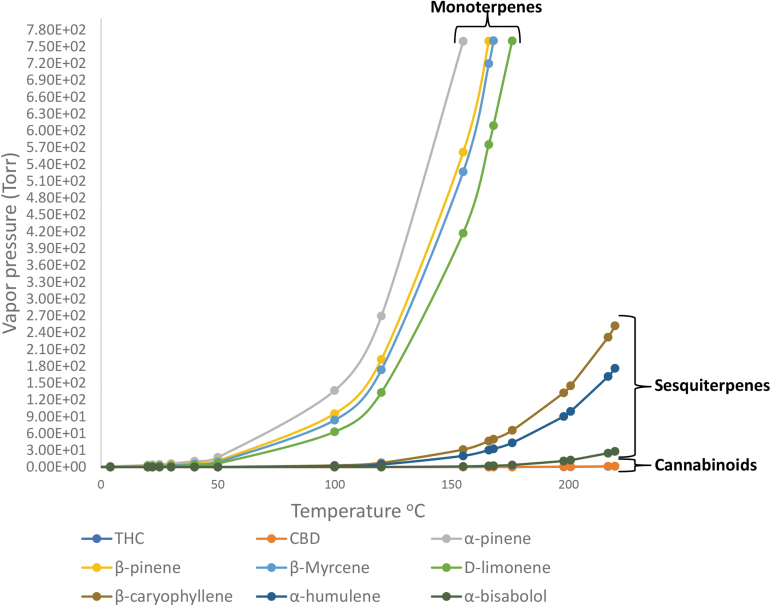
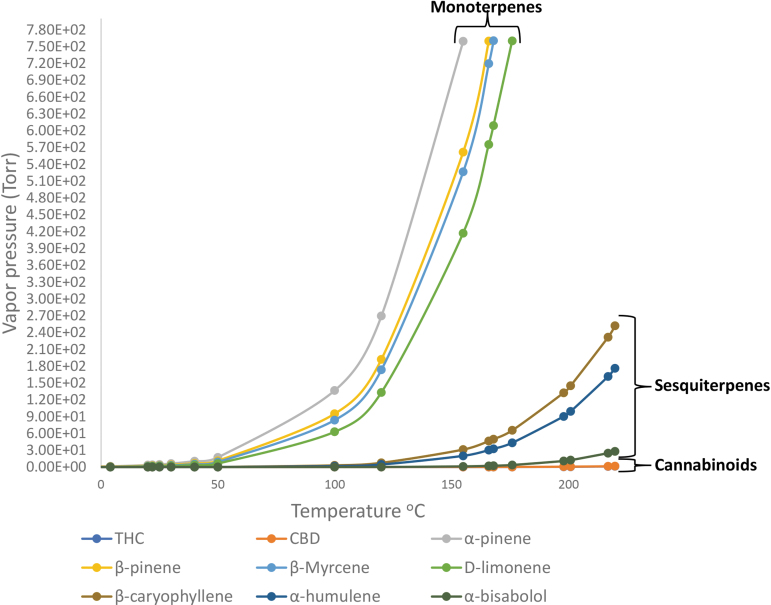
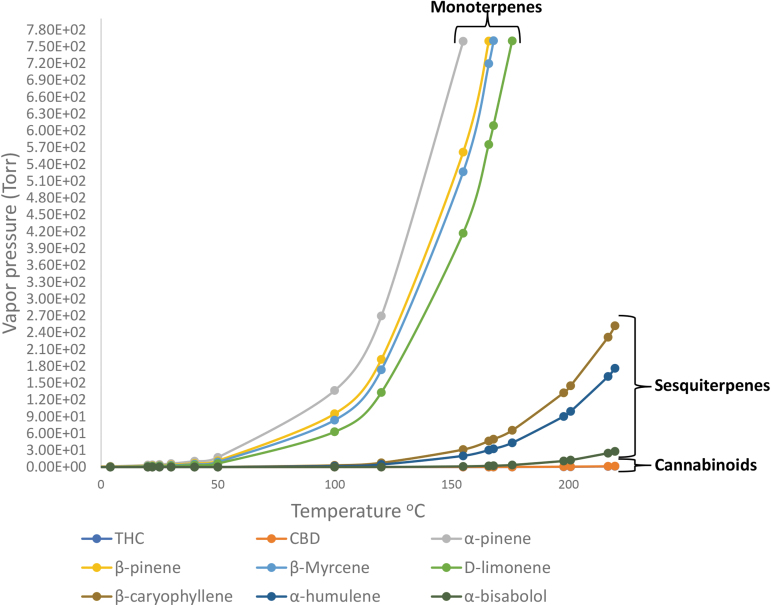
Terpenes shape the aroma and flavor of cannabis, but they also carry their own therapeutic effects and amplify cannabinoid action through the entourage effect. Some of them vaporize at lower temperatures than the main cannabinoids – which is why the first draws at low temperature taste the most aromatic and why terpenes are the first compounds lost when temperatures run too high.
| Terpene | Boiling Point | Aroma | Properties |
|---|---|---|---|
| α-Bisabolol | 153°C | Floral, sweet | Skin-soothing, anti-inflammatory |
| α-Pinene | 155°C | Pine, fresh | Memory-enhancing, bronchodilator |
| β-Caryophyllene | 160°C | Peppery, spicy | Anti-inflammatory, activates CB2 receptors |
| β-Myrcene | 168°C | Earthy, musky | Sedating, muscle-relaxing, enhances THC |
| Limonene | 176°C | Citrus | Mood-elevating, antibacterial, stress-reducing |
| Terpinolene | 185°C | Floral, herbal | Antioxidant, mildly sedating |
| Linalool | 198°C | Lavender, floral | Anxiolytic, calming, anticonvulsant |
| α-Humulene | 198°C | Hops, earthy | Appetite-suppressing, anti-inflammatory |
Bisabolol and pinene are among the most volatile terpenes and enter the vapor first – starting as low as 153-155°C. Caryophyllene follows at 160°C and stands out as the only terpene that directly activates CB2 receptors, making it a particularly potent anti-inflammatory agent. Myrcene, the most abundant terpene in cannabis, vaporizes at 168°C and brings its earthy, musky character along. Research confirms that it enhances the THC effect and acts as a muscle relaxant on its own – it also occurs naturally in hops and mangoes.
Limonene with its unmistakable citrus scent vaporizes at 176°C, lifting mood and easing stress. The higher-boiling terpenes linalool and humulene (both 198°C) only come through at medium temperatures. Linalool – the terpene that also gives lavender its calming fragrance – has anxiety-reducing and anticonvulsant properties. Humulene, familiar from hops, suppresses appetite and fights inflammation.
Terpenes are far more volatile than cannabinoids. If you want to enjoy their full aroma, take your first draws at 160-170°C and only increase afterward. Storage also significantly affects terpene content: fresh material kept in airtight containers at a cool temperature and away from light preserves the terpene profile best. Ideally, store at 15-20°C. Grind only right before use, since broken-up flower oxidizes noticeably faster due to the increased surface area.
Practical Temperature Zones
Zone 1: Low Temperature (160–175°C)
In this zone, early THC, light terpenes such as pinene and limonene, and some CBD are released. The vapor is thin and aromatic, the flavor at its Peak. The effect stays clear and heady – perfect for daytime when you need to stay productive. Sedation is minimal, and there is very little irritation to the airways.
Many medical users favor this range for anxiety disorders, since CBD is already partly vaporizing without excessive THC release. Cannabis enthusiasts who want to explore the aroma profile of a particular strain will also find this zone rewarding: this is where you taste the differences between strains most clearly. The low vapor density may feel unusual at first, but it delivers the purest flavor.
Zone 2: Medium Temperature (175–200°C)
Here you extract the full THC spectrum and the complete CBD content. Most terpenes are released, and CBN extraction begins. Flavor and effect sit in good balance – you feel a combination of head and body effects. This range is the all-rounder for most users and is frequently called the “sweet spot” in the literature.
Both flavor and therapeutic effect are at a solid level without harmful byproducts forming. For beginners who don’t want to fuss with temperature zones, 185°C is a reliable starting point. At that setting you get a balanced extraction that is neither too weak nor too sedating.
Zone 3: High Temperature (200–230°C)
Maximum potency lives in this zone. All remaining cannabinoids are pulled out, including CBC and THCV in full. CBN extraction hits its peak, heavy terpenes join the vapor. The effect is noticeably more physical and sedating, the vapor denser and more visible, though flavor becomes less nuanced.
Medical users seeking rapid relief from severe pain or insomnia often work in this range. You also end up here at the tail end of a stepping session, wringing the last residual compounds from the material. A word of caution: pyrolysis begins around 230°C – stay below that mark to avoid harmful combustion byproducts such as benzene and polycyclic aromatic hydrocarbons. As a rule of thumb, 210-215°C is the practical ceiling for pure vaporization.
Temperature Stepping: A Step-by-Step Approach
Temperature stepping is the go-to method for users who want to tap into the full compound spectrum of a session. Instead of picking a fixed temperature, you increase it gradually, extracting the volatile terpenes first, then the main cannabinoids, and finally the heavy residual compounds. The payoff: you experience the full flavor and therapeutic range of your material in a single session. Some modern vaporizers like the DaVinci IQ2 offer programmable “Smart Paths” that run this temperature ramp automatically over the session duration.
Start at 165 °C with 2–3 draws for terpenes and light cannabinoids — this is where you get the full flavor, with pinene, bisabolol, and early myrcene notes dominating. Increasing to 180 °C brings 3–4 draws for the main cannabinoids THC and CBD; the psychoactive effect kicks in clearly while the flavor remains good. At 195 °C, another 3–4 draws allow deeper extraction as CBN and heavier terpenes like linalool and humulene are released, making the effect more physical. Optionally, pushing to 210 °C provides a final 2–3 draws for complete extraction of all remaining cannabinoids — less flavor, but maximum efficiency and material yield.
This technique works especially well with high-quality flower, where you want to experience every nuance of the terpene and cannabinoid profile. Material utilization increases significantly, because at a single fixed temperature, compounds above or below the chosen range always go unused. A typical stepping session lasts 10-15 minutes and extracts more active compound from the same amount of material than a session at a constant temperature.
The Entourage Effect
Cannabinoids and terpenes don’t act in isolation – they amplify and modulate each other. This interplay, known as the entourage effect, explains why full-spectrum cannabis works differently from isolated THC or CBD. Studies show that whole-plant extracts are more effective at lower doses than isolated single compounds. THC together with CBD creates a different experience than THC alone: CBD dampens unwanted side effects like anxiety and paranoia. Myrcene paired with THC intensifies the relaxing effect, while pinene can ease the short-term memory issues caused by THC. Limonene Plus CBD lifts mood, and THCV combined with limonene produces an especially energizing profile.
Beyond cannabinoids and terpenes, flavonoids also contribute to the entourage effect. Cannabis contains over 20 different flavonoids, including the unique cannflavins. Cannflavin A and B are anti-inflammatory flavonoids that are released at higher temperatures above 200°C and broaden the overall therapeutic effect – studies indicate that Cannflavin A is 30 times more anti-inflammatory than aspirin. Flavonoids also add to the color and taste of the vapor. Through deliberate temperature selection, you directly influence which compounds are extracted and how they interact: low temperatures highlight individual synergies between a few terpenes and lighter cannabinoids, while high temperatures activate the entire spectrum including flavonoids all at once.
Practical Use Scenarios
By Effect and Time of Day
| Scenario | Temperature | Cannabinoids | Terpenes |
|---|---|---|---|
| Focus & Productivity (morning) | 165-175°C | THC (low), THCV | Pinene, Limonene |
| Balanced Effect (afternoon) | 175-190°C | THC, CBD | Myrcene, Limonene |
| Pain Relief | 180-200°C | THC, CBD, CBC | Caryophyllene, Humulene |
| Relaxation & Sleep (evening) | 195-210°C | THC, CBD, CBN | Myrcene, Linalool |
In the morning, a low temperature works best for clear, energetic effects without sedation. The terpenes pinene and limonene promote concentration and lift mood – paired with sativa-dominant strains, this makes for a productive start to the day. In the afternoon, the mid-range delivers a balanced mix that keeps you alert but already noticeably relaxed. Hybrid strains fit this temperature zone well.
In the evening, higher temperatures extract sedating compounds like CBN and myrcene that help with falling asleep. Indica strains at 195-210°C deliver the strongest evening and nighttime effect. For pain, medium to high temperatures offer the best combination of THC, CBD, and anti-inflammatory terpenes like caryophyllene and humulene. Caryophyllene is particularly interesting here because it is the only terpene that directly activates the CB2 receptor, producing its own analgesic effect.
Strain-Specific Recommendations
Different cannabis strains benefit from different temperature ranges. Sativa-dominant strains show their energizing traits best at 165-180°C – higher temperatures overwrite the typical sativa character with growing sedation from CBN release. Indica-dominant strains, on the other hand, reveal their full physical effect at 180-200°C, where the typically higher myrcene content is also optimally extracted.
CBD-rich strains need at least 175°C for complete CBD extraction, with 180-200°C being the optimal window. Terpene-rich strains with a pronounced aroma profile – say, those high in limonene or pinene – should first be enjoyed at low temperatures and only pushed higher in the second half of the session, so the volatile aromatics are not immediately lost.
Medical Temperature Protocols
Medical users can tailor temperature selection to their specific conditions. The following table summarizes proven protocols based on the boiling points of the relevant active compounds. Each protocol uses temperature stepping from the starting value to the target.
| Application | Start Temperature | Target Temperature | Primary Compounds |
|---|---|---|---|
| Acute Pain | 180°C | 195°C | THC, Myrcene, Caryophyllene |
| Anxiety Disorders | 165°C | 180°C | CBD, Linalool, Limonene |
| Sleep Problems | 185°C | 210°C | CBN, THC, Myrcene |
| Nausea | 170°C | 185°C | THC, CBD |
| Inflammation | 170°C | 200°C | CBD, CBG, Caryophyllene |
| Appetite Stimulation | 175°C | 190°C | THC, THCV |
For anxiety disorders, lower temperatures are often more effective, since they release more CBD and calming terpenes like linalool without extracting too much THC. Excess THC can paradoxically increase anxiety – a phenomenon especially common with THC-dominant strains at high temperatures. For chronic pain, a higher target temperature is advisable to fully dissolve the anti-inflammatory terpenes caryophyllene and humulene.
For sleep issues, start at 185°C and work up to 210°C to get the maximum sedating CBN and myrcene. Indica strains with a high myrcene content amplify this effect. For nausea – such as after chemotherapy – a range of 170-185°C is often sufficient for adequate THC and CBD extraction. With all protocols, begin at the lower end and increase as needed – this way you find the lowest effective temperature for your condition.
Device Technology and Temperature Accuracy
Convection vs. Conduction
In conduction vaporizers, the material is heated through direct contact with a hot surface. This allows for faster heat-up times and more compact designs, but it carries the risk of hotspots – areas where the material gets hotter than the rest of the chamber. Occasional stirring or shaking evens this out. Conduction devices like the PAX or DaVinci are well suited for use on the go and deliver quick results.
Convection vaporizers, by contrast, pass hot air through the material. Temperature distribution is more even, terpenes are better preserved, and control over compound release is more precise. This makes convection devices the better choice for temperature stepping and terpene-focused vaporizing. The trade-off: heat-up time is usually a bit longer, and the devices tend to be bulkier. Many modern units like the Mighty+ combine both heating methods as a hybrid, aiming to unite the strengths of both systems: fast heat-up through conduction and even extraction through the convective airflow.
Device Recommendations
For users who need precise boiling-point control, devices with degree-accurate settings are the way to go. The Storz & Bickel Mighty+ offers ±1°C accuracy in the range of 40-210°C and combines convection with conduction. The Arizer Solo 2 stands out with gradual adjustability and excellent temperature consistency across an entire session. The Tinymight-2/" class="vc-product-autolink">Tinymight 2 delivers on-demand convection with very precise control, and the Volcano Hybrid provides digital precision for desktop use with either a balloon or whip system.
Budget devices often deviate 5-10°C from the displayed temperature, which becomes a problem when you are trying to target specific boiling points. Premium devices stay within ±1-2°C and produce repeatable results. With a new device, it pays to spend the first few sessions testing different settings and watching the actual vapor production. Desktop units like the Volcano or Arizer Extreme Q often allow higher temperatures than portables, since their superior vapor-path cooling is easier on the airways.
Material Preparation and Vapor Quality
How you prepare your material has a major impact on vaporization and can make the difference between a mediocre session and a great one. Moisture content should sit at 58-62% relative humidity – material that is too dry can combust unintentionally and feels harsh in the throat, while overly moist material wastes heating energy on water evaporation before the actual compound extraction even begins. Boveda packs rated at 62% humidity help with regulation and keep the material in the ideal range for weeks.
Grind consistency determines how much surface area is exposed to the hot air. A medium grind offers the best balance: enough surface for efficient vaporization without blocking airflow. Material ground too finely clogs screens and creates hotspots; material ground too coarsely heats unevenly. Convection devices work better with a loose pack, since the airstream needs to pass through the material. Conduction devices tolerate a slightly tighter fill, since heat transfers through contact surfaces. The basic rule: never pack the chamber so tightly that airflow is noticeably restricted.
Higher temperatures produce denser, more visible vapor with a stronger cannabinoid concentration. Lower temperatures deliver lighter vapor that tastes more subtle and puts less strain on the airways. Inhalation technique matters too: slow, steady draws maximize extraction, while pulling fast drops the chamber temperature and disrupts vaporization. You can tell a session is finished when vapor production fades and a slightly burnt, popcorn-like taste appears – the material is spent at that point.
Scientific Foundations
Vapor Pressure and Vaporization Kinetics
The relationship between vapor pressure and temperature follows the Clausius-Clapeyron equation, a fundamental law of physics. In practical terms, this means that vaporization already occurs below the boiling point, just slowly and in small amounts. The vaporization rate rises exponentially with temperature – a 10°C increase can double the release rate of a given compound. Optimal extraction takes place near the boiling point, and the molecular weight and functional groups of a cannabinoid determine its vaporization behavior. Heavier molecules like CBC (molecular weight 314 g/mol) require more energy than lighter ones like THC (also 314 g/mol, but with different vapor-pressure characteristics).
Scientific studies use thermogravimetric analysis (TGA) and differential scanning calorimetry (DSC) to measure the vaporization kinetics of cannabinoids. TGA tracks mass changes during controlled temperature increases and pinpoints exactly which temperatures release specific compounds. DSC complements this data by measuring heat absorption during phase transitions, giving a complete picture of thermal properties. These lab results don’t always translate directly into practice, though, since the plant matrix, moisture content, and airflow inside a vaporizer all affect actual release behavior.
Research Findings
The study by Pomahacova et al. (2009) systematically examined vapor composition at different temperatures: at 170°C, terpenes dominated with little THC; at 200°C, the optimal THC-to-terpene ratio emerged; and at 230°C, the first pyrolysis products appeared. The researchers found that the greatest therapeutic range lay between 180-200°C, where both THC and CBD were extracted in meaningful quantities.
Hazekamp et al. (2006), in their landmark analysis of Volcano efficiency, showed that cannabinoid yield from vaporizing can be up to 54% higher than from smoking. Peak efficiency fell between 180-200°C, and below 230°C, no combustion products were detectable. The study also demonstrated that multiple short balloon fills at rising temperatures were more efficient than a single fill at a high temperature – a scientific validation of temperature stepping. These results confirm that the 170-210°C range covers virtually all use cases, and going above that adds no therapeutic value while increasing health risks.
Safety: Combustion Threshold and Degradation
The combustion threshold of cannabis sits at about 230°C. Above that temperature, pyrolysis kicks in: carbon monoxide, polycyclic aromatic hydrocarbons (PAHs), and other harmful byproducts are generated. Benzene becomes detectable in trace amounts starting at 200°C, and PAH formation rises sharply beyond 230°C. This is exactly why vaporizing is considered far less harmful than smoking (which involves combustion at 600-900°C). Modern vaporizers include safety mechanisms that prevent exceeding the 230°C threshold – but you should still treat 220°C as your practical maximum and only use these temperatures at the end of a session.
Degradation also happens below the combustion point: THC increasingly converts to CBN at high temperatures, shifting the effect toward sedation. Terpenes break down faster at rising temperatures – one reason why high settings deliver more potency but less flavor. Long-term use at lower temperatures (below 190°C) is gentler on the lungs, preserves the full flavor profile, and may even slow tolerance build-up through milder effects.
Oxygen exposure accelerates all degradation processes. Store your material in airtight containers, cool and dark. Freshly ground material oxidizes faster than whole buds – grind only right before use to minimize terpene and cannabinoid losses. The ambient humidity level also plays a role: very dry air can dehydrate material faster, while high humidity extends heat-up time.
AVB: What Remains After Vaporizing
Already Vaped Bud (AVB) contains varying amounts of active compounds depending on the vaporization temperature used. Material vaporized at low temperatures still holds significant potential for reuse. AVB is already decarboxylated, meaning the compounds have been heat-activated and are orally bioavailable without further heating.
| Vaporization Temperature | Remaining THC Potency | AVB Use |
|---|---|---|
| 165-175°C | 30-50% | Edibles, re-vaporize at higher temperature |
| 180-195°C | 15-25% | Edibles, tinctures |
| 200-210°C | 5-10% | Weak edibles |
At temperatures up to 175°C, 30-50% of the original THC content stays in the material – enough for potent edibles or a second session at a higher temperature. If you regularly vaporize at medium temperatures, you can collect AVB in a mason jar and use it to make cannabis butter or tinctures. Since the material is already decarboxylated, it requires no further heat activation, which simplifies the processing.
At temperatures above 200°C, the material is largely depleted and only suitable for lightly dosed preparations. The color of the AVB gives a good indication of remaining potency: light brown, slightly greenish AVB still has plenty of potential; medium brown AVB is partially spent; and dark brown to black material is nearly used up. Keep collected AVB dry and cool until you have enough for a recipe.
Conclusion and Tips for Getting Started
Knowing about cannabinoid boiling points is what separates random vaporizer use from targeted, intentional sessions. With the right temperature, you can tune your sessions to the effects you want, maximize flavor or prioritize potency, and use your material far more efficiently. The science behind boiling points is clear: each temperature range has its own compound profile, and with a bit of practice, this knowledge translates directly into your daily routine.
To get started, three simple rules are enough. Begin at 170°C to get to know the flavor and test the effect gently. Raise the temperature in 5-10°C steps and observe how vapor density and effect change. Use small amounts until you can gauge your personal tolerance. Inhale slowly and steadily – pulling too fast disrupts vaporization and cuts extraction noticeably. Clean your device regularly, since residue distorts flavor and can throw off the temperature sensor.
The ideal temperature is personal and depends on the situation. Experiment with different settings, note your experiences, and develop a feel for how your body responds to different temperature profiles. Factors like personal tolerance, the strain you are using, the time of day, and your therapeutic goal all play a role in choosing the right setting.
After just a few sessions, you will instinctively know which setting fits which occasion. The journey there is worth it: anyone who knows their temperatures gets noticeably more from their material, experiences more nuanced effects, and has full control over the vaporizer experience – from a light, aromatic morning session to deep relaxation in the evening.
Scientific Sources
- Lanz, C. et al. (2016). Medicinal Cannabis: In Vitro Validation of Vaporizers for the Smoke-Free Inhalation of Cannabis. PLoS ONE, 11(1), e0147286. PubMed 26784441
- Pomahacova, B. et al. (2009). Cannabis Smoke Condensate III: The Cannabinoid Content of Vaporised Cannabis sativa. Inhalation Toxicology, 21(13), 1108–1112. PubMed 19852551
- Hazekamp, A. et al. (2006). Evaluation of a Vaporizing Device (Volcano) for the Pulmonary Administration of Tetrahydrocannabinol. Journal of Pharmaceutical Sciences, 95(6), 1308–1317. PubMed 16637053
- Wang, M. et al. (2016). Decarboxylation Study of Acidic Cannabinoids: A Novel Approach Using Ultra-High-Performance Supercritical Fluid Chromatography. Cannabis and Cannabinoid Research, 1(1), 262–271. PubMed 28861498
Related Articles: Heating Methods · Microdosing · Cannabis Botany · Best Convection Vaporizers
Frequently Asked Questions
At what temperature does THC vaporize?
THC vaporizes from 157 °C. For maximum effect, 180–200 °C is recommended, as CBN and other cannabinoids are also released at these temperatures.
What temperature for the best flavor?
Low temperatures between 160–180 °C emphasize terpenes and deliver the purest flavor. Above 190 °C, vapor density increases but flavor diminishes.
Does CBD vaporize at a different temperature than THC?
Yes. CBD vaporizes from 170 °C, slightly higher than THC (157 °C). For CBD-rich strains, 170–190 °C is recommended.
{“@context”:”https://schema.org”,”@type”:”FAQPage”,”mainEntity”:[{“@type”:”Question”,”name”:”At what temperature does THC vaporize?”,”acceptedAnswer”:{“@type”:”Answer”,”text”:”THC vaporizes from 157 °C. For maximum effect, 180–200 °C is recommended, as CBN and other cannabinoids are also released at these temperatures.”}},{“@type”:”Question”,”name”:”What temperature for the best flavor?”,”acceptedAnswer”:{“@type”:”Answer”,”text”:”Low temperatures between 160–180 °C emphasize terpenes and deliver the purest flavor. Above 190 °C, vapor density increases but flavor diminishes.”}},{“@type”:”Question”,”name”:”Does CBD vaporize at a different temperature than THC?”,”acceptedAnswer”:{“@type”:”Answer”,”text”:”Yes. CBD vaporizes from 170 °C, slightly higher than THC (157 °C). For CBD-rich strains, 170–190 °C is recommended.”}}]}