Portable vs. Desktop: Comparing Vaporizers on a Traceable Basis
Portable and desktop describe primarily form factor and power supply. A stationary device can offer space for a different airpath, a larger heater, or a balloon system. A portable model prioritizes mobility and frequently integrates a battery. Which design actually delivers more evenly, cools better, or is easier to clean must be assessed on the individual device. Form factor alone does not answer these questions.
Portability is not a scientific quality tier
The herb chamber should also be considered separately. Greater volume means a larger possible fill quantity, but not automatically an appropriate dose or better utilization. A device that technically enables high delivery can increase exposure. Performance is therefore an operating characteristic and not an independent statement about health benefit.
Correctly relating laboratory findings to form factor
Some of the known research was conducted with Volcano devices. This makes the results readily interpretable for those setups, but does not demonstrate the superiority of all desktop devices over all portables. Conversely, a single good recovery result from a portable model cannot be transferred to all subsequent models. Changes to the control system, chamber, or airpath can alter the conditions.
For purchasing decisions, concrete questions are therefore helpful: Where will the device be used, how will it be cleaned, which parts need to be replaced, and what power supply is intended? These technical criteria can be assessed individually. A health-based ranking, by contrast, requires direct comparative data with appropriate endpoints. It cannot be derived from size, price, or mains cable.
What does form factor actually tell us scientifically?
“Portable” describes primarily the portable design, “desktop” primarily stationary use. From this follow practical differences in power supply, desk space, and transport. No fixed chemical or clinical ranking follows from this.
A smaller housing may place different demands on cooling and energy storage. How well a design meets these demands must, however, be assessed on the specific model. A stationary device is not validated as healthier or therapeutically more effective solely by virtue of its mains connection.
The earlier appeal to Hazekamp 2006 for a comparison with subsequently released portable devices was inappropriate. A trial conducted on a device of that era cannot retrospectively measure the properties of a later model. The attribution in question has been removed.
What criteria belong in a fair comparison?
Compare the intended workflow, not just a product class. This includes assembly, mounting, accessible cleaning parts, storage of hot components, and available spare parts. Also document additional tubes, balloons, or water adapters: they alter the delivery system.
For a runtime comparison it must be clear how long the device remains switched on and how operation is defined. A figure of “sessions” without duration and settings is not a common unit of measurement. For stationary devices, the available mains supply is in turn part of the usage prerequisites.
A sensory comparison should use the same maintenance state and, as far as possible, reproducible conditions. A freshly cleaned mouthpiece and a coated tube can alter an impression without the form factor class being the cause.
How does one separate comfort and active compound delivery?
Comfort can be described by weight, draw resistance, and heat sensation. The quantity of substance delivered requires an appropriate measurement method. For health effects, suitable human studies would in turn be required. These levels remain separate.
The device research in the vapor quality article shows the significance of collection point and residues. It does not provide a general efficiency class for all portable or desktop models.
Anyone selecting a device can therefore first state the practical requirements and then check which claims are actually substantiated by documentation or data. A blanket “desktop always delivers the best vapor” carries less information than a traceable comparison.
What does stationary power supply mean?
An intended mains adapter can enable operation independently of a limited internal battery charge. This says nothing yet about how much energy is consumed per session. Standby, heat-up, and actual operation all belong in the balance.
A portable device with a pass-through function is not automatically designed for the same sustained use as a desktop system. The explicitly stated operating approval remains authoritative. “Can be operated from the mains” and “designed for stationary continuous operation” are different statements.
What role do mouthpiece, tube, and balloon play?
The delivery path determines further contact surfaces and the temporal transport of the aerosol. A balloon partially separates generation and inhalation in time; a direct mouthpiece path does so differently. However, a longer cooling path does not automatically follow loss-free delivery or a health guarantee.
A substance balance must record deposits and delivered quantity separately. For a fair comparison, the specific accessories and their condition should be documented. Hazekamp et al. (2006)
How are costs compared honestly?
Take into account purchase price, energy, spare parts, and actual material consumption over the same period. A claimed material saving cannot be derived from housing size. Price and features are practical criteria, not a medical assessment.
Further reading: Vaporizer types, Heating methods, and Pass-Through. The health overview assesses clinical claims independently of mobility.
Which devices are representative examples of each form factor?

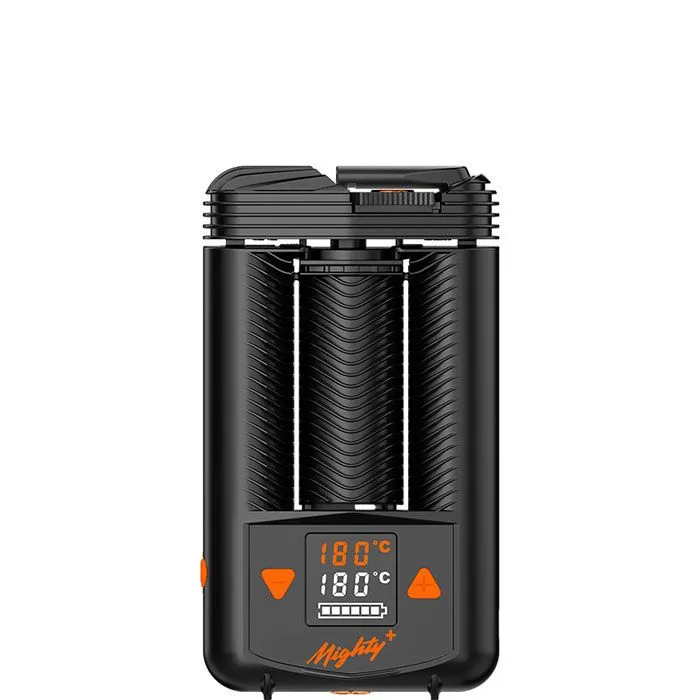
The criteria above become more tangible with concrete devices. The table shows two widely used desktop devices and six portables each, with values from our database. Prices and shop figures update daily.
| Device | Form factor | Heating type | Temperature | Weight | Price from |
|---|---|---|---|---|---|
| Volcano Hybrid | Desktop (balloon + tube) | Hybrid | 40–230 °C | 1800 g | 399.99 € Code VAPOCHECKER5 · incl. shipping |
| Arizer XQ2 | Desktop | Convection | 50–260 °C | 500 g | 159.82 € Code VAPOCHECKER5 · incl. shipping |
| Mighty+ | Portable | Hybrid | 40–210 °C | 242 g | 233.36 € Code VAPOCHECKER5 · incl. shipping |
| Venty | Portable | Hybrid | 40–210 °C | 252 g | 295.09 € Code VAPOCHECKER5 · incl. shipping |
| Crafty+ | Portable | Hybrid | 40–210 °C | 135 g | 160.30 € Code VAPOCHECKER5 · incl. shipping |
| Arizer Air MAX | Portable | Hybrid | 50–220 °C | 160 g | 111.62 € Code VAPOCHECKER5 · incl. shipping |
| Arizer Solo 3 V2 | Portable | Hybrid | 50–220 °C | 280 g | 202.95 € Code VAPOCHECKER5 · incl. shipping |
| PAX Plus | Portable | Conduction | 175–215 °C | – | 97.91 € incl. shipping |
Which type suits whom?
- Desktop is suitable when vaporizing takes place primarily at home, multiple people are involved, or balloon and tube are desired. The Volcano Hybrid covers both, the XQ2 relies on convection with a wide temperature range.
- Portable is suitable when the device needs to come along. Mighty+, Venty, and Crafty+ cover the Storz & Bickel line from large to compact, and Air MAX and Solo 3 V2 pass the vapor through glass.
- Both makes sense when comfort at home and mobility on the go both matter. Many users combine a desktop device for the evening with a portable for traveling.
Frequently asked questions about form factor
Is a desktop device automatically more efficient?
No. For that, efficiency, reference quantity, and comparison conditions must be defined. Housing size alone is not a measurement.
Can a portable achieve the same delivery?
That is a question about specific devices and protocols. Without appropriate data, no general assurance can be derived from this.
Which source is appropriate for chemical claims?
A suitable device trial with sample description and analytics. Manufacturer data on weight or mains connection answer different questions.
Source status of the supplement
As of: 10 September 2026. The addition follows VapoChecker’s editorial comparison rules. Physical fundamentals are covered under Heating Methods, and measurement parameters under Vapor Quality. The criteria are editorial classifications, not an independent laboratory test.
Hazekamp A et al. (2006)
- Investigation
- Device/dose evaluation study with analytical and clinical components
- Sample
- Primarily device/laboratory characterization; human component for inhalation/exhalation balance, exact number of participants not stated in abstract.
- Comparison and measurement
- Variation of temperature, sample, and balloon volume; inter-/intra-device variability; loaded vs. delivered THC dose; clinical inhalation measurements.
- Randomisation and blinding
- No/no classical RCT.
- Result
- On average approximately 54% of the loaded THC dose reached the balloon; approximately 35% of the inhaled THC was exhaled again.
- Strengths
- Reproducibility and dose validation; important methodological basis for later Volcano studies.
- Limitations and possible bias
- No long-term toxicology; outdated hardware/products; health-related conclusions indirect.
Hazekamp A, Ruhaak R, Zuurman L, van Gerven J, Verpoorte R. 2006. Evaluation of a vaporizing device (Volcano) for the pulmonary administration of tetrahydrocannabinol. Journal of pharmaceutical sciences. DOI: 10.1002/jps.20574 · PMID 16637053
Hazekamp A, Ruhaak R, Zuurman L, van Gerven J, Verpoorte R. 2006. Evaluation of a vaporizing device (Volcano) for the pulmonary administration of tetrahydrocannabinol. Journal of pharmaceutical sciences. DOI: 10.1002/jps.20574 · PMID 16637053