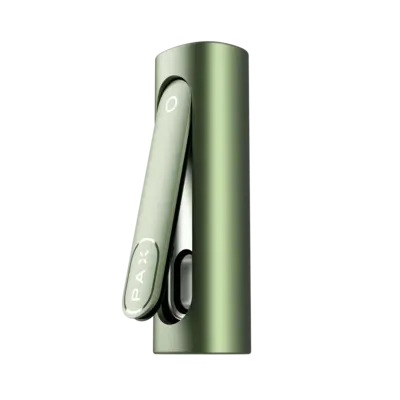
The PAX 1 was released in 2012 under the company name Ploom as a pocket-sized dry herb vaporizer: an anodized aluminum tube with the oven at one end and a retractable mouthpiece at the other. Three settings at 188, 199 and 210 °C, a motion sensor for standby mode, a charging dock and a ten-year warranty were all part of the concept. The oven holds around 0.35 grams, and the device weighs 97.5 grams. PAX Labs replaced the model with the PAX 2 in 2015; what appears in comparisons today is remaining stock. On VapoChecker you can compare current prices from verified shops.
About this vaporizer
The first PAX by Ploom (2012): conduction oven for about 0.35 g, three presets at 188, 199 and 210 °C, heats up from 30 seconds, motion sensor with standby, charging dock and a ten-year warranty. Long replaced by PAX 2 and PAX 3; the comparison lists remaining stock.
The PAX 1 has no visible button. The mouthpiece is spring-loaded and retractable; pressing it switches the device on and off. The temperature is changed by removing the mouthpiece and pressing the small button underneath; the star-shaped LED indicates the setting in colors. This very mouthpiece was the well-known weak point: resin accumulates in the shaft, the mouthpiece sticks, and Ploom supplied a lubricant as a remedy. Regular cleaning of the airpath was a necessity with the PAX 1, not an optional extra.
Oven, Settings and Heat-Up Time
The oven at the lower end is sealed by a magnetic lid and holds around 0.35 grams of finely ground material. Ploom specifies three settings: 370, 390 and 410 degrees Fahrenheit, equivalent to 188, 199 and 210 °C. According to the manual, the PAX is ready in just 30 seconds; reviews measure 30 to 60 seconds. A motion sensor lowers the temperature as soon as the device is set down and heats back up when picked up again; this preserved the built-in lithium-ion battery. A known issue was the lip sensor, which triggered thermal cut-offs on some devices.
Charging Dock and Contents
Charging is not done via a cable connected to the device, but on a dock: the PAX is placed mouthpiece-down onto the charging station. Inside the box were the PAX, the charging dock, four screens, a mouthpiece, the oven lid and the manual. The anodized aluminum housing was available in blue, purple and black; the airpath is made from laser-welded stainless steel and the plastic components are food-safe. At launch the PAX retailed for 249.99 US dollars; the ten-year warranty was unusual for a device in this class.
PAX 1, PAX 2 and PAX 3
The PAX 2 of 2015 retained the form factor, sealed the housing, replaced the retractable mouthpiece with a flat mouthpiece featuring a lip sensor and heated up faster. The PAX 3 added app control and a concentrate insert in 2016. Anyone buying a PAX 1 today is buying a collector's piece with functional core technology and the well-known cleaning demands. The prices in the comparison come from remaining stock at individual shops; new stock has not been available for years.
Three settings: 370, 390 and 410 °F, i.e. 188, 199 and 210 °C. Switching is done via the button beneath the removable mouthpiece.
Around 0.35 grams of finely ground material.
On the dock, with the mouthpiece facing down. There is no cable connection on the device itself.
Resin accumulates in the shaft of the spring-loaded mouthpiece. Regular cleaning of the airpath prevents this; Ploom included a lubricant for that purpose.
No, PAX Labs replaced it with the PAX 2 in 2015. The comparison shows remaining stock from individual retailers.
Sign-in runs through Google or Microsoft, which process data themselves in the process. We only receive your email address, your name and an account identifier, and store them to manage your account. We do not pass on your data for advertising purposes.
With your consent, we use cookies and similar technologies to store and access device information and to analyse, for example, browsing behaviour on this website.
Functional
Always active
The technical storage or access is strictly necessary for the legitimate purpose of enabling the use of a specific service explicitly requested by the subscriber or user, or for the sole purpose of carrying out the transmission of a communication over an electronic communications network.
Preferences
The technical storage or access is necessary for the legitimate purpose of storing preferences that are not requested by the subscriber or user.
Statistics
The technical storage or access that is used exclusively for statistical purposes.The technical storage or access that is used exclusively for anonymous statistical purposes. Without a subpoena, voluntary compliance on the part of your Internet Service Provider, or additional records from a third party, information stored or retrieved for this purpose alone cannot usually be used to identify you.
Marketing
The technical storage or access is required to create user profiles to send advertising, or to track the user on a website or across several websites for similar marketing purposes.




Comments
No comments yet. Be the first!
Sign in to comment