Ruby Twist Pro Review: Ball Vape with PID and Ruby Balls
Ruby Twist Pro Review: Ball Vape with PID and Ruby Balls
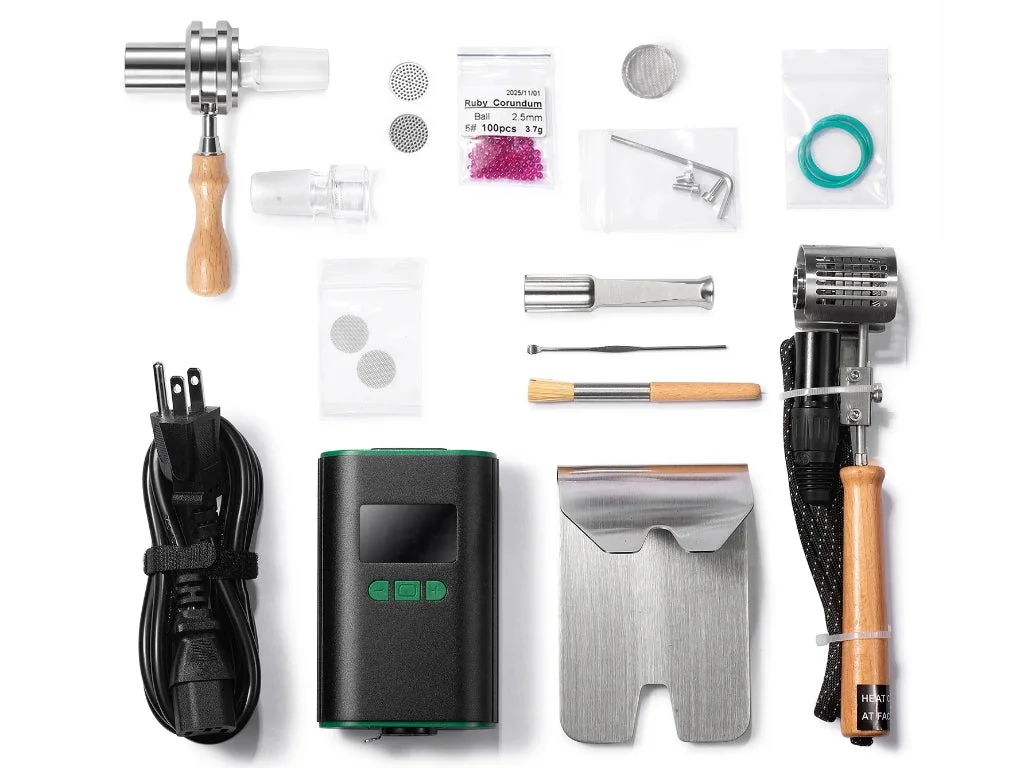
In short: The Ruby Twist Pro is a desktop ball vape from CrossingTech with 155 ruby balls, PID temperature control, and an included conversion kit for upgrading to 255 balls. The device is corded, requires a bong, and costs around 180 dollars. It is a good fit for you if you vaporize at home with a water pipe and want PID control.
At a Glance
- CrossingTech Ruby Twist Pro (from 205.07 € incl. shipping): convection, 45s
What Is the Ruby Twist?
The Ruby Twist Pro belongs to the ball vape category—desktop vaporizers that use heated balls as thermal storage. CrossingTech (also known as SZCrossing) uses synthetic ruby balls made of corundum. The material is chemically identical to sapphire but gets its red color from the addition of chromium. Corundum is food-safe, extremely hard, and does not release any substances even at high temperatures.
What makes the Ruby Twist Pro special is that it offers two operating modes in one device. In Twisted mode, 155 ruby balls work together with vortex fins that create a spiral airflow. If you want more thermal mass, the included conversion kit lets you upgrade to 255 balls—this is Traditional mode. No surcharge, no additional order. Everything is included in the box.
The Ruby Twist connects to a water pipe or bong. Two glass joints—14.4 mm and 18.8 mm—are included and cover the most common ground-joint sizes. The titanium chamber sits on top of the PID controller, and the vapor path runs through borosilicate glass. No plastic, no silicone.
Ruby Twist, Ruby Twist Injector, or Pro—which Device Are We Talking About?
Anyone looking for the Ruby Twist will find three devices from CrossingTech. They share the same basic design but differ at their core—and the name alone does not reveal which one is meant.
The line has grown in three stages. It began with the Thermal Twist Injector: an injector head without any balls. Instead of a ball bed, it contains a solid metal core through which air is directed in a vortex. Next came the Ruby Twist Injector—the same design, supplemented with a chamber containing around 230 cut rubies in a titanium housing. The rubies store significantly more heat, the vapor develops faster, and the flavor is cleaner. This model is the “Ruby Twist” without any suffix. Finally came the Ruby Twist Pro, which is the subject of this review.
| Thermal Twist Injector | Ruby Twist Injector | Ruby Twist Pro | |
|---|---|---|---|
| Thermal storage | Metal core, ball-free | Approx. 230 cut rubies | 155 ruby balls (2.5 mm), 255 with kit |
| Twist element | Permanently installed | Permanently installed | Removable |
| Second operating mode | No | No | Yes—conversion kit included |
| Housing | SS316 stainless steel | Titanium | Titanium |
| Usable range | — | 270–330 °C | 260–330 °C |
| Product page | Thermal Twist Injector | Ruby Twist Injector | Ruby Twist Pro |
The most important difference between the Injector and Pro lies in the twist element. It is permanently installed in the Injector, so the head always operates with vortex airflow. On the Pro, it can be removed and replaced with a screen—only then does the vortex head become a traditional ball vape with 255 balls. If you only want a ruby ball vape and can do without the conversion option, the Injector is the more affordable choice.
What’s Included
- Ruby Twist Pro unit with PID controller
- Titanium chamber with 155 ruby balls (Twisted configuration)
- Conversion kit: 100 additional ruby balls + 2 CNC-machined stainless steel screens
- Titanium bowl
- Glass bowl
- 14.4 mm glass adapter
- 18.8 mm glass adapter
- Stainless steel screens
- Cleaning brush
- Stand
- Dosing spoon
Two bowls are included—one made of titanium and one made of glass. The titanium bowl retains more heat and is suitable for larger loads. The glass bowl is more flavor-neutral and makes it easier to check the fill level.
How Does a Ball Vape Work?
A ball vape does not heat the herb directly. Instead, it heats a bed of balls that stores the heat and transfers it to the air flowing through:
A heating element—a PID-controlled coil in the Ruby Twist—brings the chamber up to operating temperature. The chamber contains hundreds of small corundum balls. These balls absorb heat quickly and release it again in a controlled manner. When you draw through the bong, room-temperature air flows between the balls. Each individual ball transfers a small portion of its stored heat to the air. The contact area created by 155 (or 255) balls is enormous—which is why the air ultimately reaches the herb at a uniform temperature. No hot spots, no thermal shock.
Twisted mode goes one step further. Vortex fins inside the chamber direct the airflow into a spiral. This increases the contact time between the air and the balls, resulting in even more uniform extraction. In Traditional mode, with 255 balls and no fins, the air flows straight through—more mass, faster heat transfer, stronger hits.
Operation
Operating a ball vape differs from using portable devices. Here are the steps:
- Set the temperature. The PID controller can be adjusted to the exact degree. For herbs, 260–285 °C is a good starting point. For thicker clouds, increase it to 290–320 °C.
- Wait for the heat soak. After switching the device on, the ruby balls need about 2–3 minutes to reach their target temperature. Drawing too early produces thin vapor.
- Fill the bowl. Use a medium grind and do not pack it too tightly. Air must be able to flow through the material.
- Draw slowly. Inhale steadily through the bong. The balls provide consistent heat throughout the entire draw.
- Stir. Stir briefly after 2–3 draws for even extraction. A simple toothpick is sufficient.
A tip for beginners: Start at a lower temperature and work your way up slowly. This helps you find the sweet spot for your own taste faster than experimenting at random.
Vapor Quality and Performance
Among experienced users, ball vapes are known for dense, flavor-packed clouds. The Ruby Twist is no exception.
At 270 °C, it produces visible, aromatic clouds with plenty of terpene flavor. Increasing the temperature to 310 °C produces significantly thicker, milky hits. Extraction is noticeably more thorough than with most portable devices—the material is fully vaporized in just a few draws.
The difference between Twisted and Traditional mode is noticeable in everyday use. Twisted (155 balls) extracts somewhat more slowly—but the flavor lasts longer. Traditional (255 balls) adds more thermal mass: stronger hits and a more stable temperature, even during fast draws. Which mode is the better fit depends on your personal style. The conversion kit lets you switch between the two modes.
Materials and Purity
The Ruby Twist’s vapor path contains only:
- Chamber: Titanium (Grade 2)—food-safe, corrosion-resistant
- Balls: Synthetic corundum (ruby, Al₂O₃)—harder than steel, chemically inert
- Vapor path: Borosilicate glass—flavor-neutral, heat-resistant
- Screens: CNC-machined stainless steel
No plastic, silicone, or adhesive in the air path. That is not a given among desktop vaporizers under 200 dollars and makes the Ruby Twist one of the cleanest ball vapes in its price range.
Value for Money
The Ruby Twist Pro costs around 180 dollars. That alone would be a good price for a ball vape with a PID controller and ruby balls. But it also includes more:
- Conversion kit included (50–100 dollars extra from other manufacturers)
- Two bowls (titanium + glass) instead of just one
- Two adapter sizes (14.4 + 18.8 mm)
Comparable ball vapes with ruby balls and PID control can easily cost 400–500 dollars from competitors. The Ruby Twist delivers similar core features for less than half the price. There are compromises in the housing design and finishing details—anyone expecting a premium appearance will not be happy here. Those who prioritize function over form get a device that can hold its own in a direct vapor comparison.
Ruby Twist vs. Cordless Ball Vapes
Some manufacturers now offer battery-powered ball vapes. The Ruby Twist is deliberately corded. This has consequences in both directions.
Advantages of a corded device: Consistent performance without a weakening battery. No charging required—plug it in and get started. It is also significantly less expensive because no battery technology needs to be built in.
Disadvantage: The Ruby Twist stays at the desk. Anyone looking for a ball vape for use on the go must choose a cordless model—and pay significantly more.
The name mentioned most often in this context is the Tempest 2. The device from Mad Heaters brings ball-vape vapor to a portable format: a titanium housing weighing around 46 grams with a zirconia ball matrix, entirely without a battery or power supply. Its price is close to that of the Ruby Twist Injector, but the devices target different situations. The Tempest 2 is heated externally and only displays its temperature instead of regulating it. The Ruby Twist maintains its target temperature with degree-level precision for hours using PID control. If you want long sessions at your desk and precise temperature control, choose the Ruby Twist; if you want to take the vapor with you, choose the Tempest 2.
Finding the Right Temperature
One misunderstanding ruins most good draws with a ball vape: The temperature set on the PID is not the temperature that comes into contact with the herb. The sensor is located on the heating coil outside the housing. The rubies beneath it are slightly cooler, and the room-temperature air flowing through them during a draw reaches the bowl at an even lower temperature. Anyone who mistakes the number on the display for the herb temperature sets it far too low and then wonders why the vapor is thin.
CrossingTech specifies 280 °C as the starting value and 330 °C as the upper limit for Traditional mode. In practice, three ranges have become established:
| PID setting | Result | Best for |
|---|---|---|
| 260–285 °C | Clear, aromatic vapor, light clouds | Flavor, first draws |
| 290–320 °C | Dense, milky draws, rapid extraction | Everyday use |
| 325–330 °C | Maximum density, flavor recedes | Final draws, large load |
Two simple actions make a bigger difference than any fine-tuning. The first is the heat soak—not to be confused with the device’s heat-up phase, which takes two to three minutes after switching it on for the rubies to heat through. Here, it means briefly letting the filled bowl rest on the hot head: around 15 seconds, or up to 25 for larger loads. The second is draw speed. Drawing slowly gives the air time to absorb heat from the rubies; a hurried draw pulls cold room-temperature air through the bed, cools the core, and produces less vapor. If you are getting too little vapor despite an appropriate setting, try drawing more slowly before increasing the temperature.
Disadvantages
- Can only be used with a power outlet—no battery, not portable
- Heat-up phase of 2–3 minutes before the first Session
- Learning curve: You first have to find the optimal temperature for your own style
- Glass bowls and adapters can break
- Currently available from only a few European retailers
- Size and setup—a ball vape requires a bong and space
Technical Specifications
| Feature | Value |
|---|---|
| Heating method | Convection (ball vape) |
| PID temperature range | 260–330 °C |
| Heat-up time (element) | ~45 seconds |
| Heat-up phase (balls) | 2–3 minutes |
| Ruby beads | 155 (Twisted) / 255 (Traditional) |
| Bead diameter | 2.5 mm synthetic corundum |
| Herb chamber | Titanium (Grade 2) |
| Vapor path | Borosilicate glass |
| Bowls | Titanium + glass (both included) |
| Connections | 14.4 mm + 18.8 mm glass joint |
| Power supply | Power adapter (AC), no battery |
| Auto shutoff | up to 5 hours |
| Water filtration | Yes (bong required) |
| Warranty | – |
| Manufacturer | CrossingTech / SZCrossing |
Frequently Asked Questions
What else do I need besides the Ruby Twist?
A bong or water pipe with a 14.4 mm or 18.8 mm ground-glass joint. Both adapters are included with the Ruby Twist. You will also need a grinder for a medium grind.
What temperature is recommended for beginners?
Between 260 and 285 °C for flavorful vaporizing. For denser clouds: 290–320 °C. The PID can be adjusted by individual degrees, so feel free to work your way up in 5-degree increments.
What is the difference between Twisted and Traditional mode?
In Twisted mode, 155 ruby beads work with vortex fins to create a spiral airflow – slightly slower extraction, but longer-lasting flavor. In Traditional mode, 255 beads are used without fins: more thermal mass and more powerful hits. The conversion takes only a few minutes and requires no tools.
How long does the heat-up phase take?
About 2–3 minutes for the ruby beads to reach their target temperature. The element itself heats up in around 45 seconds, but for optimal vapor quality, you should give the beads time.
Where can I buy the Ruby Twist in Europe?
Availability in Europe is still expanding. Current prices and retailers on Vapochecker.
Conclusion
The Ruby Twist Pro is right for you if you vaporize at home with a water pipe and want precise PID temperature control. With the Conversion Kit, you can choose between 155 beads for slower, flavor-focused sessions and 255 beads for more powerful draws.
The drawbacks are typical for the category: corded, not portable, and requiring a learning curve. Anyone who wants to vaporize on the go or does not use a water pipe will be better served by a battery-powered vaporizer.
Current Prices
All Ruby Twist variants at a glance:
- Ruby Twist Pro – Price comparison
- Ruby Twist Injector – Price comparison
- Thermal Twist Injector – Price comparison
All CrossingTech products on Vapochecker