Induction Heater for DynaVap — The Best IH Compared 2026
If you own a DynaVap, you know the ritual: pull out the lighter, heat the cap, wait for the click. It works, sure. But there’s a more convenient alternative — the induction heater. Slide the DynaVap in, wait a few seconds, done. No butane gas, no soot, no fumbling around in the wind.
In this comparison, we look at the most popular induction heaters for DynaVap. How well do they perform, what do they cost, and who actually benefits from buying one?
What Is an Induction Heater?
An induction heater (IH for short) heats your DynaVap’s cap through electromagnetic induction. Inside there’s a coil that generates an alternating magnetic field. As soon as you insert the DynaVap into the opening, the metal cap heats up directly — no flame, no physical contact.
You might know the principle from induction cooktops. The heat is generated within the material itself, not from an external flame. This heats the cap more evenly than a jet lighter, where you have to control the angle and distance yourself.
There are desktop models that plug into the wall and portable versions with built-in batteries. Both have their place — it depends on how and where you use your DynaVap.
Why an IH Instead of a Lighter?
Let’s be honest: the lighter is part of the DynaVap experience the way a ritual belongs to smoking. Still, there are solid reasons to switch to an IH.
Consistent results. An IH heats the cap the same way every time. No guessing whether you were too close or too far away. The outcome is reproducible — session after session.
No refilling butane. If you use your DynaVap frequently, you know the drill: the lighter is always empty right when you need it. With an IH, that problem disappears entirely. Power comes from the wall or a battery.
Home comfort. Sit on the couch, slide in the DynaVap, wait, done. No flame, no hot lighter in your hand. Especially in the evening, that’s just more pleasant.
Wind-proof. Using a jet lighter outside in the wind? Annoying. A portable IH doesn’t care at all.
Medical users. If you use the DynaVap for health reasons and maybe have limited motor skills, the simple operation is a huge benefit. Insert, press the button, done.
The downside? An IH costs money. And the ritual with the flame is gone. For some people, that’s exactly what makes the experience special.
The Best IH at a Glance
Ispire Wand
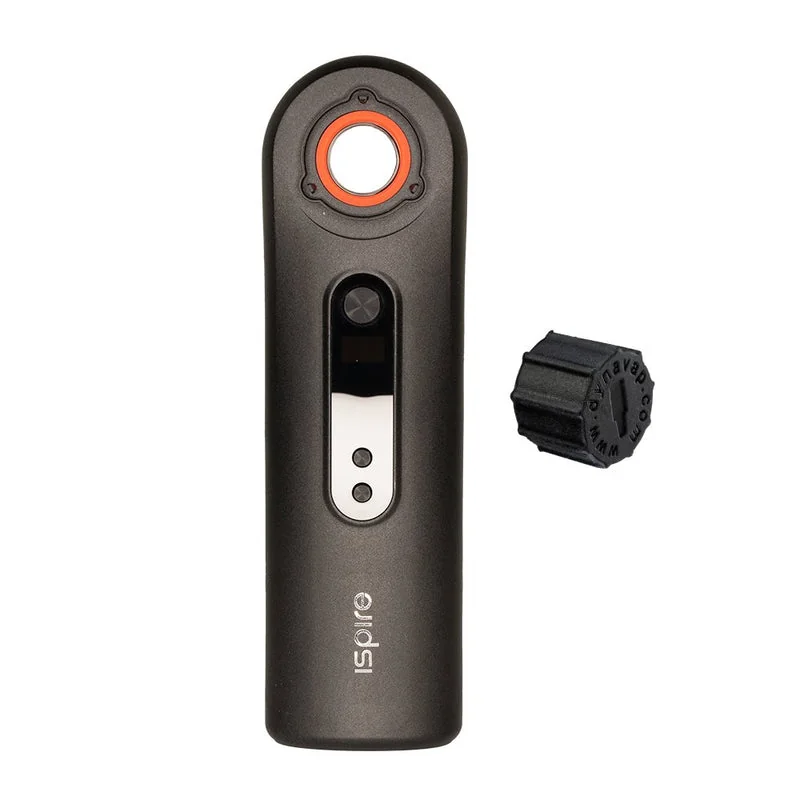
The Ispire Wand is currently the most popular induction heater on the market — and for good reason. It works both as a desktop device (with a charging dock) and as a portable IH with a built-in battery.
What sets it apart from the competition: you can adjust the temperature. Through a small display, you set how much the cap gets heated. Lower settings for flavor, higher settings for thicker clouds. That gives you a level of control you never had with a lighter.
The build quality is solid, the design understated. Battery life ranges from 15 to 25 sessions depending on the setting. Price-wise, the Wand sits between 130 and 180 EUR — not cheap, but reasonable for the flexibility it offers.
Strengths: Portable and desktop in one, temperature control, good battery life, solid build.
Weaknesses: Higher price, almost overkill for desktop-only use.
VapHotBox
The VapHotBox is a pure desktop device. Plug it in, insert the DynaVap, wait a moment. Done. No frills, no displays, no settings.
That’s precisely its advantage: the VapHotBox does one thing and does it well. The build quality is sturdy, the wooden housing looks premium. Multiple wood types are available, giving the device a handcrafted feel.
Heat-up time sits at about 5 to 8 seconds — fast enough for daily use. Price-wise, the VapHotBox ranges from 100 to 150 EUR.
Strengths: Simple, reliable, beautiful build, fair price.
Weaknesses: Desktop only, no temperature adjustment, always needs a power outlet.
Caldron / Portside Mini
The Caldron (sometimes sold as the Portside Mini) is the entry point into the IH world. Compact desktop format, low price, straightforward operation.
The design is simple: housing, coil, power supply, button. Press and hold, the cap heats up, wait for the click, release. Heat-up time is comparable to the VapHotBox.
The Caldron targets people who want to try an IH without spending 150+ EUR right away. Between 80 and 120 EUR, you get a functional device that gets the job done.
Strengths: Affordable entry point, compact, easy to use.
Weaknesses: Build quality not quite on VapHotBox level, no portable options, few extras.
Koil Boi
The Koil Boi is one of the few portable induction heaters with its own battery. If you want to use your DynaVap on the go without a lighter, this is your option.
The device is compact enough for a jacket pocket. The battery lasts for roughly 20 to 30 heat cycles — that’s one to three days depending on usage. Charging is via USB-C.
Price-wise, the Koil Boi sits between 100 and 140 EUR. For a portable device with a battery, that’s a fair deal.
Strengths: Portable, compact, USB-C charging, good battery life.
Weaknesses: Slightly slower than desktop IHs, no temperature control, battery eventually needs charging.
DIY Induction Heater
If you can solder and enjoy tinkering: you can build your own IH. The basic idea is straightforward — a ZVS module, an induction coil, a power supply and a housing. That’s it.
What you need:
- ZVS induction module (~10-15 EUR, Amazon or AliExpress)
- Induction coil (often included with the ZVS module)
- 12V power supply with at least 5A (~10-15 EUR)
- Momentary switch
- Housing (wooden box, 3D print or plastic enclosure)
- Glass tube as an adapter for the DynaVap
- Wire, solder, heat shrink tubing
Total cost: Between 30 and 50 EUR, depending on what you already have lying around.
Guides are all over Reddit (r/inductionheaters) and YouTube. The build takes an afternoon. The result might not look as polished as an Ispire Wand, but it works just as well.
Warning: You’re working with electricity. If you’ve never soldered before, a ready-made device is the safer choice. Short circuits on a ZVS module are no joke.
Comparison Table
| Model | Type | Price (approx.) | Portable | Key Feature |
|---|---|---|---|---|
| Ispire Wand | Desktop + Portable | 130–180 EUR | Yes | Temperature control, display |
| VapHotBox | Desktop | 100–150 EUR | No | Wooden housing, multiple variants |
| Caldron | Desktop | 80–120 EUR | No | Most affordable entry |
| Koil Boi | Portable | 100–140 EUR | Yes | Compact, USB-C |
| DIY | Desktop (usually) | 30–50 EUR | Possible | Self-built, maximum control |
What to Look for When Buying
Compatibility. Not every IH fits every DynaVap generation. Most current models support the M series, Omni and Vong. But older or unusual caps can cause issues. Check before you buy.
Power source. Desktop or portable? If you only use the DynaVap at home, a desktop IH is perfectly fine. For on-the-go use, you need a model with a battery — and the selection shrinks.
Heat-up speed. Most IHs reach the click in 5 to 10 seconds. There aren’t huge differences. Desktop models tend to be slightly faster because more power is available.
Build quality. Wooden housing, plastic, metal — that’s a matter of taste. But look for clean craftsmanship. An IH has to handle heat daily. Cheap components come back to bite you after a few months.
Warranty and support. Especially relevant for niche products. A broken IH is useless. Buy from retailers that offer warranty coverage and are actually reachable.
Who Should Get an IH?
Daily users. If you use your DynaVap multiple times a day, an IH saves you time and hassle. No refilling, no fiddling with the flame.
Medical users. Simple operation matters here. Insert, press, wait. Anyone can do that.
Home users. If you mainly use the DynaVap at home, you’ll benefit most from a desktop IH. Comfortable, consistent, quiet.
Aesthetics fans. On a purely practical note: a wooden IH on your desk looks better than a jet lighter next to an ashtray. If you care about your setup, an IH is a nice piece of gear.
Who doesn’t need one: Occasional users who only pull out their DynaVap every now and then. Or purists for whom the lighter ritual is part of the experience. The investment isn’t worth it in those cases.
Tips for Using an IH
An induction heater isn’t rocket science, but a few things are worth knowing to get the most out of it.
Vary insertion depth. How far you push the DynaVap into the opening affects heat distribution. Deeper in heats closer to the tip — less deep heats more toward the middle of the cap. Experiment with it. Most IH users find their sweet spot after a few days.
Respect the click. The cap’s click is your signal with an IH too. Some people ignore it and heat past the click. That can work, but it quickly moves toward combustion. Better to pull out at the first click and test if the vapor density works for you. On the next cycle, you can always add a second or two.
Clean regularly. An IH accumulates particles and residue in the chamber over time. Wipe the glass tube (on models with a glass insert) regularly with isopropyl alcohol. For wooden housings, go over them with a dry cloth occasionally.
Battery care for portable IHs. Lithium-ion batteries don’t like extreme temperatures. Don’t leave the Koil Boi or Ispire Wand in a hot car. And don’t always drain the battery to 0% — keeping it between 20% and 80% is better for longevity.
Don’t leave desktop IHs plugged in permanently. Some models don’t have a real off switch. Unplugging the power supply overnight is a good habit — saves electricity and protects the electronics.
IH and DynaVap Models: What Fits?
Not every DynaVap behaves the same in an IH. The M series (M7, M Plus) works with all common IHs without issues. The stainless steel cap is the standard that all manufacturers design for.
The Omni series with titanium cap reacts faster to induction — titanium heats up faster than stainless steel. This means the click comes sooner. Some see that as an advantage, others need to adjust their technique.
With Vong models that have a wooden body, be careful: wood doesn’t conduct heat away. Not a problem in a desktop IH, but with prolonged heating the cap can get hotter than expected. Short cycles are safer here.
DynaVap models with the new Adjust-a-Bowl (from M7 onwards) work in every IH. Chamber size has no effect on induction heating — only the cap gets heated.
Conclusion
An induction heater makes the DynaVap more convenient, more consistent, and more practical for daily use. The Ispire Wand offers the most flexibility — portable and stationary, with temperature control. If you’re looking for a pure desktop device, the VapHotBox or Caldron will serve you well. And if you enjoy tinkering, build your own for under 50 EUR.
The choice depends on your usage profile. On the go a lot? Ispire Wand or Koil Boi. Home only? VapHotBox. Tight budget? Caldron or DIY. There’s no wrong answer, as long as you know what you need.
At the end of the day, an IH isn’t a must. Your DynaVap works with any lighter. But once you’ve tried an IH, you’ll rarely want to go back to the lighter.
Current prices for DynaVap products and accessories can be found in the price comparison on vapochecker.com.