Artisan Vaporizers: Vapman, Lotus, Camouflet
Artisan Vaporizers — Vapman, Lotus & Camouflet in Detail
Anyone with even a little familiarity with the world of butane vaporizers will eventually come across a small but very lively niche: handcrafted devices from small workshops. No mass production, no anonymous factories in China — but one-off pieces or small batches that someone built with a genuine interest in craftsmanship and vapor quality.
That is exactly what this article is about. Three manufacturers take center stage: Vapman from the Jura region of Ticino, Lotus Vaporizer from the USA and Camouflet from Canada. All three work with butane, all three have loyal fan bases — and all three look completely different from what you would usually know.
What makes an artisan vaporizer?
Before we get to the individual devices: what actually sets an artisan vaporizer apart from a DynaVap or a Flowermate?
The most obvious thing is the material. Artisan vaporizers are almost always made from high-quality woods, often with visible grain, sometimes hand-sanded and oiled. Some manufacturers work with brass, bronze or titanium in small batches. That means every piece is slightly different — different grain, different wood color, sometimes minimal differences in shape.
Then there is the question of scale. Small workshops build twenty devices a month, not twenty thousand. Some manufacturers have waiting lists. At first glance that sounds frustrating, but it also changes the buying experience: you are not getting a generic mass-produced product, but something that someone actually assembled by hand.
And finally: the vapor quality. Artisan vaporizers often place special emphasis on short, clean air paths made from glass or stainless steel. The focus is on flavor, not clouds. If you enjoy terpene-rich, aromatic vapor, this category is exactly right.
Vapman — Craftsmanship from Ticino

The Vapman comes from Losone in the canton of Ticino — a small town in the Italian-speaking part of Switzerland. It is built by hand, in very small quantities. The device has existed for over ten years and has built up a worldwide fan base over the years.
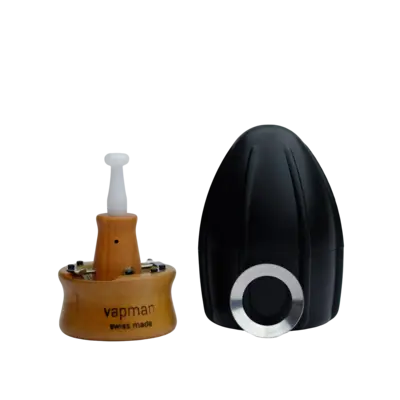
The principle: The Vapman consists of a wooden shell that encloses the brass heating head. You remove the top shell, fill the small herb bed, put the shell back on — and heat it from below with a butane flame. No cap, no tip like on the DynaVap. Instead, there is a broad, flat heating body that warms the herbs evenly from below.
The heating concept is unique: the flame hits a brass heat shield disc that distributes the heat. You hear a soft click when the right temperature is reached — similar to the DynaVap. Then you draw through the built-in glass tube, which also serves as the mouthpiece.
The wood: Vapman shells are made from different woods — walnut, cherry, peach, sometimes more exotic varieties. Every wooden shell is unique because of the natural grain. On the Vapman website you often see photos of ten or twenty devices side by side, and not a single one looks identical.
Vapor quality: Excellent for flavor. The short glass path keeps the vapor cool and aromatic. If you like terpene richness, you will like the Vapman. The hits are rather moderate — the Vapman is not a cloud-chasing device.
Price and availability: Between 180 and 250 EUR, depending on the type of wood and finish. There are sometimes waiting lists. Buy directly from the manufacturer or from specialized European retailers.
Who is it for? Anyone who values origin, craftsmanship and a very personal device. The Vapman is not for everyone who simply wants a good device quickly — it is for someone who wants to own a device.
Lotus Vaporizer — The flat plate
The Lotus Vaporizer looks at first glance like a pipe bowl — because it is basically used like a pipe. The device has a round, flat metal plate on top, a herb chamber underneath, and you hold the butane flame just above the metal plate without touching it directly.
The heating principle: The clever part of the Lotus is that you never point the flame directly at the herbs. Instead, the flame heats the stainless steel plate, which then warms the air above it — and you draw that hot air through the herbs. That is convection heating in a very minimalist form.
The Lotus takes a bit of practice. The flame has to be close enough to heat, but far enough away not to overheat the plate. Once you get the hang of it, you draw calmly and evenly — and your draw also regulates the temperature. Faster draw = more air = more cooling. Slower draw = less air = hotter vapor.
The mouthpiece: Interchangeable, usually made of glass. The glass air path is short and clean, and the vapor has little room to cool down or settle. Cleaning is simple: take out the glass and rinse it.
Shape and handling: The Lotus is not a handy pipe for use on the go. It is more of a tabletop device or home device. The brass or aluminum body is robust, but using it one-handed in the air plus a butane lighter is not quite as relaxed as with the DynaVap. Even so, many users handle the Lotus daily — after a while it develops real familiarity.
Price: Between 100 and 140 EUR for the basic device, depending on the retailer and mouthpiece set.
Strengths: Very clean, cool vapor. Affordable for the category. Hardly any parts that can break — metal, glass, done.
Weaknesses: Learning curve. Needs a calm setting and a steady hand. Not for rushed sessions.
Camouflet — Canadian craftsmanship at a high level
Camouflet is a small workshop from Canada and may make the most technically refined artisan butane vaporizers available. The current product line includes three models: Convector, Convector XL and Inductor.
Convector: The entry-level model — although “entry-level” is relative with Camouflet, because the Convector is also priced at around 150 EUR. It consists of a brass heating head that is placed over the herbs, similar to a thimble. You heat from above, and the herbs are cooked by the convection heat of the heating head. The result: very even extraction, clean vapor.
Convector XL: Like the Convector, but with a larger herb chamber. More per session, slightly thicker hits. For users who prefer larger loads. The price is around 200 EUR.
Inductor: The flagship device — and the most interesting device in the line. The Inductor is built for induction heaters, not butane lighters. Anyone with an induction heater can use the Inductor without a flame. That makes it hybrid: an artisan device and future-proof at the same time.
Material quality: Camouflet works with brass, stainless steel and sometimes titanium. All parts are precision-milled, with no cast parts. The devices feel substantial — this is not plastic, not polymer. When you hold the Convector in your hand, you immediately know what you paid for.
Vapor quality: Excellent. The Convector produces dense, aromatic hits. The convection heating ensures very even extraction without hot spots. Anyone previously using a torch-heated DynaVap will notice the difference on the first draw.
Price: 150 to 300 EUR, depending on the model. Not excessive for handcrafted quality at this level of precision — but not an impulse buy either.
Comparison at a glance
| Vapman | Lotus | Camouflet Convector | |
|---|---|---|---|
| Price | 180–250 EUR | 100–140 EUR | 150–300 EUR |
| Heating principle | Mixed conduction/convection | Convection | Convection |
| Material | Wood + brass | Stainless steel + glass | Brass / stainless steel |
| Origin | Ticino, Switzerland | USA | Canada |
| Learning curve | medium | high | medium |
| Portability | good | medium | good |
| Collector factor | very high | medium | high |
| Special feature | Unique wooden shells | Hot air over plate | Inductor version for IH |
Who are artisan vaporizers for?
Honest answer: not for everyone. If you are looking for a simple, affordable device that just works, you are better off with a DynaVap B or a beginner-friendly butane device.
Artisan vaporizers are for people who are interested in the device itself. People who appreciate the material, who enjoy thinking about the heating principle, who may want to build a small collection. And who are willing to invest a bit more time — both when buying (waiting lists, limited availability) and when using it (understanding the technique, practice).
Some users live in both worlds: DynaVap in the morning on the way to work, Vapman in the evening at the desk. Different devices for different moments.
The collector aspect
Collecting is absolutely common in the artisan scene. A Vapman in walnut, one in cherry wood, one from a limited small batch — that is nothing unusual. Camouflet occasionally releases special versions with different materials or finishes that sell out within hours.
That may sound exaggerated, but it fits the way these devices exist. They are not just tools, they are objects. Beautifully made objects that last a long time and that you enjoy looking at even when you are not using them.
Some manufacturers sign their devices, number their series or include handwritten notes. Details like that make no functional difference — but they make the buying experience something different from Amazon Prime.
Conclusion
Vapman, Lotus and Camouflet represent three different approaches to what handmade butane vaporizers can look like. The Vapman is the most personal, almost jewellery-like device. The Lotus is the purist of the three — the simplest technology, maximum purity. Camouflet brings the highest technical precision and the broadest model range.
What all three share: small teams, real craftsmanship, and a philosophy that clearly stands against disposable products. Once you have used an artisan device daily, you look differently at mass and class afterwards.
Prices for all three in the current comparison:
Price comparison on vapochecker.com
Current prices