Connecting a vaporizer with water filtration: setup and compatibility
Short answer: For a water attachment, the vaporizer, adapter and glass vessel must be mechanically and functionally compatible. The decisive factors are the connection size, connection type, insertion depth, airpath and an operating position permitted by the manufacturer. Water is not a proven universal health safeguard. A fixed 95-per-cent active-substance retention figure cannot be derived from Hazekamp 2006. [Hazekamp2006]
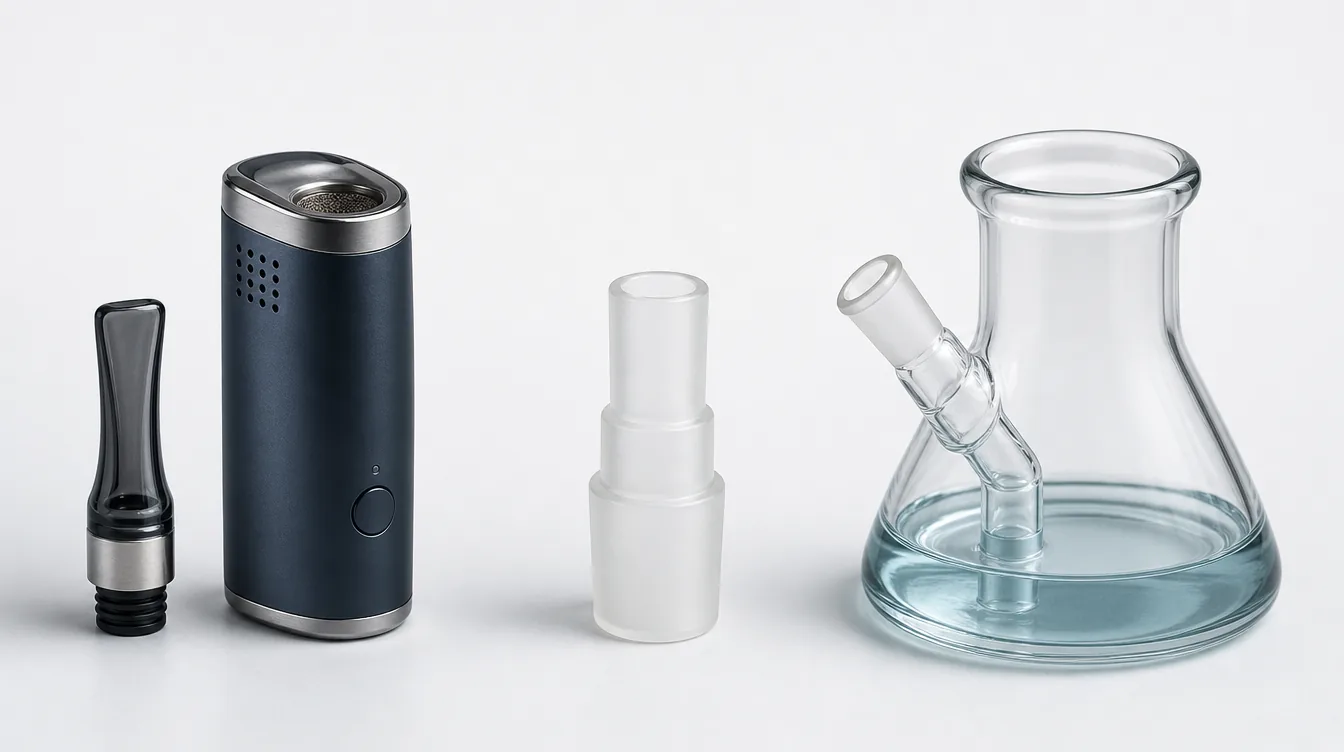
What this page covers
This page explains the technical selection and preparation of a water-bearing setup. It is not a medical filtration recommendation and not a ranking by lung protection. The scientific rationale and the open measurement questions are discussed in detail in the background article Water Filtration with Vaporizers.
A compatible setup cannot be identified from a product photo alone. Adapters may have similar nominal dimensions yet still differ in joint direction, length or seal. The complete connection chain should therefore be known before purchasing.
The twelve scientific studies do not provide a current accessory compatibility database. Model-specific approvals are manufacturer statements. Where such approval is absent, it is not replaced here by a supposedly scientific general statement.
The complete path from device to mouthpiece
A typical setup comprises the vaporizer outlet, a water pipe adapter (WPA), the connection to the water vessel, a path through or past water, and the final mouthpiece section. Tubes or additional cooling pieces can create further transitions.
Every transition can alter the airpath. Leaky connections can admit bypass air; incorrect insertion depths can block openings or cause parts to collide. A setup that appears to fit together is therefore not necessarily correct.
Weight distribution also matters. A heavy device on a long lever arm places different stress on the glass joint and base than a short, light adapter. The specific combination is decisive. The scientific emissions studies do not examine this mechanical load-bearing capacity.
Checking compatibility before purchase
| Check point | What must be established | Why it matters |
|---|---|---|
| Connection size | Nominal dimension on both sides | Similar designations do not guarantee compatibility |
| Connection direction | Male or female joint, or the intended plug system | Counterparts must match each other |
| Insertion depth | Clearance to screen, bowl or inner tube | Avoids contact and blocked airpaths |
| Operating position | Orientation permitted by the device manufacturer | Liquid and sensitive device areas must remain separated |
| Seal | Intended material and position | Improvised seals may be unsuitable |
| Stability | Complete setup including device and cable | The glass base alone does not describe the overall stability |
| Maintenance | Disassembly and approved cleaning procedures | Internal surfaces must remain accessible |
The table is a technical inspection aid. It does not assert any measured improvement in aerosol chemistry.
What 14 mm and 18 mm indicate – and what they do not
Such figures are frequently used in the accessory trade to describe the size of a ground-joint connection. They make no statement about the overall geometry. The direction of the joint, its length and the specific model approval must also be correct.
An adapter may additionally have a manufacturer-specific connection on one side and a glass joint on the other. Looking only at the glass side then leaves the decisive device compatibility open. With multiple adapter pieces, additional transitions and lever arms accumulate.
Anyone faced with an unclear product description needs the dimensional drawing or an unambiguous compatibility statement. Applying more force when joining parts together is not a solution for differing geometry. An article should therefore not use a blanket list of “fits all vaporizers”.
Bubbler, large water vessel or recycler?
A compact bubbler can allow a short setup. A larger vessel changes volume and footprint. A recycler routes liquid and air via additional paths. These descriptions concern form factor and handling.
Which form factor is practically suitable also depends on the available surface area, cleaning access and desired portability. More chambers do not automatically mean a better solution. Additional narrow channels can make inspection and maintenance more difficult.
The pool of studies contains no direct clinical comparison of these form factors. Statements such as “medically best filtration” or “maximum lung protection” would therefore be unsubstantiated. Ease of handling is likewise a personal or technical assessment, not a health endpoint.
Water volume and draw resistance
For the fill level, the vessel’s instructions are the primary reference. A universal millilitre figure would be misleading given the differing internal geometries. The same volume can reach a different height in a wide vessel than in a narrow one.
The water column and the flow path influence the resistance against which air is moved. Too much water can alter the intended flow or allow liquid to reach unintended areas. Operation must not depend on compensating for an incorrect fill level by drawing particularly hard.
A cold function test without the vaporizer switched on can show whether water reaches the direction of the connection during normal handling. It does not, however, replace a manufacturer approval. Particularly with electrical devices, a setup is required that structurally keeps liquid away from sensitive areas.
Why water temperature and device temperature remain separate considerations
The heating setting determines the controlled variable of the vaporizer. The water temperature describes a later part of the aerosol path. A water attachment does not automatically make a higher device setting acceptable, nor does it define a safe material temperature.
Equally, a fixed outlet temperature cannot be derived from cool water. During a draw, several components transfer heat; with repeated use their initial state changes. Anyone wishing to quantify a cooling effect must measure it on the complete setup.
Manufacturer specifications regarding permissible liquid and temperature conditions must therefore be observed separately. This article does not recommend extreme water temperatures as supposedly scientifically superior. The source pool provides no direct evidence for this.
THC retention: what is actually evidenced
The frequently repeated claim that 95 per cent of active substances are retained after water filtration is not used here. Hazekamp studied a Volcano and its delivery into a balloon. The study does not validate any such figure for water attachments. [Hazekamp2006]
The argument that “THC dissolves poorly in water, so nothing is lost” is also incomplete. An aerosol can deposit material on various surfaces. How much cannabinoid reaches the end of a setup is a question of analytical mass balance, not merely of water solubility.
Lanz demonstrates, in the general device experiment, why residues and different collection fractions must be recorded separately. This is methodological background, not a validation of the accessory chosen here. [Lanz2016]
Cleaning and drying: follow material-specific instructions
Before cleaning, hot components must be allowed to cool in accordance with their instructions and electrical parts must be disconnected. Glass, seals, coatings and plastics may require different cleaning procedures. A product suitable for bare glass is not automatically suitable for every seal.
Components that can be fully emptied and inspected are practically helpful. After the prescribed cleaning, no residue of the cleaning agent may remain in the inhalation path. The specific rinsing and drying steps follow from the manufacturer’s instructions.
A universal scientifically derived cleaning interval cannot be derived from the pool of twelve studies. Usage, setup and approved procedures differ. Visibly clear water proves neither microbiological cleanliness nor a particular aerosol quality.
Typical errors when assembling a setup
Buying based on joint size alone: This leaves the device connection and insertion depth unchecked. It is better to describe the complete connection from outlet to glass vessel.
Confusing comfort with protection: A subjectively pleasant draw may be relevant for personal use. It does not evidence the removal of specific harmful substances or long-term safety.
Reading historical studies as accessory tests: Volcano studies do not constitute blanket approval for arbitrary adapters, bubblers or current device models. The tested configuration is part of the finding.
Comparing only the price of the adapter: A complete setup may require a vessel, additional connectors, and a suitable base. Purchase costs are part of the product decision and must correspond to the respective offer.
Equating more parts with higher quality: Additional joints alter the setup. Whether this is advantageous depends on a clear objective and the specific implementation.
A well-reasoned purchasing decision
The sensible order is: identify the existing device, determine the approved connection solution, verify the complete geometry, and only then compare offers. The model version, scope of delivery, and, where applicable, the position of the power supply/cable should be documented.
For scientific assessment, a separate question remains open: Are there data for precisely this configuration and precisely the advertised endpoint? If not, the selection remains a technical accessory decision. A long list of references does not substitute for this missing fit.
The water filtration evidence check explains what measurements a quantitative claim would require. Those who primarily wish to assess flavour and draw feel will find a separate evaluation framework in the article Vapour Quality.
Frequently Asked Questions
Does every vaporizer fit a water pipe?
No. The device connection, adapter, geometry, and permitted operating position must be compatible with the specific model. A standard joint size alone is not sufficient.
How much water should I fill in?
Follow the vessel manufacturer’s specification. A universal quantity is not meaningful due to differing internal geometries. Liquid must not enter unintended parts of the setup.
Is water filtration scientifically proven to be healthier?
Within the pool of twelve studies used here, there is no direct comparison that supports this general health claim. The statement about the limited pool is not a worldwide comprehensive literature search.
Does Hazekamp prove 95 per cent active compound retention?
No, not for water filtration. The paper examines the delivery of a Volcano and is not a corresponding water filter test. [Hazekamp2006]
Can I compensate for a higher heat setting by using water?
Downstream cooling validates neither the aerosol chemistry nor the temperature in the plant material. Heat setting and water attachment must be assessed separately.
Studies, Sources, and Limits of Claims
The study cards describe the respective experimental setup and its limitations.
Hazekamp2006: Volcano laboratory validation with pure cannabinoids and plant material; supplementary measurement of exhaled THC.
Hazekamp A, Ruhaak R, Zuurman L, van Gerven J, Verpoorte R. Evaluation of a vaporizing device (Volcano) for the pulmonary administration of tetrahydrocannabinol. Journal of Pharmaceutical Sciences. 2006;95:1308–1317.
- Design and Material/Population
- Volcano laboratory validation with pure cannabinoids and plant material; supplementary measurement of exhaled THC.
- Sample Units
- Four devices; temperature trials conducted in triplicate, final device comparison with 4 mg THC performed five times per device. The brief report does not state an unambiguous total number of clinical participants.
- Measurement
- HPLC and quantitative NMR; predominantly 8-L balloon. Loading 2–8 mg pure THC. Temperature measured centrally in the filling chamber above the liquid pad. Loaded, delivered and exhaled quantities are recorded separately.
- Finding
- In the final device comparison, an average of 53.9 % of the loaded THC passed into the balloon. The trial also investigated condensation at the chamber, valve and balloon. The near-complete deposition on the analytical glass-fibre filter is not a finding relating to a water filter.
- Uncertainty and Transferability
- Recovery is protocol- and substrate-dependent, not a universal bioavailability figure. The supplementary clinical measurement did not include pulmonary function testing. No comparison with and without water filtration was made.
- Funding and Interests / Design Notes
- Devices from Storz & Bickel, plant material from Bedrocan; Farmalyse supported the preparation of clinical cannabinoid standards. No separate comprehensive declaration of interests was found.
- Specific Source Location
- Original pp. 1310–1312: Methods; pp. 1314–1315: delivery/condensation; p. 1316: Acknowledgements. Manufacturer copy with differing pagination additionally cross-checked.
- Review Scope
- Relevant full-text passages, methods and support statements verified on 10.09.2026; previously abstract only.
Verified Source · DOI: 10.1002/jps.20574
Lanz2016: In-vitro validation of Volcano Medic, Plenty, Arizer Solo, DaVinci and Vape-or-Smoke with THC- and CBD-containing plant material as well as standards.
Lanz C, Mattsson J, Soydaner U, Brenneisen R. Medicinal Cannabis: In Vitro Validation of Vaporizers for the Smoke-Free Inhalation of Cannabis. PLOS ONE. 2016;11:e0147286.
- Design and material/population
- In-vitro validation of Volcano Medic, Plenty, Arizer Solo, DaVinci and Vape-or-Smoke with THC- and CBD-containing plant material as well as standards.
- Sample units
- Five models, not five clinical groups. The replicates per experimental condition are technical replicates; different sample types and measurement fractions must not be combined into a single total.
- Measurement
- HPLC/GC-MS; investigation of cannabinoid recovery, residues and decarboxylation. Electrical devices were tested under defined temperature conditions.
- Finding
- Cannabinoid recovery differed between the specific devices. Combustion was observed in the gas-powered Vape-or-Smoke that was examined.
- Uncertainty and transferability
- Recovery, decarboxylation and losses at device surfaces are separate measured quantities. No direct measurement of lung deposition, blood levels or long-term disease outcomes.
- Funding and interests/design notes
- No specific funding; the authors declare no competing interests and explain the subsequent employment/involvement of one author at AiFame/AiLab.
- Specific source location
- Materials and Methods: Vaporization, Sample Preparation and Analysis; Results and Discussion: Recovery of Cannabinoids, Decarboxylation; Table 2 and figure legends.
- Review scope
- Relevant full-text passages reviewed on 10.09.2026.
Source review: 10 September 2026. Within the targeted pool of twelve primary studies, eleven were reviewed on the basis of relevant full-text passages. For Van Dam 2010, accessible original sections beyond the abstract were additionally reviewed; a complete PDF and table review remains outstanding. Further literature cited in the article belongs to separate source reviews. No systematic comprehensive search.