Vaporizers for Wax and Dabs: Comparing Product Approvals and Exposure Correctly
A device suitable for flower is not automatically intended for wax, dabs or other concentrates. What matters is the specific product type and the explicit approval of the device or attachment. Health findings from a dry-herb vaporizer must not be applied wholesale to concentrate use. Muheriwa-Matemba et al. (2024)
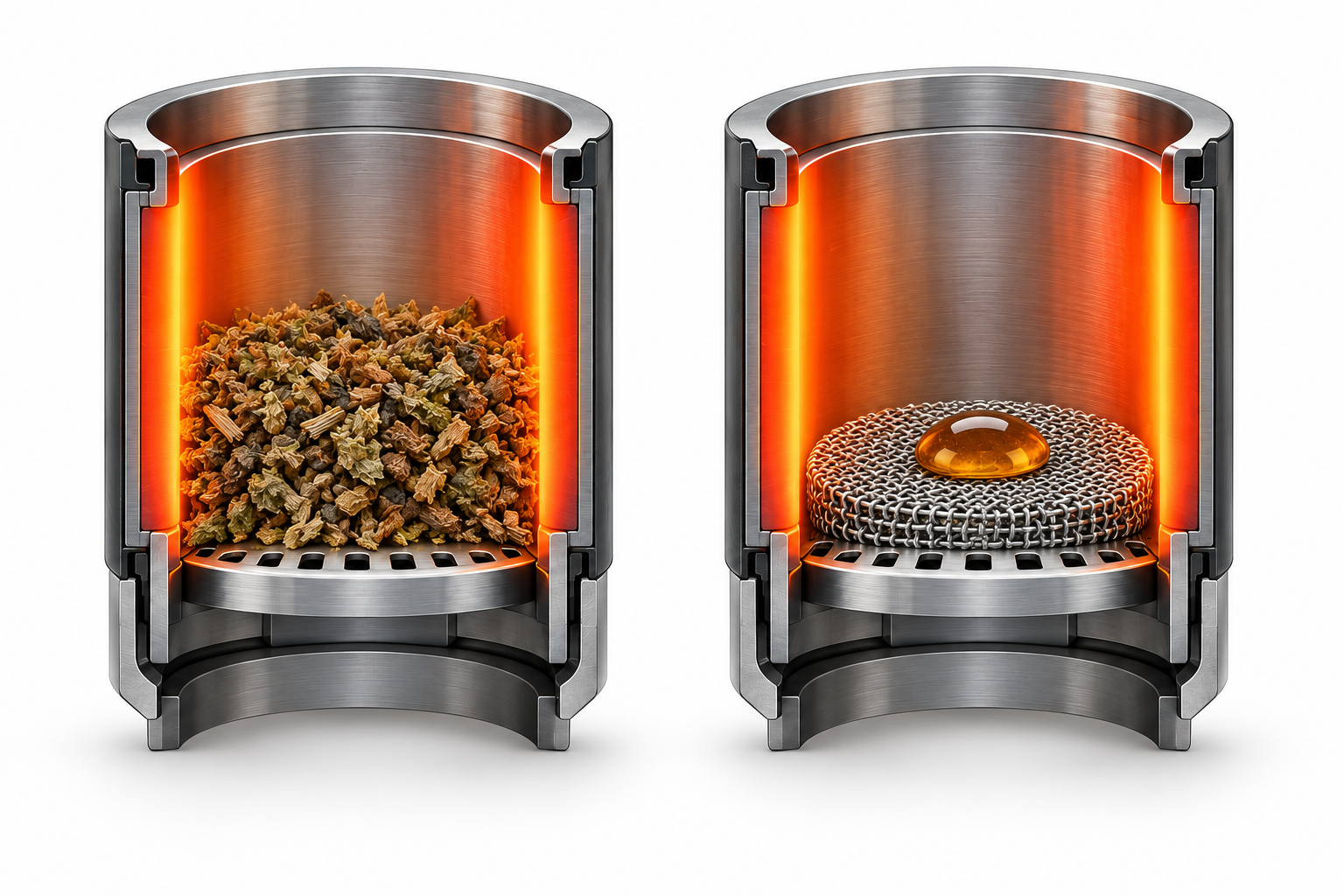
Schematic AI illustration by VapoChecker. Colors identify components and heat paths; not a scale drawing and does not contain measurement data.
Why is material approval the first step?
Concentrates can behave differently from a herb load during heating and residue build-up. A suitable insert must be compatible with the intended airpath and heating system. The fact that a product can be placed in a chamber proves neither correct delivery nor appropriate cleaning.
Different concentrates are not automatically interchangeable either. A product name and consistency do not provide a complete composition. A clear description of the sample used is required for any meaningful comparison.
What should be checked with modular attachments?
An attachment requires a compatible power supply and the intended operating mode. Shared thread types do not describe all electrical requirements. Systems with a separate heater involve additional mechanical and thermal connections.
Always check specific model versions and approvals. A temperature or power figure from a different setup is not a general recommendation. Modifying contacts or safety features is not part of a normal installation.
Can flower and concentrate efficiency be compared directly?
Only with a clearly defined endpoint and appropriate measurement. Equal material mass does not mean equal nominal THC dose when potency differs. Identical visible vapor clouds do not mean equal delivered or absorbed quantities.
Laboratory work on dry-herb vaporizers describes specific transfer conditions. It is not a conversion table for wax or dabbing. Lanz et al. (2016) Hazekamp et al. (2006)
What role does high THC potency play?
The review by Petrilli reports associations between higher potency and psychosis and cannabis use disorder. A later review rates the overall certainty of evidence as very low and highlights substantial gaps for several long-term outcomes. The signals are relevant but do not yield a precise individual risk figure for a specific attachment. Petrilli et al. (2022) Lake et al. (2025)
Potency, quantity used, and usage patterns remain separate variables. A technical comparison should therefore not treat maximum concentration as a quality goal without further context.
Which maintenance considerations matter in practice?
Check accessible contact surfaces, intended cleaning methods, and available replacement parts. A cleaning agent not approved for the device can introduce a new technical problem. A removable insert does not automatically make the complete device safe to soak.
Further reading: Extracts and Concentrates, Dry Herb vs. Concentrates and 510 Thread. This distinction makes selection transparent without turning product compatibility into a health guarantee.
Product Categories Compared
| Designation | Clarify First | Typical Comparison Gap |
|---|---|---|
| Pen or Cartridge System | Which product and which electrical combination are intended? | Thread is mistaken for full compatibility |
| Electronic Rig | Which insert belongs to the specific device generation? | Display reading is compared with another system without reference to measurement location |
| Separate Heater with Attachment | How do the controller, heater, contact, and tray work together? | Individual parts are assessed independently of the overall system |
| Dry-Herb Device with Additional Insert | Is there an explicit approval for this material? | Physical fitment replaces manufacturer approval |
The categories organize construction types. They are neither a ranking nor evidence of equivalent exposure. ‘Pen’, for example, describes the form but not unambiguously the contents. For a scientific comparison, the chemical description of the sample is just as important as the device designation.
What is often missing from costs and running costs
Compare the purchase of a complete, intended system. An inexpensive attachment without the required power supply cannot be compared directly with a complete set. Add the costs of necessary replacement parts and approved maintenance products. If the service life of a consumable is not reliably documented, no precise annual figure may be calculated from this.
Material costs must also be considered separately. Equal amounts in pounds per gram answer a different question for different products than cost per analytically determined active-ingredient quantity. Even the latter does not yet yield a price per absorbed dose or clinical benefit. Such a figure requires further measurements and may not be derived from product concentration alone.
Studies in detail: methods, results and limitations
The following boxes make the key sources and their limits of transferability transparent. A device study or pharmacokinetics study does not automatically constitute evidence of long-term health safety. For technical articles, the studies are often relevant only to the explicitly stated distinction between health claims and yield claims.
Muheriwa-Matemba SR et al. (2024)
- Study
- Systematic review
- Sample
- 42 included publications: 6 case reports, 21 reviews, 15 empirical studies; among the empirical studies are 2 RCTs, 5 retrospective analyses, 3 longitudinal studies, and 3 cross-sectional studies.
- Comparison and measurement
- Web of Science, ProQuest, PsycINFO, Scopus, Embase, and Medline; peer-reviewed publications 2009–2023; PRISMA; only studies with documented route of administration.
- Randomisation and blinding
- Not at the review level; only a small proportion of the primary studies were randomised.
- Result
- Smoking was most consistently associated with respiratory symptoms and conditions; edibles showed little direct respiratory effect; tachycardia was reported across several routes of administration.
- Strengths
- Tailored specifically to route of administration; broad database search; distinguishes smoking, vaping, oral use, and dabbing.
- Limitations and potential bias
- Highly heterogeneous evidence; includes reviews and case reports alongside primary studies; no meta-analysis; the authors themselves describe route-specific conclusions as preliminary.
Muheriwa-Matemba SR, Baral A, Abdshah A, Diggs BA, Gerber Collazos KS, Morris KB, Messiah SE, Vidot DC. 2024. Cardiovascular and Respiratory Effects of Cannabis Use by Route of Administration: A Systematic Review. Substance use & misuse. DOI: 10.1080/10826084.2024.2341317 · PMID 38644600
Lanz C et al. (2016)
- Study
- In-vitro device and aerosol validation
- Sample
- No human participants; 5 commercial dry-herb vaporizers, THC-dominant and CBD-dominant plant material.
- Comparison and measurement
- GC/MS for cannabinoid recovery in collected aerosol, HPLC for acidic cannabinoids and decarboxylation; Volcano Medic, Plenty, Arizer Solo, DaVinci, and a gas-powered device.
- Randomisation and blinding
- Not applicable.
- Result
- Electrically temperature-controlled devices decarboxylated THC/CBD very efficiently and delivered cannabinoids reproducibly; combustion was observed with the gas-powered device.
- Strengths
- Validated analytical methods; multiple devices; direct measurement of material transfer.
- Limitations and potential bias
- No human participants, no clinical endpoints, no comprehensive toxicological aerosol analysis; device generations are older.
Lanz C, Mattsson J, Soydaner U, Brenneisen R. 2016. Medicinal Cannabis: In Vitro Validation of Vaporizers for the Smoke-Free Inhalation of Cannabis. PloS one. DOI: 10.1371/journal.pone.0147286 · PMID 26784441 · PMC4718604
Hazekamp A et al. (2006)
- Study
- Device and dose evaluation study with analytical and clinical components
- Sample
- Primarily device and laboratory characterization; human component for inhalation and exhalation balance, exact number of participants not reported in the abstract.
- Comparison and measurement
- Variation of temperature, sample, and balloon volume; inter- and intra-device variability; loaded versus delivered THC dose; clinical inhalation measurements.
- Randomisation and blinding
- No/not a classical RCT.
- Result
- On average, approximately 54% of the loaded THC dose reached the balloon; approximately 35% of the inhaled THC was exhaled again.
- Strengths
- Reproducibility and dose validation; important methodological basis for subsequent Volcano studies.
- Limitations and potential bias
- No long-term toxicology; outdated hardware and products; health-related conclusions are indirect.
Hazekamp A, Ruhaak R, Zuurman L, van Gerven J, Verpoorte R. 2006. Evaluation of a vaporizing device (Volcano) for the pulmonary administration of tetrahydrocannabinol. Journal of pharmaceutical sciences. DOI: 10.1002/jps.20574 · PMID 16637053
Petrilli K et al. (2022)
- Study
- Systematic review of observational studies
- Sample
- 4.171 publications screened; 20 studies with approximately 119.581 participants in total.
- Comparison and measurement
- MEDLINE, Embase, PsycINFO to 14.01.2021; PROSPERO; high- vs low-potency cannabis, outcomes psychosis, anxiety, depression, CUD.
- Randomisation and blinding
- No.
- Result
- Higher potency was consistently associated with greater risk of psychosis and CUD; findings on depression and anxiety were mixed.
- Strengths
- Explicit potency question; established databases; PROSPERO; multiple outcomes.
- Limitations and potential bias
- Observational studies; definition of ‘high-potency’ differs across studies; potency correlates with use behavior and product form.
Petrilli K, Ofori S, Hines L, Taylor G, Adams S, Freeman TP. 2022. Association of cannabis potency with mental ill health and addiction: a systematic review. The lancet. Psychiatry. DOI: 10.1016/S2215-0366(22)00161-4 · PMID 35901795
Lake S et al. (2025)
- Study
- Systematic review of observational and experimental studies
- Sample
- 4.545 records screened, 42 studies included.
- Comparison and measurement
- Five biomedical databases; predefined THC potency classes (1–9%, 10–19%, 20–30%, ~30–50%, concentrates ≥60%); two independent reviewers; GRADE.
- Randomisation and blinding
- Mixed designs; some experimental, many cross-sectional or observational.
- Result
- Evidence particularly for greater problematic cannabis use at higher potency; other health domains less consistent. Overall certainty of evidence: ‘very low’.
- Strengths
- Very current; absolute potency classes; independent screening and quality assessment; GRADE.
- Limitations and potential bias
- Predominantly cross-sectional; large research gaps regarding cardiorespiratory, cancer, and long-term outcomes.
Lake S, Murray CH, Henry B, Strong L, White K, Kilmer B, Cooper ZD. 2025. High-Potency Cannabis Use and Health: A Systematic Review of Observational and Experimental Studies. The American journal of psychiatry. DOI: 10.1176/appi.ajp.20240269 · PMID 40134269 · PMC12549548
Frequently Asked Questions
Why is material approval the first step?
Concentrates can behave differently from a herb load during heating and residue build-up. A suitable insert must be compatible with the intended airpath and heating system. The fact that a product can be placed in a chamber proves neither correct delivery nor appropriate cleaning.
What should be checked with modular attachments?
An attachment requires a compatible power supply and the intended operating mode. Shared thread types do not describe all electrical requirements. Systems with a separate heater involve additional mechanical and thermal connections.
Can flower and concentrate efficiency be compared directly?
Only with a clearly defined endpoint and appropriate measurement. Equal material mass does not mean equal nominal THC dose when potency differs. Identical visible vapor clouds do not mean equal delivered or absorbed quantities.
References
- Muheriwa-Matemba SR, Baral A, Abdshah A, Diggs BA, Gerber Collazos KS, Morris KB, Messiah SE, Vidot DC. 2024. Cardiovascular and Respiratory Effects of Cannabis Use by Route of Administration: A Systematic Review. Substance use & misuse. DOI: 10.1080/10826084.2024.2341317 · PMID 38644600
- Lanz C, Mattsson J, Soydaner U, Brenneisen R. 2016. Medicinal Cannabis: In Vitro Validation of Vaporizers for the Smoke-Free Inhalation of Cannabis. PloS one. DOI: 10.1371/journal.pone.0147286 · PMID 26784441 · PMC4718604
- Hazekamp A, Ruhaak R, Zuurman L, van Gerven J, Verpoorte R. 2006. Evaluation of a vaporizing device (Volcano) for the pulmonary administration of tetrahydrocannabinol. Journal of pharmaceutical sciences. DOI: 10.1002/jps.20574 · PMID 16637053
- Petrilli K, Ofori S, Hines L, Taylor G, Adams S, Freeman TP. 2022. Association of cannabis potency with mental ill health and addiction: a systematic review. The lancet. Psychiatry. DOI: 10.1016/S2215-0366(22)00161-4 · PMID 35901795
- Lake S, Murray CH, Henry B, Strong L, White K, Kilmer B, Cooper ZD. 2025. High-Potency Cannabis Use and Health: A Systematic Review of Observational and Experimental Studies. The American journal of psychiatry. DOI: 10.1176/appi.ajp.20240269 · PMID 40134269 · PMC12549548
Editorial status: 10 September 2026. Evidence-based overview based on a selected library of 34 publications; no independent systematic literature search and no medical review. Bibliographic details and available abstracts were verified; the key works by Spindle (2018) and Lanz (2016) were additionally checked in open full text. Technical selection and maintenance guidance should be distinguished from health evidence. New data may change this assessment.