Butane vaporizers when travelling — What you need to know
If you own a butane vaporizer, you know: these devices are robust, do not need a power socket, and fit into any jacket pocket. Sounds like perfect travel luggage. And most of the time it is — as long as you know a few rules before you set off.
Because “butane gas in hand luggage” sounds like a problem at the airport at first. In fact, in most cases it is not, if you know what is allowed and what is not. This guide explains everything you need to know: from boarding and cleaning to the question of where to buy more butane abroad.
At a glance
- The DynaVap M7 weighs 18 grams and fits into any jacket pocket
- Butane gas is not allowed in hand luggage — buy more at your destination
- Many devices look like tools and barely attract attention at the airport
- A small can of gas is enough for 50 to 80 sessions
Flying with a butane vaporizer — what actually applies
Here is the good news first: a butane vaporizer itself is not a dangerous good. The device as such — whether DynaVap, Vapman or another model — may be taken in hand luggage. No ban, no special declaration.
The catch is the butane gas. And there are clear differences here:
Lighters in hand luggage: A normal disposable lighter (Bic type) is generally allowed in hand luggage under IATA rules — one per person, carried on you, not in the suitcase. This applies at most European airports and likewise in the USA under TSA rules. A simple utility lighter with piezo ignition falls into the same category.
Torch lighters (jet flame): This is where it gets uncomfortable. Many airlines and airports treat torch lighters (the blue flame you need for DynaVap) much more restrictively than normal lighters. The TSA, for example, allows “lighters” in hand luggage but explicitly excludes “torch lighters”. In the EU the rules are similar — in the end, the respective airport and airline decide. Some let them through, some do not.
Butane gas canisters: No chance. Pressurised gas containers — whether small or large — belong in neither hand luggage nor checked baggage. Full stop. This applies to butane gas cartridges for camping just as much as to small refill bottles for lighters.
Checked baggage: Lighters (including normal ones) are generally prohibited in checked suitcases. This is sometimes ignored and sometimes checked strictly — do not rely on it.
Practical tip: Take a normal disposable lighter with you and buy a torch lighter after landing. You can find them in almost every tobacconist or delicatessen shop. Or use an induction heater at your destination instead (more on that later).
Price history
Cleaning before the trip — not an optional step
This is the part many people underestimate: a vaporizer that smells of herbs and has visible residue can raise questions at the security checkpoint — even if you use it legally.
Why cleaning matters: Security officers worldwide react to smells. An uncleaned DynaVap or Vapman smells of used material — and that can provoke unpleasant questions even without any substances present. In some countries, suspicion alone becomes the problem.
What you should do before travelling:
- Clean the condenser and tip on the DynaVap thoroughly with isopropyl alcohol (IPA, 90%+) and let them air-dry for at least one hour
- Burn out the Vapman bowl briefly over a flame until no more smoke appears, then wipe it with IPA
- Check all individual parts for residue — especially in crevices and threads
- After cleaning, smell it yourself: if you sniff it closely and notice nothing, that is usually enough
What does not work: giving it a quick wipe and hoping for the best. Resin settles into metal and wood and will still give off odour when warmed up or put under mechanical stress.
If you want to play it safe, transport the vaporizer and accessories in an odour-proof case (more on that below).
The best butane vaporizers for travelling
Not all butane vaporizers are equally well suited for use on the move. These three have proven themselves as travel companions:
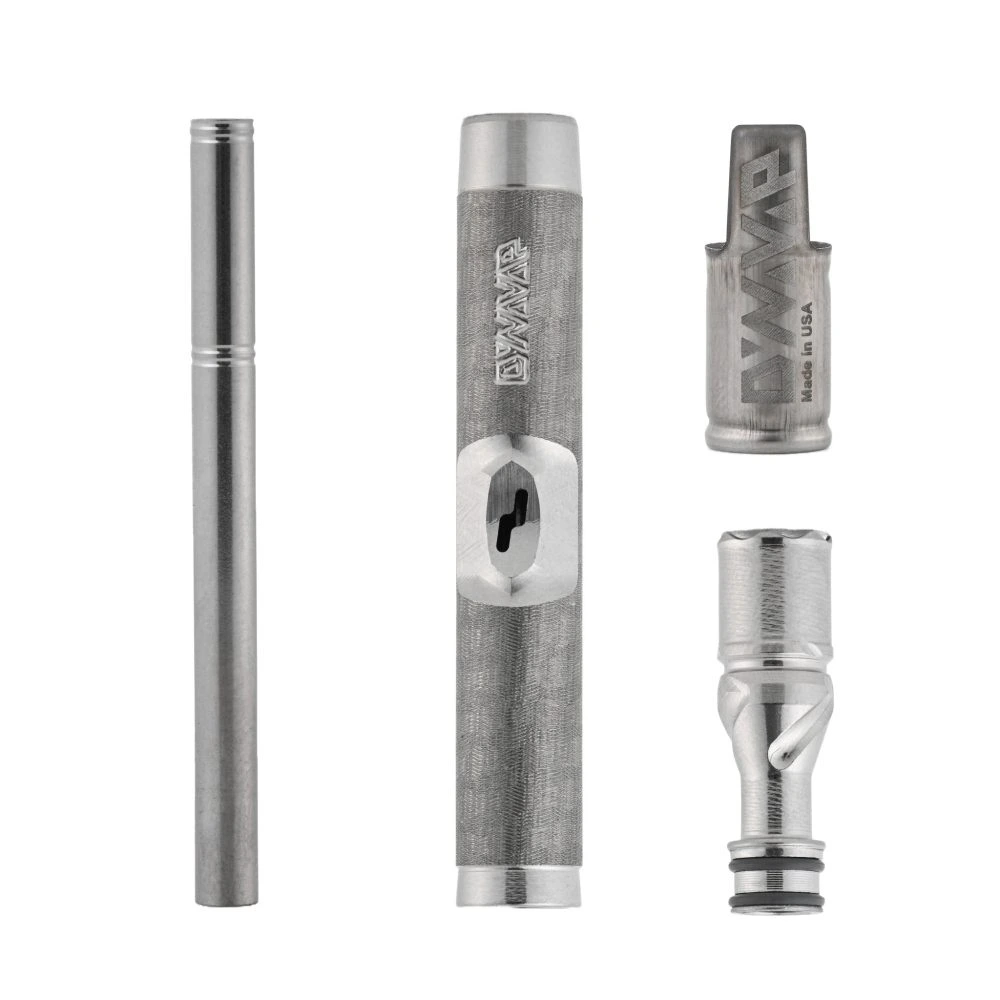
DynaVap M7 — The classic for travelling. Made entirely of titanium, smaller than a normal pen, and disassembles in seconds. No electronics, nothing that can break. Stored in a Doob Tube (a plain plastic tube), it hardly attracts attention. The downside: you need a torch lighter, which can sometimes cause problems at the airport.
Vapman — For those who want something special. This Swiss device made of wood and brass looks like an artistic object — no security officer in the world would spontaneously think of a vaporizer. It works with a normal utility lighter. Downside: slightly more maintenance-intensive and more sensitive to knocks.
Portable induction heater (IH) + DynaVap — This combination avoids the torch problem completely. An IH such as the Ispire Wand or similar devices heats the DynaVap by induction — no lighter needed, no butane gas, just USB-C charging. It can be taken in hand luggage without issue (check that the battery capacity is under 100 Wh). Perfect for air travel.
Buying butane gas abroad — how easy is it?
The short answer: in Western Europe, almost everywhere without a problem. In other parts of the world, it depends.
Europe: Butane refill bottles are available in tobacconists, supermarkets, DIY shops and petrol stations. In Spain, France, Italy, the Netherlands and Germany, you will find them without searching. Price: 2–5 euros for a standard bottle.
Eastern Europe: Also readily available, often cheaper. Poland, the Czech Republic, Hungary — no problem.
USA and Canada: Butane is available in smoke shops and head shops, sometimes in supermarkets. It is best to buy torch lighters there at the same time — brands such as Xikar or Blazer are readily available.
Asia: In large cities (Bangkok, Tokyo, Seoul), no problem. In rural areas or more conservative regions, it can be more difficult — it is worth checking in advance.
Note on gas quality: Low-quality butane can leave residue in the vaporizer and affect the flavour. If possible, buy triple- or quad-refined butane (brands such as Colibri, Xikar, Vector). You rarely find this in supermarkets — head shops or specialist tobacconists are the better choice.
Packing — tips for travelling
Doob Tubes for the DynaVap: These narrow plastic or metal tubes (originally intended for joints) are the perfect DynaVap sleeve. They protect against scratches, reduce odours slightly and look harmless.
Odour-proof bags: For all your vaporizer gear, a smell-proof bag is recommended — brands such as Stashlogix or Revelry make them in various sizes. Double-walled zips keep odours contained more effectively than normal bags.
Transport individual parts separately: If you have a DynaVap, separate the tip, condenser and body from one another. That way each part looks innocuous on its own, and the total surface area for cleaning residue is smaller.
Keep accessories to a minimum: When travelling, one tool for the herb, one packer, and the lighter are enough. Leave your full home arsenal at home.
Legal matters — an honest note
This section does not replace legal advice. Laws change, and what is taken for granted in one country can be problematic elsewhere. Still, a few points for orientation:
A vaporizer is not drug paraphernalia by definition — it is a device for vaporisation. In most Western countries, it is legal to own and transport a clean vaporizer, regardless of what you normally use in it.
The decisive point: clean. A device with residue can be classified as drug paraphernalia in many countries, even if you only use it for legal herbs. This applies especially in countries with strict drug laws (many Asian countries, Arab states, etc.).
In Europe, the situation is more relaxed, but varies. Germany, the Netherlands, Switzerland — no problem with a clean vaporizer. In other countries, a quick check of local laws is worthwhile.
For long-haul trips outside Europe: Find out about the legal situation at your destination before departure. No general statement can replace that.
Comparison: butane vaporizers for travel
| Model | Size | Lighter type | Suitable for flights | Price (approx.) |
|---|---|---|---|---|
| DynaVap M7 | 92 mm | Torch | Yes (IH as an alternative) | 75 € |
| Vapman Basic | 100 mm | Normal/utility lighter | Yes | 119 € |
| DynaVap + Ispire Wand | 92 mm + 90 mm | No lighter | Yes (ideal) | 75 € + 80 € |
| Sticky Brick Junior | 75 mm | Torch | Yes (with IH limitation) | 110 € |
All the models mentioned are made of metal or wood — robust materials that withstand travel well.
Conclusion
A butane vaporizer is a good travel companion if you know the rules of the game. The device itself is not a problem — butane gas in hand luggage is. Clean it thoroughly before travelling, pack the torch lighter in your checked… no, wait — lighters do not belong in checked baggage. Buy a normal disposable lighter and get a torch lighter at your destination, or switch to an IH for air travel.
With a bit of preparation, you can travel in a relaxed way: compact device, minimal luggage, no dependence on power sockets. That is one of the real advantages of butane — and it really comes into its own when travelling.
Price comparison on vapochecker.com
What should you watch out for when buying a vaporizer?
How much does a good vaporizer cost?
Where can you find the best deals on vaporizers?
Has been testing and comparing vaporizers on VapoChecker since 2020. 800+ devices, 274 shops, 51 countries.